
 English
 Français
 Deutsch
 Italiano
 Turkish
 Greek
 Serbian
Ambassador Gonzato: Supreme State Audit Institution Is Independent and in Line with Best International Practices




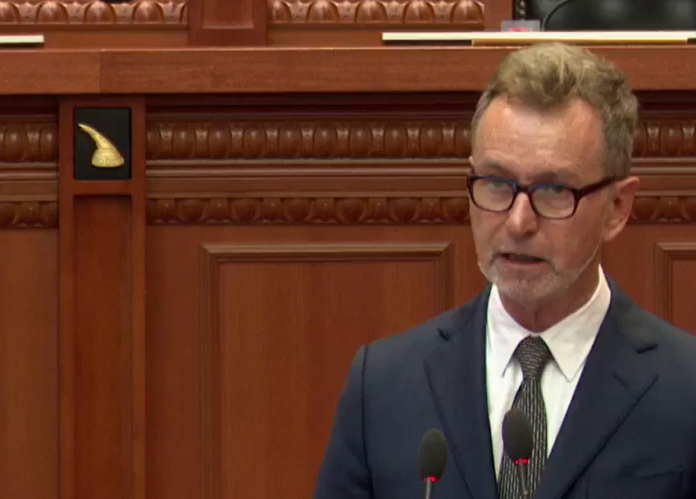
The European Union Ambassador to Tirana, Silvio Gonzato, delivered a keynote speech at the ceremony marking the 100th anniversary of Albania’s Supreme State Audit (KLSH), held in the plenary hall of the Albanian Parliament.
Ambassador Gonzato emphasized that the establishment of KLSH shortly after Albania’s independence underscores the fundamental importance of such an institution in the functioning of a modern state. According to him, over the past 100 years—and especially in the last decade—KLSH has made significant progress, evolving into a national authority for fiscal control and operating as an independent institution aligned with international best audit practices.
“The opening of Albania’s EU accession negotiations, and in particular the opening of the Fundamental Chapters cluster in October 2024, are key milestones in the country’s path toward the European Union,” said Gonzato. “The role and functioning of KLSH are specifically addressed under Chapter 32 on financial control, which is part of the Fundamentals cluster. However, the significance of KLSH goes beyond this chapter—it plays a central role in assessing the rule of law, democratic standards, and the fight against corruption.”
Ambassador Gonzato further underlined that EU legislation requires state audit institutions like KLSH to be fully independent, with adequate resources and a clear mandate to audit all public income and expenditure, including funds from the EU and other donors. “We are pleased to see that the current legal provisions for KLSH meet most of the key requirements,” he noted.
He also mentioned that discussions are ongoing to further align specific legal provisions, and stressed that any amendments must remain fully consistent with EU law and the international standards governing supreme audit institutions.
Ambassador Gonzato congratulated the leadership of KLSH for its continued efforts to implement international standards, strengthen internal capacities, and ensure effective performance in public financial oversight. “Your request for a peer review of audit methods based on OECD/SIGMA principles is a clear sign of your commitment to continuous learning and improvement,” he said.
He also stressed the importance of the practical use of KLSH reports—not only by Parliament as part of budgetary control and accountability, but also by the executive at central and local levels, as well as by citizens and civil society. “In this way, audit reports become part of a broader public debate and contribute to a culture of transparency,” Gonzato stated.
The ambassador welcomed the activation of the parliamentary subcommittee for external oversight in 2024 as a positive development, expressing hope that it will enhance parliamentary scrutiny and ensure proper follow-up on audit recommendations.
Finally, Ambassador Gonzato emphasized that the implementation of audit recommendations and the strengthening of accountability mechanisms will be critical benchmarks under Chapter 31 of the EU acquis. “More importantly,” he concluded, “they are essential for fully integrating public financial management systems and, above all, for cultivating a culture of accountability. It is not just about adopting laws or issuing recommendations—it is about changing mindsets.”
Të ngjashme
Latest News


Most read










 RTI