
 English
 Français
 Deutsch
 Italiano
 Turkish
 Greek
 Serbian
Italian Arte Sky: The iconic Pyramid of Tirana is reborn as a cultural center and “urban sculpture”




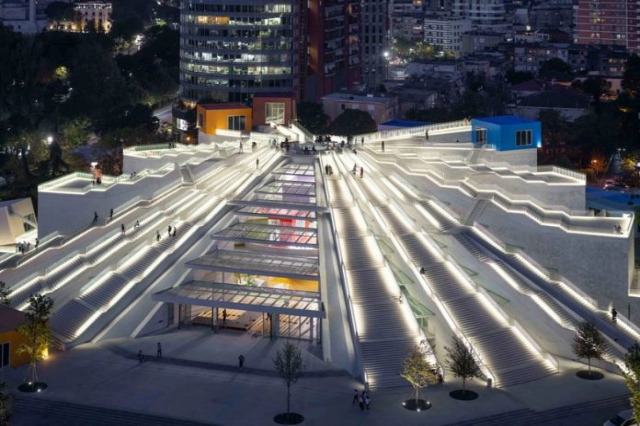
Thanks to the recovery project of the Dutch studio MVRDV, the historic Albanian structure has become an innovative cultural center with classrooms, offices and public spaces. Originally conceived as a dedicated museum of the former dictator, the building now houses a plurality of collective functions and is partly intended for the extracurricular activities of the students.
The new cultural, educational and attractive pole of Albania is located in the heart of Tirana. The iconic Pyramid of the Albanian capital has been completely renovated and, more than thirty years after its construction, has been transformed into a versatile “habitable sculpture” in concrete, destined to accommodate young people and students in its spaces in particular.
THE NEW CULTURAL POLO DI TIRANA
Keeping the original structure intact, MVRDV has given new look to the imposing architecture, modernizing it and redeveloping it through the creation of multi-purpose spaces, classrooms, offices, laboratories for start-ups and refreshment areas. One part of the building will be open to the public; the other will host TUMO, a learning center that offers free children between 12 and 18 years old a series of extracurricular activities related to technology, music and cinema. In addition to being made available to the local community like never before, the renewed Pyramid of Tirana also meets the Sustainable Development Goals outlined by the United Nations. “In keeping in mind that it was the most expensive building the Communist state had ever built, at a time when the Albanian population lived oppressed in poverty, we removed all the symbols that glorified the dictatorship. We have retained some original details, so that visitors are aware of the building’s dark past. […] Once referred to as the “Mausoleum of Enver Hoxha,” the new Pyramid has now become a monument to the people and its ability to overcome and survive dictators,” said Winy Maas, co-founder of MVRDV.
THE HISTORY OF THE PIRAMIDE OF TIRANA
The MVRDV project has allowed not only to fully recover and renovate the construction, but also to make the top of the Pyramid accessible, thus recovering one of the ancient functions of the building. First opened in 1988, as a museum dedicated to the communist dictator Enver Hoxha, and fallen into disuse after his death, the Pyramid was used as a meeting place by young Albanians who enjoyed climbing and sliding on inclined beams. Over the decades, the construction has been used for several functions: from radio station to nightclub, up to conference venue, broadcasting center and, during the Kosovo War in 1999, even based on NATO. All these changes in its use, combined with incomplete renovation operations, have left the building’s interiors bare and messy. Thus, in 2017 the Albanian government started the plan to transform the imposing concrete construction, which today is returned to the public in the unexpected role of a monument “to live”.
Të ngjashme




Latest News










Most read










 RTI