
 English
 Français
 Deutsch
 Italiano
 Turkish
 Greek
 Serbian
The Italian ‘Il sole 24 ore’: Mountains, cities and castles: autumn explorations in Albania




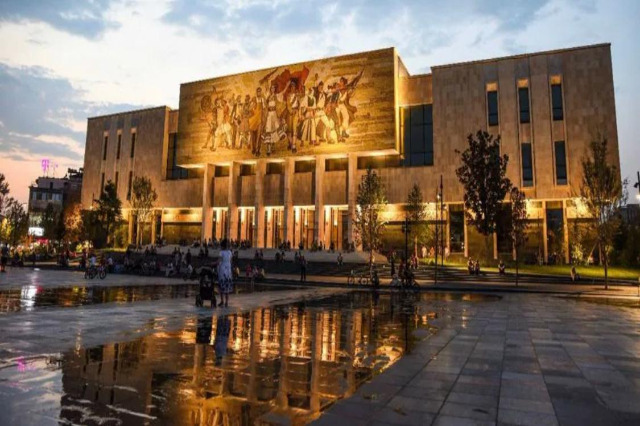
Albania, the Land of Eagles, is a land with strong contrasts that gives many surprises. Appreciated today, after the tourist boom of recent years, especially for its coasts bathed by two seas (the Adriatic and the Ionian Sea) it reserves an inland, almost entirely mountainous, of harsh beauty, between small villages that live with pastoralism and architectural jewels such as the splendid Berat and the Twin-Gergerus – cities where Eastern and Western culture merge, testimonies of the Ottoman Empire and multiculturalism of the Balkan area – or the beautiful Korca.

A land that lends itself to being explored even in autumn. Archeering seaside resorts of the Ionian coast such as Saranda and Ksamil, characterized by a crystal clear sea, can be the basis for excursions inside, where to discover together with incredible natural beauty, between mountains and lakes, the history of this small country, which does not count even three million inhabitants, 40% of which are Muslim (the others are mainly Catholic or Orthodox). If you don’t like worldly life, traffic – and landscapes in some cases unfortunately scarred by too much concrete – it is better to stop at Himara, a village on the sea, always on the Ionian coast, south of Tirana.
One thing to know: in Albania there are no highways (only fast-liver arteries) nor a real railway network. The best way to get around remains the car, although some roads, despite the government’s investments, are still not in good condition. Of course, there are public transport, like buses, but they do not arrive everywhere and the journeys are very long, in relation to the distances traveled. Tirana is the gateway for those who decide to arrive in Albania by plane: a million inhabitants, noisy and chaotic, the capital will surprise you with its many skyscrapers and its colorful houses, with a nightlife (if you like) that you can experience in the Blloqu district, where once resided the dictator Enver Hoxha (remake to power until death, in 1985), today an area with cafes. Two days are enough to get an idea of the city, starting from the famous Piazza Scanderbeg, the heart of the city, and the Pyramid, a pyramid-shaped mausoleum that the daughter of Hoxha wanted to build in 1988 to celebrate her father.

At this point the advice is to rent a car and aim, in the south, on Himara, perhaps making some detours along the way to visit Vlora, with its theory of large hotels overlooking the sea. Going along the road leading to this seaside village means testing what awaits you on the southern coast of the country and in its beautiful hinterland. Roads that climb the mountains and then descend, between steep hairpin bends, towards a coast that hides beautiful bays and coves nestled between the rocks. With a warning, however, the government has strengthened environmental legislation – currently national parks cover an area of almost 14% of the total – but the impetuous growth of tourism, combined with a still lack of sensitivity to the environmental issue, have left their mark. It is not uncommon to run into piles of abandoned waste and there is no lack of problems with pollution of waterways and threats to biodiversity. But here you will discover small heavenly beaches such as that of Gjipe, a sandy inlet overlooking the azure waters, still protected by mass tourism because to reach it you need to walk a path of about four kilometers that starts from the main road.
But it is from Himara, about 8 thousand inhabitants, that it can begin the exploration of the hinterland, where you will travel through spectacular canyons on poorly busy roads to know the most authentic face of Albania. You will therefore come across small villages often equipped with guest houses to stay overnight, surrounded by nature. You can reach the town of Pogradeci, on the beautiful and clear Lake Ohrid. You can stop, not far away, in the beautiful Korca, where the homonymous beer is produced, with a historic center characterized by the roofs of slate, and then focus on Argirocastro, with its large castle, the narrow cobbled streets and the houses in the shape of medieval towers, a town declared a World Heritage Site by UNESCO. Just like Berat, last stop, towards the North and Tirana. The first settlement dates back to the 4th century BC and is known as the city with overlapping windows, as from afar its houses seem to have a thousand eyes. It is a must-visit a visit to the castle, allowing oneself to be pervade from the sense of harmony that derives from centuries of coexistence between different religious and cultural communities.
Të ngjashme




Latest News










Most read










 RTI