
 English
 Français
 Deutsch
 Italiano
 Turkish
 Greek
 Serbian
“Il Giornale”: Discover Albania, the Land of Eagles, amidst castles and archaeological sites




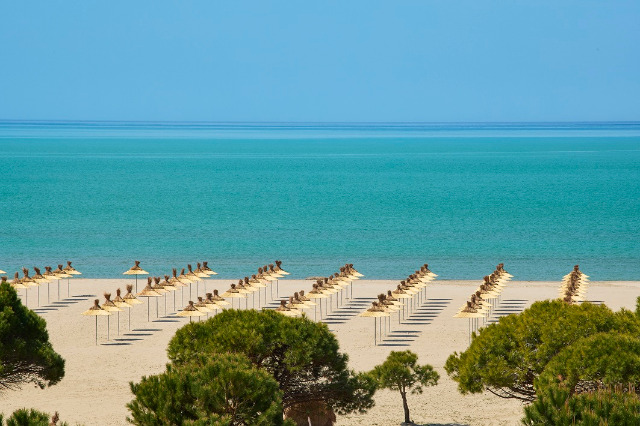
After the summer boom, the discovery and development of Albania don’t stop. It’s not just the 400 kilometers of coastline primarily along the Ionian Sea in the south of the country that attracted high numbers of tourists, including Italians, between July and August, who were seeking affordable holidays. The “Land of Eagles” has many other cards to play,” writes journalist Camilla Golzi Saporiti in an article in the Italian daily “Il Giornale.
Cities, villages, castles, archaeological sites, and museums complete the picture, making Albania one of the most compelling tourist destinations in Europe and the world at the moment. Both ‘The Times’ and ‘The Guardian’ have written about it.
From Regime to economic and tourist improvement
Albania experienced a dark period from 1976 to 1991 when it was isolated and became a part of one of the most brutal communist dictatorships. It was frequently mistreated by neighboring Balkan countries and often faced distrust from the international community.

In recent years, Albania has managed to rise from its troubled past and embark on a path of openness and development, evolving into a full-fledged democracy.
With a projected GDP growth of +2.2% in 2023 and +3.4% in 2024, along with an increasing level of services and accommodations, today’s Albania primarily centers around Tirana, which is a must-visit.
Tirana in Evolution
Tirana, with its one million inhabitants (whose average salary is 500 euros per month), is experiencing a period of significant growth and transformation.
One noteworthy destination is Skënderbej Square, which is well worth a visit.
The heart of the capital, renovated in 2017, is a 24,000 m² rectangle adorned with a mosaic of natural stones from various historical regions of Albania.
Completely pedestrianized, it features a mix of benches and green spaces, earning it the “European Public Urban Space” award in 2018.
In the center stands the bronze cavalry monument of Skanderbeg, the national hero. Surrounding this area are the city’s main historical buildings, including the Et’Hem Beu Mosque, the Opera House, the Palace of Culture, and the National Historical Museum.
For a full view of the square, it’s ideal to ascend to the top of the Clock Tower.
Don’t miss the New Market, considered one of the most beautiful markets in Europe, thanks to its steel and glass structure.
Durrës
From Tirana, you can head towards Durrës. The five-star hotel, which opened in May 2023, offers a spacious beach overlooking the Adriatic, pine forests, a variety of restaurants, an à la carte menu, and a spa.

One of the hotel’s strengths is its strategic location, which allows you to explore the distinctive central-northern region of Albania. This area boasts unspoiled coastlines featuring both rocky and sandy beaches, like Cape Rodon, where the past and the present intertwine through medieval castles, monasteries, and archaeological sites.
The first capital, Kruja, preserves a limited number of remains from the ancient castle, the National Museum dedicated to Skanderbeg, and a village with an Ottoman-style bazaar.

Another, much better-preserved castle can be found in Berat, known as the ‘city of a thousand windows,’ and it’s also home to the Onufri Iconographic Museum.

Not a castle, but a temple and odeon can be found at Apollonia, an archaeological site dating back to 588 BC.

Të ngjashme



Latest News










Most read










 RTI