
 English
 Français
 Deutsch
 Italiano
 Turkish
 Greek
 Serbian
Albanian handmade carpets, a century old tradition




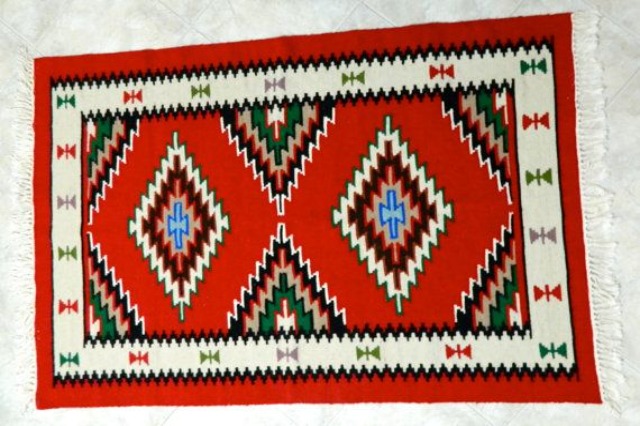
Albanian is known for an extremely rich tradition of craftsmanship with precious values, created for centuries by popular craftsmen, in each of its provinces, according to the characteristics and specifics of different geographical areas, standing out for its diversity, the large number of relics as well as the aesthetic presentation of objects which reached previously unsuspected heights.
The works in wood, iron, copper, alabaster, in precious materials of gold and silver, leather, wool, etc. stand out in particular which among other things, is a proof of our national identity.
The first craft factory was opened in 1951 (in Old Kukës) and had a great impact on the cultivation of this craft in the city. This is where former employers learned the trade and since its closure in the early 90s, they have worked hard to preserve it. Today, they excel in their exquisitely beautiful blend of traditional and contemporary rugs. Many of their products have crossed national and regional borders, representing Albania beautifully at countless fairs throughout Europe.
Even the cities of Kruja, Shkodra dhe Korca still preserve the tradition of making carpets, rugs, folk clothing, etc. Wool is the most common material for rugs, but cotton is also used.The colors and the method used for making carpets continue to be considered very special in the Albanian tradition, being often described as a cultural heritage. Researchers estimate that the popular motifs used in the carpets and tapestries are characteristic and ancient. They stand out for the colorful combinations and fine artistic taste.
In every Albanian family, mainly before the 90s, the carpet was one of the main elements of home decoration.

Carpets are made on a loom and need a lot of precision. The first step of wool processing begins with the shearing of sheep. The wool is washed in an artisanal way, to rinse it from the flowing mud and dirt that the sheep get in the pasture.
After the rinsing, the wool is put into a large container, bucket or bin, adding warm water and grated soap and leave it like this for almost 2 hours, to have the dirt and grease released. At the end, the wool is dried.The next step in preparing it is spinning.
The yarn obtained from the spinning passes through the dyeing process, which is done with plant-based dyes such as walnut husks, chilli leaves, red onion chips, and spinach leaves, from where black and green color is obtained. The dyeing is done on a vegetable basis, as it does not damage the wool fibers. During dyeing, the wool turds are mixed with a wooden stick inside the container, so that the wool takes on a uniform color.
Weaving of the carpet
At the beginning of this process, the top is taken (cotton thread in two colors, black and white).The weave is made in the shape of the number 8. Work is done vertically and horizontally.
Also, to make a carpet, you need the technical drawing, with the national and cultural symbols of our country.
It takes almost seven days and an intensive work of eight hours to produce a carpet of 1 square meter. Geometric motifs are among the simplest but also among the oldest. We find them more often in genuine rustic art objects, that is, in objects made for one’s own needs and not for the market. The most used tool in folk decoration is the angular geometric shape.

/k.s/
Të ngjashme



Latest News










Most read










 RTI