
 English
 Français
  Deutsch
 Italiano
 Turkish
 Greek
Greek Serbian
Kosova Marks 26 Years Since Serbia’s Capitulation




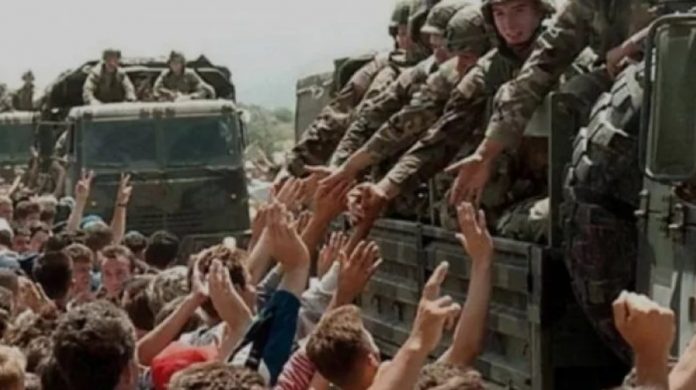
Kosova today marks 26 years since the signing of the Kumanova Military-Technical Agreement, which ended the war and forced Serbia to withdraw its military and police forces.
The agreement, signed on 9 June 1999 between NATO and the Federal Republic of Yugoslavia, came into effect two days later. General Michael Jackson, the first KFOR commander, signed on behalf of NATO. Serbian Army Chief Nebojsa Pavkovic, later indicted in The Hague for war crimes and genocide, signed for Yugoslavia.
The deal followed the armed resistance of the Kosova Liberation Army, decades of Albanian struggle since the 1913 London Conference, and 78 days of NATO airstrikes against Serbian targets. Over 10,000 people died in the war, around 5,000 went missing, and more than one million Albanians were displaced. Material destruction across Kosova was severe.
The agreement forced Serbia to pull out all military and police forces. This included regular troops, navy, armed civilians, paramilitaries, air force, national guard, border police, reservists, military police, intelligence services, and local, special, riot, and anti-terror police. NATO defined any other banned groups. The agreement created a 25-kilometer air safety zone beyond Kosova’s borders and a 5-kilometer land buffer zone inside Serbia, where only border guards could operate, without heavy weapons.
NATO infantry troops entered Kosova on 12 June 1999. Serbian troops began to withdraw immediately.
One day earlier, NATO Secretary General Javier Solana had ordered a halt to the bombing campaign. The UN Security Council passed Resolution 1244 the same day, approving the deployment of 37,200 KFOR troops from 36 countries.
The KFOR mission was divided into five zones: American, British, French, German, and Italian.
As NATO entered, the United Nations deployed a temporary civilian administration to govern Kosova.
Meanwhile, the Kosova Liberation Army disbanded and reformed as the Kosova Protection Corps.
/a.p./
Të ngjashme
Latest News

Most read




 RTI
RTI