
 English
 Français
 Deutsch
 Italiano
 Turkish
 Greek
 Serbian
Portuguese media, “GAZ”: Albania, ethnicity and language that go beyond the territory




“The great Scanderbeg Square, in the heart of the capital of Tirana, offers a walk through the turbulent and interesting history of Albania. The country has 2.8 million inhabitants distributed between a beautiful mountainous region, in the interior, and fertile plains with wonderful beaches, on the shores of the Adriatic and Ionian seas,” writes Aidir Parizzi in an article published in the Portuguese daily “GAZ “.
It is important to remember that there are also six million Albanians outside the homeland, in addition to the descendants of immigrants who fled to Western Europe in the diaspora after the Ottoman Turkish invasion in the 16th century.
Albanians still make up the vast majority of the population in Kosovo, a country contested by Serbia, which shares ethnicity and language with Albania.
On the facade of the National Historical Museum, there is a large mosaic, which summarizes a constant factor of Albanian history, the resistance to foreign invaders.
Inhabited by Illyrian tribes in ancient times (the Albanian language comes from the Illyrians, considered older than Latin), Albania was conquered by the troops of Alexander the Great, colonized by the Greeks, annexed by the Romans.
The republic, occupied by Byzantium, had regions included in the Republic of Venice, four centuries of Turkoman occupation (until 1912), Fascist and Nazi occupation during World War II, and conflicts from Balkan neighbors.
After 1945, a revolution created the People’s Socialist Republic of Albania, until in 1991, the fall of communism allowed the formation of the current Republic of Albania.
For several millennia, the country has been a victim of its geography, positioned at the critical transition between West and East.
The name of the capital’s main square refers to the great national hero, Gjergj Kastrioti (1405-1468), military commander known as Scanderbeg.
Kastrioti represents the resistance to the foreign threat, celebrated for having prevented the advance of the Ottoman Turks in Albania and Europe for 25 years. After his death, the country came under Muslim rule in 1506.
In the square, in addition to the impressive statue of Scanderbeg’s cavalry, you can see the double-headed eagle from the coat of arms of the Kastrioti family that occupies the Albanian flag.
Albania: ethnicity and language that go beyond territory
The massive Islamization of the country came with the Ottoman Turks, between the 17th and 18th centuries.
Today, Sunni Muslims make up 60% of the population. Et-Hem Beu mosque is located at Scanderbeg square, which was closed down by the communist regime. In 1991, a peaceful protest was decisive for the return of religious freedom in the country.
Nearby is the beautiful Resurrection Cathedral, the seat of the primates of the Autocephalous Orthodox Church of Albania, a name which derived from Byzantine influence, especially in the region bordering Greece.
In 1054, the Great Eastern Schism had already divided Albanian Christians into Catholics in the north and Orthodox in the south.
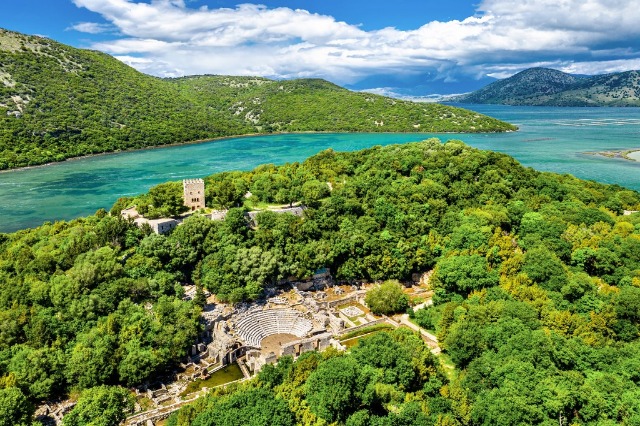
The ancient city of Butrint, a national park that represents an important fragment of Mediterranean history. The most visited cultural destination in Albania, it offers an incredible journey through different historical periods from the 8th century BC, passing through the Greeks, Romans, Byzantines, Venetians and Ottomans.
Walking through temples, squares, amphitheaters, aqueducts, thermal baths and ancient residences, make you lose get lost in almost 10 thousand hectares of the archaeological park, a treasure that was discovered only less than a century ago.
/k.s/
Të ngjashme



Latest News










Most read










 RTI