
 English
 Français
 Deutsch
 Italiano
 Turkish
 Greek
 Serbian
Albania Sees Strong Improvement in Sovereign Risk Perception in Early 2025




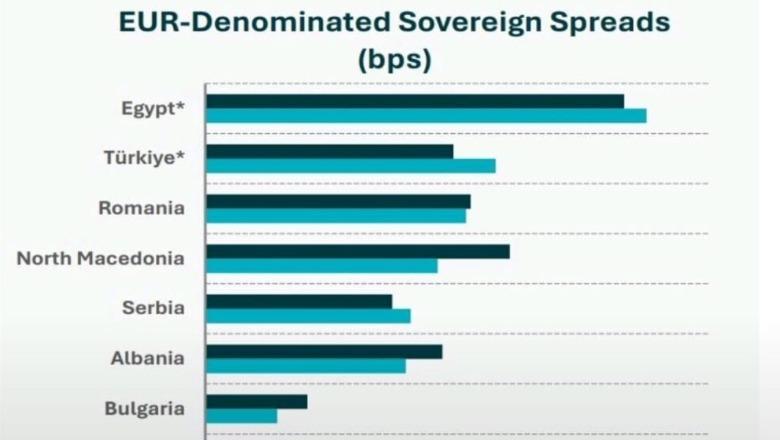
In the first half of 2025, Albania recorded a significant improvement in its sovereign risk perception from international markets.
According to updated data published in a European Commission working paper on June 23, 2025, the spread between Albania’s euro-denominated sovereign bonds and U.S. Treasury bonds dropped sharply compared to the end of 2024.
The chart shows that on December 31, 2024, Albania had a higher spread. By June 2025, the spread had fallen to around 200 basis points, signaling improved financial credibility and reduced investor risk perception. Albania now ranks better than Egypt, Turkey, Romania, North Macedonia, and Serbia, leaving behind a group of countries with higher sovereign risk levels.
This improvement reflects a combination of positive factors: stronger fiscal indicators, macroeconomic stability, improved political outlook, and growing confidence in Albania’s EU integration path.
The lower spread means Albania can access international capital markets more easily and borrow at lower costs.
Compared to late 2024, similar improvements have been noted in Serbia and Bulgaria. Meanwhile, Egypt and Turkey continue to top the list of high-risk countries, based on their higher spreads versus U.S. Treasuries.
The spread over U.S. Treasuries measures the extra return investors demand to lend to a country instead of investing in safer U.S. government bonds. A high spread reflects higher risk and borrowing costs. A low spread reflects greater market confidence and cheaper debt servicing.
In Albania’s case, the drop in spreads during 2025 shows increased investor trust and lower perceived risk.
In early February, Albania returned to the capital markets for the seventh time, issuing a €650 million Eurobond. It carried a 4.75% coupon and a 5% yield, with a 10-year maturity set for February 2035. Strong investor demand helped lower the interest rate.
This was Albania’s most successful bond issuance since its first in 2010.
Over the last two years, Albania has significantly reduced its public debt, prompting credit rating upgrades from Moody’s and Standard & Poor’s.
By the end of 2024, public debt had dropped to 54.74% of GDP—down 2.7 percentage points from 2023—marking the lowest debt-to-GDP ratio since 2008.
This decline in perceived risk has also attracted more foreign investors to Albania’s domestic bond market. Since last year, non-resident investors began purchasing government debt instruments denominated in Lek. Bank of Albania data shows that in 2024, foreign investors bought about 14 billion Lek worth of local debt instruments.
This amount accounted for roughly 28% of the government’s new domestic borrowing for the year.
The participation of foreign investors is a key development. It has increased demand and liquidity in the government securities market, contributing to lower yields./Monitor/
Të ngjashme




Latest News









Most read










 RTI