
 English
 Français
 Deutsch
 Italiano
 Turkish
 Greek
 Serbian
Albania’s UNESCO Wold Heritage Sites




Albania is home to a number of monuments of valuable cultural and historical importance. Some of them have been recognized by UNESCO as “World Heritage Sites” due to their uniqueness and importance to the collective interests of humanity.
Butrint – A rare combination of pristine archeology and natural beauty, inhabited since prehistoric times but Butrint was abandoned in the late Middle Ages after a major earthquake flooded the area. Butrint has been protected by UNESCO since 1996.
Durres Amphitheater – The Durres Amphitheater is one of the largest in the Balkans and the largest in Albania, once having a capacity of 20,000 people. Used for performances until the 4th century, the monument was later the site of an early Christian church, beautifully decorated with mosaics and frescoes. The amphitheater has been designated as one of the most endangered cultural heritage sites in all of Europe. The amphitheater of Durres is protected by UNESCO since 1996.
Royal Tombs of Selca – On the banks of the river Shkumbin near the town of Pogradec, lie the ruins of the ancient city of Pelion. This settlement was an important commercial center and the residence of the Illyrian kings of the 4th and 3rd centuries. The royal tombs are carved into the rock. Archaeologists have discovered a variety of artifacts, including weapons, bronze vessels, pottery, and gold jewelry. The city began to decline after the Roman road Via Egnatia bypassed its location and was eventually destroyed by the Slavs. The Royal Tombs of Selce have been protected by UNESCO since 1996.
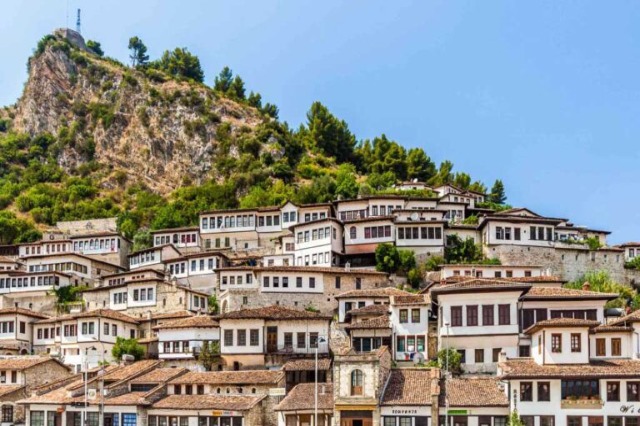
Berati and Gjirokastra – Nestled in the hills of Southern Albania, Berati and Gjirokastra have been continuously inhabited from ancient times to the present day and reflect the diversity of cultural and religious influences in the Balkans. The fortified town of Berat is home to a castle, known locally as Kala, which was built in the 13th century, although part of the structure dates back to the 4th century BC. Gjirokastra boasts a 13th-century castle, a bazaar, mosque and 18th-century church. The houses built on the hillsides reflect the classical Balkan architecture of the 18th and 19th centuries. Berat and Gjirokastra are protected by UNESCO since 2005.
Lake Ohrid – Lake Ohrid is a deep and ancient lake, which has existed continuously for about two to three million years. Its waters are home to over 200 species of plants and animals unique to the lake, including algae, flatworms, snails, crustaceans and fish. Archaeological sites around the lakeshore have revealed artifacts dating back to the Neolithic period. Lake Ohrid is protected by UNESCO since 2011.
/m.ll/
Të ngjashme
Latest News










Most read










 RTI