
 English
 Français
 Deutsch
 Italiano
 Turkish
 Greek
 Serbian
Impressive landscape of Korab-Koritnik nature park




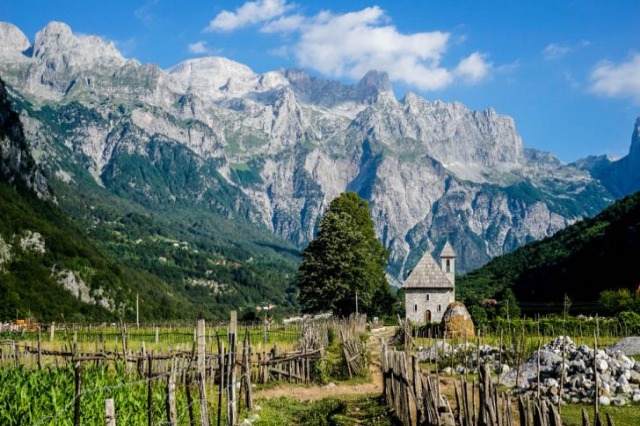
Korab-Koritnik nature park is attracting more and more domestic and foreign visitors with its natural beauties and impressive landscapes.
In the months of January-June, there was an increased flow of visitors to this park, which lies at an altitude of over 1300 meters above sea level.
One of the favorite paths for tourists is the Path of Colors, which passes from the mountains of Çaja Kukës and continues to the Field of Korab.
During the ascent to the mountain, visitors have the opportunity to visit other natural monuments, such as “Gryka e Vanave”, Beles Waterfall, Kallabaku lake, where they can enjoy the panorama that this lake offers.
Korab-Koritnik Park has 25 natural monuments (the third category of protected areas in Albania). The peak of Mount Korabi, the highest in Albania, has a rare beauty. In addition to it, there are other mountain ridges, with limestone and gypsum formations, covered with herbaceous plants and alpine pastures, with different types of fragrant flowers during spring and summer.
The mountain ecosystem here includes natural values of great importance for biodiversity and culture. This is also Albania’s largest nature park, bordering National Park of Mavrova in North Macedonia and connected to the Sharri National Park in Kosovo. Korab-Koritnik Nature Park is a beautiful place in eastern Albania to visit for the outdoorsy.
It also fulfills an important role, being a safe haven for wildlife. Korab – Koritnik Nature Park has a mountainous terrain with many rivers,natural lakes, caves, and canyons, cold water springs, snow-covered mountain peaks, which offer great opportunities to enjoy every detail of mountain tourism, winter and summer.
Traces of this path come from antiquity to the time of Christianity. It is thought to be a 2400-year-old trail, called “Scardus” by the Romans, which in Latin means full of colors, because of the many flowers and the landscape that is created in different seasons. Positioned south of the Sharri Mountains, this area is thought to be among the largest alpine pastures in Europe.
Vegetation levels vary based on altitude. Oak forests range from 400 to 900 m (1,300–3,000 ft), and conifers and beech forests with mixed broadleaved forests range from 1,000 to 2,000 m (3,300–6,600 ft).
The hills are forested mainly by deciduous trees, with silver fir, Austrian pine, Bosnian pine, and Macedonian pine being the most common. Black alder is also seen occasionally on the slopes. Oak forests can be found at lower altitudes, including the oriental hornbeam, downy oak, Macedonian oak, and field maple.
The wildlife in this area consists of 37 different mammals. Large animals, such as the brown bear, grey wolf, Balkan lynx, roe deer, and wild boar can all be found here. Birds such as the golden eagle, peregrine falcon, common buzzard, eagle-owl, and so many more are also seen here.
/k.s/
Të ngjashme
Latest News










Most read










 RTI