
 English
 Français
  Deutsch
 Italiano
 Turkish
 Greek
Greek Serbian
U.S. Renews MCC Compact Program for Kosovo, Supporting Clean Energy Transition




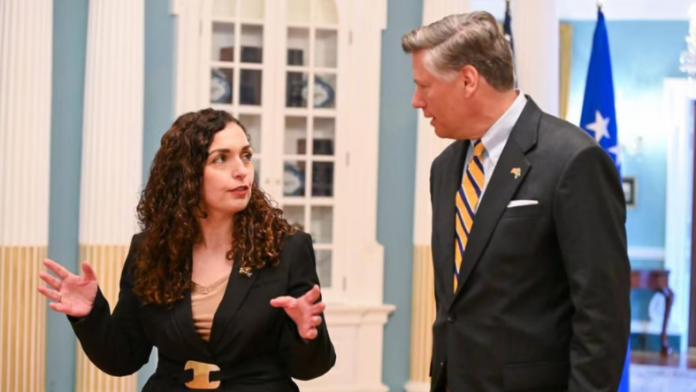
The administration of former U.S. President Donald Trump has approved the continuation of the Millennium Challenge Corporation’s (MCC) Compact Program for Kosovo. President Vjosa Osmani confirmed the news today.
According to Osmani, U.S. Deputy Secretary of State Christopher Landau officially notified her of the decision.
“Great news for Kosovo! Deep gratitude to the United States of America,” she wrote on Facebook.
Meanwhile, the MCC Compact remains one of the largest U.S. investments in Kosovo’s energy sector. It focuses on clean energy and long-term sustainability.
The program began implementation in April 2024. It is valued at \$236.7 million. Of this amount, \$202 million comes from MCC, while \$34.7 million is contributed by the Government of Kosovo.
Earlier in July, during her visit to the United States, Osmani formally presented the request to American officials for the program’s continuation.
At the core of the MCC Compact is a large-scale battery energy storage project. Specifically, it includes high-capacity batteries of 170 megawatts, enabling storage of up to 347 megawatt-hours.
As a result, Kosovo is expected to have the highest battery storage capacity per capita in the world by 2027.
Moreover, the compact aims to modernize Kosovo’s energy infrastructure. It will integrate more renewable sources into the national grid. At the same time, it will reduce the country’s reliance on coal.
In fact, MCC officials described the program as “a cornerstone for Kosovo’s green energy transition.” They emphasized that it will boost energy security and support the country’s socio-economic development.
Currently, Kosovo generates most of its electricity by burning coal. Two power plants—Kosova A and Kosova B—handle this production.
However, according to the Energy Strategy adopted in 2023, Kosovo plans a major shift. By 2031, it aims to generate 35% of its electricity from renewable sources. Furthermore, it intends to completely eliminate coal by 2050.
Since 2016, MCC has worked closely with Kosovo. In addition to the energy compact, it has supported economic development projects worth \$50 million. Additionally, it has funded scholarships for women in the energy sector.
/a.c/
Të ngjashme

Latest News




Most read




 RTI
RTI