
 English
 Français
 Deutsch
 Italiano
 Turkish
 Greek
 Serbian
Financial Times: An Albanian adventure




Please use the sharing tools found via the share button at the top or side of articles. Copying articles to share with others is a breach of FT.com T&Cs and Copyright Policy. Email [email protected] to buy additional rights. Subscribers may share up to 10 or 20 articles per month using the gift article service. More information can be found at https://www.ft.com/tour.
https://www.ft.com/content/ddc3b3c5-ca1c-4e78-af04-8734ded9a6e1
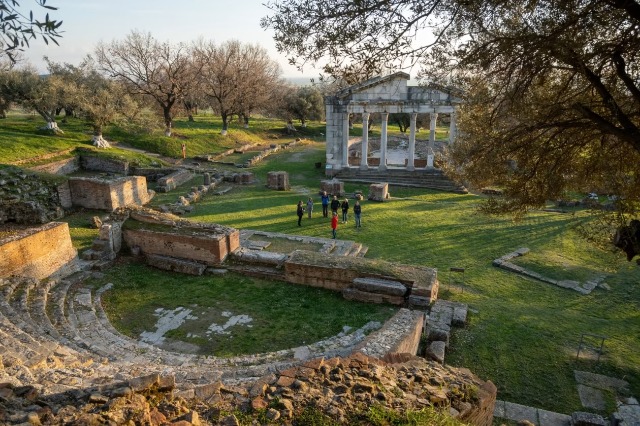
Losing a day’s hiking was a shame, but it did give us more time to explore an area little known — indeed, long barred — to the outside world. We spent two happy hours wandering all by ourselves among the impressive ruins of Byllis, an ancient Roman city built on a mountaintop with yet more stunning views over the Vjosa.
South of Gjirokaster we drove up a dirt track and found ourselves equally alone in the ancient Roman theatre of Hadrianopolis, excavated scarcely 20 years ago, its tranquillity disturbed only by farmers ploughing the surrounding fields.
And then there was Gjirokaster itself, an Ottoman-era city and Unesco World Heritage Site with narrow cobbled streets tumbling down a vertiginous mountainside. It is also the birthplace of both Hoxha and Ismail Kadare, Albania’s best-known novelist, who wrote those words about “hanging your hat on a minaret”.
Arben talked our way into the 1,500-year-old fortress overlooking the city, although it was officially closed that day. We explored the labyrinthine nuclear bunker built beneath the city hall in Hoxha’s time to protect Gjirokaster’s communist officials. We visited one of the wonderful old merchant’s houses whose owner, Nesip Skenduli, was the ninth successive generation of his family to live in it. Hoxha was a school friend of his father’s, he said, but later imprisoned him for 13 years and forced the Skendulis to share their home with seven other families.
The relics of Hoxta’s brutal rule are chilling but fascinating. Driving back to Tirana we stopped to explore a long abandoned labour camp at Tepelena. On Tirana’s edge we inspected the inconspicuous grave to which Hoxha’s remains were moved following communism’s collapse. In the capital itself we toured the House of Leaves, former headquarters of Hoxha’s secret police, which displays in harrowing detail the methods and equipment the Sigurimi used to crush all resistance.
Tireless to the last, Arben rushed us round one final horror early on the morning of our departure: the vast, subterranean nuclear bunker Hoxha built at the base of a mountain on Tirana’s eastern fringe in the 1970s. Its 106 rooms were designed to protect the top regime officials and their families and included an entire suite for Hoxha himself. So thick are the concrete walls of this monument to a deluded dictator that it will doubtless outlast Albania’s many Roman settlements.
Rushing to the airport, we passed unmistakable reminders of modern Albania’s less savoury side — glitzy new buildings constructed with dodgy cash and an inordinate number of flashy new cars. Yet we had experienced nothing but warmth and generosity in a country that may be ravaged by emigration, but is blessed with abundant natural beauty and historical interest.
Të ngjashme



Latest News









Most read










 RTI