
 English
 Français
 Deutsch
 Italiano
 Turkish
 Greek
 Serbian
The Times: Albania, the unexpected place you’ll want to tour this summer — on two wheels




A smattering of black buckshot peppering the tarmac provided the first hint of trouble ahead. Then, as I swooshed around a hairpin bend, the aroma of the breeze soured, scented no longer with pine and wild mint but more acrid notes. Soon the crickets, chirruping vainly, became drowned out by a clanking metallic orchestra.
Suddenly, I was confronted by the owners of those pellets, pongs and polyphonic plinks: goats. Dozens of goats. Scores of goats — no, hundreds: a jostling, bleating river of goats, accompanied by barking shepherds, dogs and churn-laden ponies. Brakes squealed as I skidded to a halt, and for ten absorbing minutes I sat astride my bike amid the chaos, watching the herd flow along the road before streaming off into an adjacent meadow. A quintessentially Albanian traffic jam.
Midway through a cycling expedition around the south of this long-isolated Balkan nation, I’d become accustomed to road hazards. Not sketchy drivers or broken tarmac — most Albanian motorists are respectful of bikes, even welcoming, and the truck-swallowing potholes of yore are, on the whole, now filled. Rather, obstructions were more picturesque: platoons of waddling ducks; venerable farmers side-saddle on donkeys bearing boxes of melons or apples; even an incautious tortoise napping on the warm tarmac.
Tourism in Albania is a fraction of, say, Croatia’s, and most is concentrated at key towns or along the coast, now being eulogised by the hipper beach seekers. However, in Albania’s predominantly agricultural south, cycling is a joy — and a largely undiscovered one. My eight-day guided tour of southern Albania’s most fascinating cities, landscapes and ancient sites, staying at characterful guesthouses and four-star hotels, allowed me to see this extraordinary country from its mountains and hilltop towns. I did it the (relatively) easy way, too — with a tour operator that also laid on a support van and moved my luggage each day.
We started in Tirana. In vast Skanderbeg Square, the equestrian statue of its 15th-century national hero is overshadowed by the blocky National Historical Museum where proud socialist workers, women and warriors glare sternly down at pedestrians from the Triumphalist mosaic above the museum entrance; the elegant 18th-century mosque of Et’hem Bey across the square seemed timid in comparison.
A long history of invasion and strife — involving Illyrians, Greeks, Romans, Byzantines, Venetians, Turks, Italians, Nazi Germany and the repressive regime of communist dictator Enver Hoxha, followed by anarchy in 1997 — may not have left too much urban beauty. But it has created a fascinatingly complex culture and language. With no fewer than 36 letters and a grammar incomprehensible to all but native speakers, Albanian isn’t for novices. So in the evening I was grateful that local guide Erlis read the menu and piled our table with grilled vegetables, flaky pastry byrek, vegetable qofte balls and salads of plump tomatoes, cucumber and feta-like djathe — a cheese that also appeared baked with spinach in a sizzling clay dish and with red peppers and onions in tasty fergese.
Our first easy glide was a descent from Qafe Thane pass to Lake Ohrid, which sparkled with unique (and delicious) trout. Skirting its western shore, we passed onion sellers and fields studded with tall haystacks like furry Daleks. Fishermen waved their catch at us; laughing children simply waved. Approaching the North Macedonian border at the lake’s southern extremity, another crop became evident: bunkers. From the 1960s, as Hoxha fell out first with the Soviet Union and then China, concrete mushrooms and tunnels proliferated. By his death in 1985, hundreds of thousands had sprouted up across the country.
This was August and it was hot; by 10 o’clock the next morning, as we puffed up the first pass of the trip, the mercury was sliding past 30C. I was grateful to be met at the top by both a breeze and a refreshing new vista, of rolling fields and orchards laden with the rosiest of apples, backed by the distant Grammoz Mountains. This second day set the template for the six to follow. With distances ranging from 30 to 45 miles, climbing among diverse mountains, we’d set out to tackle the toughest sections before the sun hit full beam, pausing for coffee and a hearty lunch before exploring each new destination in the relative cool of early evening.
In Korce, we roamed the restored bazaar where, two centuries ago, hundreds of shops peddled the diverse wares of the Ottoman empire. And in a restaurant, eating baked cheese, we were regaled with melancholic folk songs recalling Korce’s sobriquet: “City of Serenades”. As with everywhere we visited, food and refreshments came at bargain prices.
The following day took us up among peaks swathed in beech and pine, past statues commemorating Second World War partisans who battled German occupation. That night we dined on trout at a farm guesthouse before settling down for the night in log cabins. Our morning wake-up call came courtesy of honking geese and gobbling turkeys. We progressed into loftier alpine terrain where the white limestone wall of the Nemercke Mountains rose before us as we pedalled high above the Vjosa River then among dusky black grapes to reach Benje. Here we crossed a magnificent Ottoman bridge to soak in sulphurous thermal waters — reputedly good for kidney, liver and stomach complaints — and certainly soothing for cycle-heavy limbs.
Continuing south, orchards were replaced by olive groves and stands of pomegranate trees before our final climb to the Unesco world heritage centre of Gjirokastra. This ancient bastion provides spectacular views across the Drino Valley to Lunxheri Mountain, and over the Ottoman houses of the old quarter, with their distinctive stone-tiled roofs. The bazaars and cobbled back streets of Albania’s most captivating town are evidence of an Ottoman heyday. Then, wealthy merchants built imposing mansions such as the Skenduli House, which still contains a marriage chamber beautifully painted with pomegranate flowers.
Albania’s true historic centrepiece, though, lies 25 miles south — as the crow flies, at least. We meandered through orange groves to Butrint Lake, where a creaky chain ferry carried us across to the archaeological site of Butrint. In The Aeneid, Virgil wrote of it: “I saw before me Troy in miniature”. And that was before the Greeks, Romans, Byzantines, Venetians and Ottomans added bath houses, theatres, temples, mosaics, aqueducts, towers and mighty castle walls.
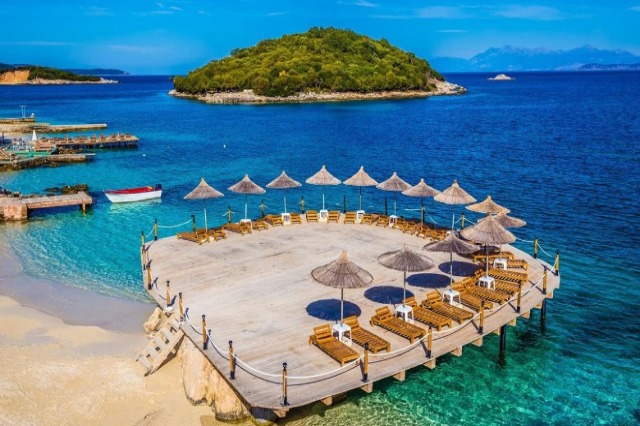
For many, though, beaches appeal more than basilicas, and Albania’s Ionian coast, stretching north from Butrint, pulls in the sun-worshipping masses. Cycling high above the shore over the following two days, we gazed down longingly at Prussian blues and bright azures fringing the many beaches, as enticing as any in Cephalonia or Corfu, the latter visible across the strait. In bustling Sarande, a typical Med sun, sea and sand resort, we ate excellent seafood. But I preferred our penultimate stop, Himare — a cluster of oleander-pinked houses and hotels on a quiet cove into which the sun melted with a vermillion glow.
The high point — figurative and literal — came on our last day. The 1,000m climb to the Llogara Pass presents a tough challenge to cyclists, and I was grateful for the distractions of sweeping coastal views as I puffed past blue and yellow beehives and locals gathering wild roadside oregano.
Wolves, deer and golden eagles can be spotted in the pine forests of Llogara National Park at the top. I was oblivious to wildlife, thrilling instead to a long, speedy downhill to the Bay of Vlore and the cool hotel pool that awaited us. This time, I chose to whizz past another bleating herd of goats.
Të ngjashme



Latest News









Most read










 RTI