
 English
 Français
 Deutsch
 Italiano
 Turkish
 Greek
 Serbian
Medieval center of Berati




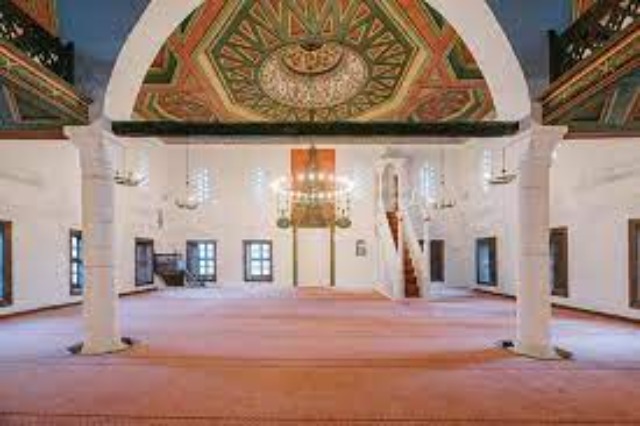
Berat is one of the cities with history and culture in south-central Albania. The geographical positions of the city have inspired the settlement of events, cultures, beliefs and stories that have influenced the course of history. A proof of the character is the medieval center of Berati, is the King’s mosque, the Helveti church, the inns as well as several monumental tombs. One of the main attractions of the Ottoman period in Berat, this large complex is a beautiful mosque, ornate roofs and carved wooden balconies.
This center was built after the Ottoman occupation and was called by the locals as “Sheria of Berati”, which means center. Unfortunately, the consequences of the First World War were devastating for the library of this territory and a school where the young people of the city studied, which no longer exist today.
King’s Mosque
The King’s Mosque is one of the oldest in Berat and is located in this complex built by Sultan Bayazit II around the year 1480. The mosque consists of the minaret, the elution hall and the portico. The side walls have ample windows that provide light to the interior of the cult building. The building inside is divided into two floors, the architecture of which consists of columns, arches and colorful decorations. Wood carving is an outstanding element in this building, subtly enriched by religious meanings.
The Helvetic Tekke
Helvetic Tekke is another monument of this complex which represents, according to the municipality of Berat, one of the best architectural achievements in the city. The tekke was built in the 15th century and was rebuilt by Ahmet Kurt Pasha at the end of the 70s of the 18th century. The object belongs to the sect with the same name and is located in the eastern part of the King’s Mosque. The Tekke is surrounded by the courtyard, enriched with many mansions as called balconies in the local language.
The rare object in terms of beautiful decorations in wood and colors reveals an antechamber that precedes that of prayers. The ceiling is the most beautiful part of the building, decorated with great finesse in harmony between green, gold, violet, red and blue colors. In this decorative manifestation, the side walls are also decorated with frescoes of religious belief that exalt faith in God.
Monumental Tombs and Mansions
Next to the prayer hall is the mausoleum of the graves of Ahmet Kurt Pasha and his son. Balconies are also built of wood and supported by columns. These guesthouses served as inns for religious women who came to perform religious rites or for students who studied in the madrasah that was destroyed during the First World War. Under the building there is a channel that collects the remaining water and pours it into the Osum River. You can complete your visit to the religious-social complex by visiting the shrine of Sheh Qerim, which is located near other buildings.
/Klara Ruci/
Të ngjashme









Most read










 RTI