
 English
 Français
  Deutsch
 Italiano
 Turkish
 Greek
Greek Serbian
NASA publishes satellite images: Lake Ohrid and Lake Prespa, 2 of the 30 oldest in Europe




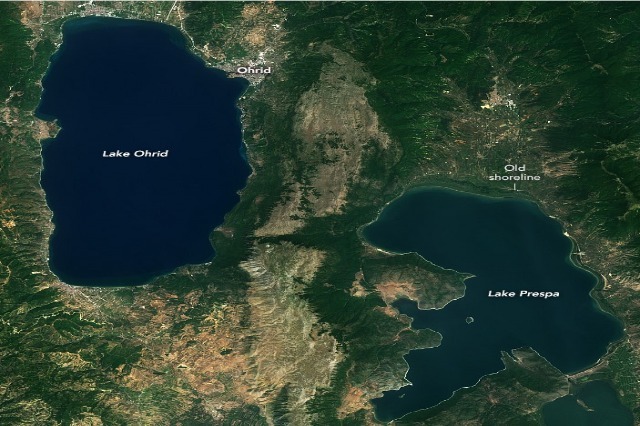
Lake Ohrid and Lake Prespa are considered by NASA to be two of the 30 oldest in Europe. NASA has published satellite images of the 2 lakes while describing them as two of the oldest lakes with unique characteristics and features.
The Operational Earth Imager-2 (OLI-2) on Landsat 9 captured the natural color images of the lakes on August 19, 2022, which were released by NASA.The two lakes lie in a mountainous area along the borders of North Macedonia, Albania and Greece. Lakes have existed for at least 1 million years and possibly longer.
Lake Ohrid is the larger and deeper of the two, with an average depth of 155 meters (509 feet). While Prespa has an average depth of 14 meters (45 feet). Most of the world’s millions of lakes are less than 18,000 years old and were formed when glaciers melted at the end of the last Ice Age. Geologists classify only 30 lakes, including Ohrid and Prespa, as “ancient”, continuing for more than one ice age cycle (at least 130,000 years).
Lakes owe their longevity to sustained tectonic activity that causes the land beneath them to sink, creating low valleys surrounded by faults.This constant sinking of valleys prevents sediments and plant life from building up and turning lakes into marshes over time, as most lakes do after a few thousand years. Most of Ohrid’s water comes from underwater sources, but about 20 percent of it flows from the upper Prespa through underground karst channels. While water levels have remained relatively stable in Lake Ohrid in recent decades, Prespa has suffered a significant decrease in both surface area and volume.
The low-nutrient, high-oxygen waters of Lake Ohrid support more than 1,200 species of plants and animals, giving the lake one of the highest concentrations of biodiversity in the world.The longevity of Lake Ohrid has allowed the evolution of 200 species found nowhere else, including unusual snails, ducks and trout.
The lake is a UNESCO World Heritage Site and is sometimes called the European Galapagos or a museum of living fossils because of its incredible biodiversity.Lakes are not the only local features notable for their ages. Ohrid, the largest city on the lake, is one of the oldest human settlements in Europe. It has the oldest Slavic monastery and more than 800 Byzantine-style icons created between the 11th and 14th centuries.In 2010, scientists at the International Astronomical Union named Ohrid a lake on Titan, a moon orbiting Saturn.
/Klara Ruci/























 RTI
RTI