
 English
 Français
 Deutsch
 Italiano
 Turkish
 Greek
 Serbian
The codex of the monastery of Saint Cozmai




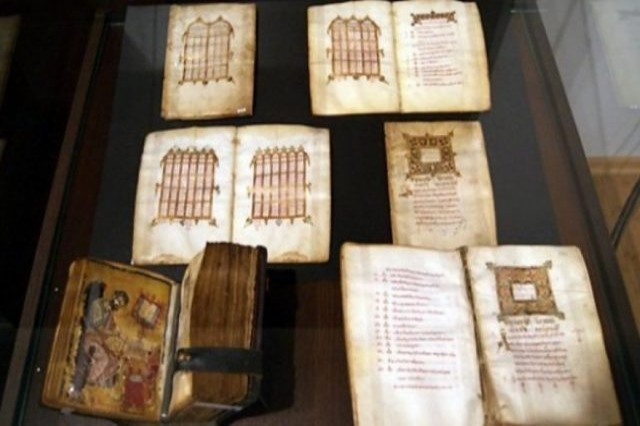
This codex of the monastery of Saint Cozmai, in which marriage contracts were registered from 1819-1843, has been preserved until May 1957 in the monastery of St. Kozmai in the village of Kolkondas, and in 1957, it was sent to the bishopric (bishopric) of Berat.
The codex consists of three covers. The outer cover is parchment, cream-colored and quite yellowed by time. On its surface, squares formed by two thin parallel brown dashes can be distinguished; on the side, this cover folds with a width of 5.6 cm., in a way that covers the entire codex; the top page of the cover is torn long and missing almost half. On the untorn part, the following notes are read: this register… of St. Belgrade, Joasaph… marriages. The middle cover is white cardboard and folds to the side like the first. Some notes are written on its irregular surface, with a religious character. The inner cover is slightly thick brown colored paper. This note is written in two lines on the surface of the first page: This register belongs to Saint Joasaph of Belgrade, for marriage contracts, and in the second page are written irregularly: I, Kola, and below: I, the undersigned Petro.
The pages of the codex are white and slightly yellowed by time, thick, slightly rough and without lines, with the dimension of 22.5 cm x 15.5 cm. It contains a total of 96 pages divided into 5 fascicles sewn with twine, but now they are detached and having 8 separate pages with different forms. The codex, as an ethnographic source, sheds light on the study of marriage doques, clothing and onomastics in the province of Myzeqe in the first half of the 20th century.
The monastery of Saint Cozmai in Kolkonda has a very interesting history. Before this object was built, next to it on the southern side there was another early Christian temple: the Church of “Saint Mary”. It was built at the end of the 18th century. On the ruined wall of this church, on a plaque placed near one of its apses, this text is read in Greek: “This beautiful temple was painted with the contribution of the gracious Metropolitan of Berat Josif, with the expenses and efforts of all the Christian priests and secular, July 30, 1792”. This temple had the bad luck of being destroyed due to its position on the bank of the river Seman. Precisely in the apse of this church, the monk Kozma was first buried after he was pulled out of the waters of the Seman river.
The Monastery and Church of Saint Cozmai was built in 1814-1815 with the order and help of Ali Pasha Tepelene in honor of Cozma Etoli. The construction of the monastery was done after Ali Pashe Tepelena conquered the Pashallek of Berat. After this event, he ordered that a monastery be built in his burial place to honor the monk.
For the construction of the monastery, all the people of the Myzeqe province worked for a period of almost two years. In this building, pumice stones brought from Apollonia were used. The monastery consisted of the church of Saint Kozmai and the mansions. The church is a Basilica type building with a dome. Its architecture is of the late Byzantine type, in the form of a pyramid and arms in the form of a cross. The mansions had two floors and contained 60 rooms. On the upper floor lived the clergy and servants of the monastery, while on the first floor boarding students, pilgrims and merchants who came on the days of the fair. By order of Ali, a primary school with a dormitory of 100 students was opened next to this monastery, turning it into the largest school of the three. Another order of the Pasha was that the monastery of Kolkondas should return to the center of the Christian religious direction of the whole region from Shkumbini to Vjosa.
/Klara Ruci/
Të ngjashme










Most read










 RTI