
 English
 Français
 Deutsch
 Italiano
 Turkish
 Greek
 Serbian
History of Albanian currency




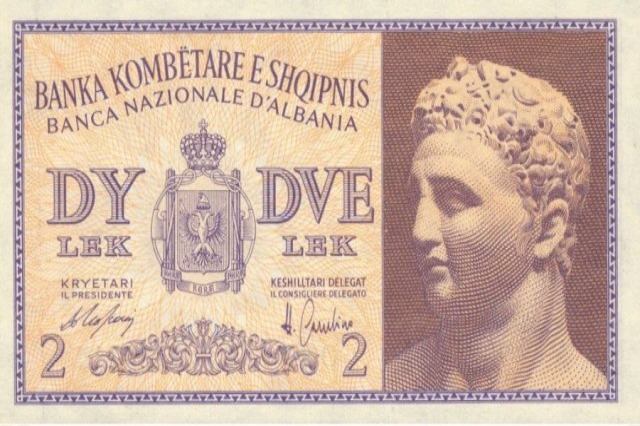
“Leku” our national banknote, celebrates… one century birthday. In February 1922, the naming of the official Albanian currency Lekë became legal for the first time.
What happened in Albania in the session of February 1922, in fact was the creation of a new monetary unit, as the gold franc was not abolished, but in parallel a new monetary unit was created, named “Lekë”. The situation would continue to be so until 1947, when a decree was passed that removed the “Franc” banknotes from circulation. In this way, the basic unit of currency in the country would be designated “Lek”.
This name is said to have been made in honor of Alexander, or Leka the Great. “According to the parliamentary talks in 1922, the alternative proposals were Skënder or Shqipe”..
History:
Albania after the First World War: The banknote issued in the Municipality of Vlora, in the value of 50 (hundred-banknote), had the figure of Ismail Qemali, that of the Municipality of Korça was still the banknote issued by the French. Nationwide meanwhile, 20- and 5-franc denominations had begun, as well as nickel coins with various figures and symbols.
Economists saw the situation as very alarming. In these conditions in the Albanian parliament, in 1923, an Albanian currency was discussed, named after an Albanian name. Ahmet Zogu proposed the name Lekë, in honor of Alexander the Great of Macedonia. The proposal was received with applause, but only in 1926 began the first minting of the Lek, by the Albanian National Bank.
This was 5 lek, equal to the previous 1 gold franc. On the main side he held the portrait of Zog, while behind a cow plough farmer. It read “Albania-Albania”. This banknote was quickly removed from circulation after being criticized for its Roman-style eagle. Then another coin was issued, with the same value. Year after year improvements were made to new emissions. The banknotes depicted Alexander, Pyrrhus, Hercules, and even Achilles, who lived 900 years before them.
First World War:
Albanians, once, under Ottoman rule used Turkish coins, lira, aspra, etc. During the War I introduced other foreign currencies, Austrian, Italian, Greek and Serbian, while in Korça, in the time of the French, it became an Albanian currency that circulated only in this city. These currencies circulated in the free and uncontrolled market.
Local currencies:
The French, when administering Korça in 1918, issued a coin entitled “Korça”. There were 44,000 francs with the name “Korça” in the banknote denominations. The church and the mosque were stamped on the francs, next to each other. Also, the Council of the Government of the Autonomous Province issued in three parts the banknotes for one franc and half a franc, one part of which he named “Self-governing Albania” and the other part “Republic of Albania”. All three missions had the eagle with open wings. Such coins also appeared in Vlora and Shkodra.
King Zog’s Coins:
Since the establishment of the Bank of Albania coincides with the time of King Zog, in the first coins and banknotes the main place was occupied by his portrait. In the banknotes of this time we also find mythical heroes: Anteu, Hercules, or Illyrian kings like Pyrrhus of Epirus, Gent, Teuta, etc., but images of bridges, buildings and cities also began to be used.
One of the first banknotes issued in 1926, was worth 20 Gold Francs. Written in two languages, Italian and Albanian, it bears the portrait of an Albanian boy, in a folk costume, with a hat and a vest.
Coins of fascism:
At the time of the fascist occupation, the Albanian lek coins with monuments, cities, bridges, neighborhoods during the fascist occupation were replaced with the head of Victor Emmanuel II and the Duchess, with the corresponding inscriptions, while on the back was written “Albanian”. With a decree of August ’39: “The new coins would have on one side the portrait of King Vitorio Emanuele III, with the inscription around it ‘King. E for Vitt. Em.III ‘and on the other hand the double-headed eagle with the inscriptions ‘Shqipni-Albania 1939-R”.
Coins of communism:
In the time of socialism the coins were with factory workers, young railwaymen with pickaxes and shovels, with trains and turbines, tractors and combine harvesters. While in other periods there were mints where the emblematic symbols of Alexander the Great were placed, in socialism they were removed, the lek remained without Alexander the Great, although it bore his name. On all banknotes, but also coins, the coat of arms of the Republic was placed, which contained as date “May 24”, the Congress of Përmet.
Currencies in the period of democracy:
After the fall of communism, in order to be as “correct” as possible on the banknotes, portraits of national heroes, or renaissance, were printed on wreaths or laurels. In the coins of the post-1992 period, portraits of national figures, such as: Skënderbeg, Ismail Qemali, Naim Frashëri, Pjetër Bogdani, Fan Noli, while on the back Kruja Castle, a book, a candle, Naim’s words, the building of the declaration of independence, a view of the Catholic church, etc.
Museum of Lek
Although there has long been a project for the establishment of a museum of coins, numismatics, although there was a good documentary material base in the archives of the Bank of Albania, although there has been a large number of professional and amateur collectors, again little has been done for a scientific treatment of currency, this valuable cultural heritage.
The history of coins and banknotes is the passport of the state, which must have this history complete and untouched. To this project belongs the inauguration in 2016 of the Money Museum by the Bank of Albania, a museum that has essentially the Albanian currency over the centuries, but also other historical objects related to the Bank’s past and antiquity.
/Klara Ruci/
Të ngjashme








Most read










 RTI