
 English
 Français
 Deutsch
 Italiano
 Turkish
 Greek
 Serbian
Xhumari: New Waste Management Law, a Concrete Step Toward the EU




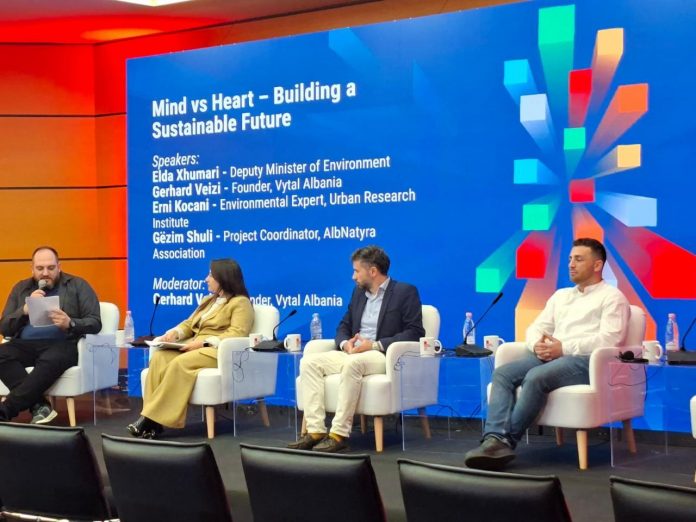
Albania is taking another step toward EU standards. Environmental policies through 2030 were in focus at the Tirana International Fair, held at the Palace of Congresses.
During a special panel on “Circular Economy and Sustainable Environmental Policies,” experts and officials stressed the need for stronger cooperation among institutions, businesses, and communities. Therefore, they agreed that joint action is essential to achieve national environmental goals.
New Law Boosts EU Alignment
Deputy Minister of Environment Elda Xhumari presented the new law on integrated waste management. According to her, it represents one of Albania’s most concrete steps toward alignment with EU directives.
“This law is based on the ‘polluter pays’ principle,” Xhumari said. “It includes clear tools to raise awareness among citizens, businesses, and institutions. In this way, strategies turn into measurable and achievable results.”
Moreover, she explained that three additional draft laws are now under discussion. These proposals include both fiscal incentives and penalties for those who fail to respect environmental standards.
“We take the best European models and adapt them to Albania’s reality,” she added. “Ultimately, we aim to motivate businesses to use recyclable materials and reduce pollution.”
Communities Drive Green Change
Meanwhile, Gëzim Shuli, Executive Director of AlbNatyra, highlighted the vital role of communities in driving environmental initiatives.
“Often, it’s not businesses that start green projects—it’s people and communities,” he said. “When citizens act, awareness grows much faster than through words alone.”
Balancing Policy and Public Awareness
At the same time, Urban Research Institute expert Erni Kocani described environmental policymaking as a social evolution. In his view, public awareness and political action must progress together.
“In recent decades, societies have shifted from seeking economic growth to demanding environmental rights,” Kocani said. “As a result, laws now respond to public awareness, while civic activism pushes policymakers to act.”
Furthermore, he noted that businesses increasingly see environmental protection as an opportunity for economic growth. They are turning toward sustainable practices and green investments.
Circular Economy Gains Ground
Likewise, panelists agreed that Albania’s circular economy is entering a new stage. Sustainability is no longer about image or marketing. Instead, it is about concrete financial and environmental results.
“Today, sustainability is not a luxury or a trend,” they concluded. “Rather, it is a necessity for Albania’s social and economic development.”
Food Safety Takes Center Stage
In addition, food safety was among the main topics at the 31st Tirana International Fair, organized by Klik Ekspo Group. Experts and officials underlined the importance of technology and digital tracking systems to guarantee safe products in the market.
Deputy Minister of Agriculture Arjan Jaupllari stressed the need for electronic traceability systems and more professionals in agronomy, veterinary science, and biotechnology.
“Food safety requires both technology and expertise,” he said. “Therefore, we must equip farmers with the right tools to ensure it.”
Meanwhile, Jona Boci from the Institute of Food Safety and Veterinary stated that Albanian products are safer than imports.
“Most pesticide issues appear in imported goods, mainly from the region,” she said. “By contrast, Albanian products are better controlled and safer.”
Finally, Yllka Allaraj from the National Food Authority (AKU) said the “Alert” system operates in real time. Consequently, it tracks and blocks suspicious products, ensuring consumer protection.
/a.c/
Të ngjashme
Most read










 RTI