
 English
 Français
 Deutsch
 Italiano
 Turkish
 Greek
 Serbian
Albanian traditional dances




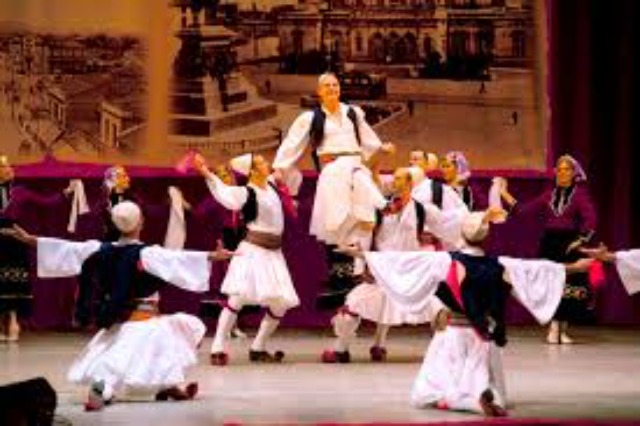
Albanian traditional dances are part of the national artistic culture and are mainly associated with holiday celebrations. There are two genres of dance: lyric dance and epic dance.
Lyric dance takes a big place in the choreographic folklore. Most commonly, they are danced by women, although sometimes they can be danced by men and women together. Lyric dance branches in the following kinds: ritual dance, wedding dance, funny dance and pantomime dance.
Epic dances are characterized by strength, bravery, fighting and glory and they are usually danced by men. Sometimes dances will combine both epic and lyric forms of dance, such as dances from Labinoti, Elbasani and Hasi.
Within its national elements, Albanian dance has characteristics of certain regions and dances of those regions have minor differences between them. Toskeria, Myzeqea, Laberia and Çameria dances are characterized by accompanying the dance with polyphonic singing. Dances of Lunxheria and Zagoria (etc) create choreographic unities according to geographic specifics. Dances of Shpatiti, Dumrea, Polisi (Elbasan) and etc are marked by accompanying polyphonic and homophonic vocals. Eastern regions of Central Albania (Çermenika, Gryka e Zaranikes, Polisi, Rajces, Tirana, Kruja, Martaneshi, Mati) are marked with dances featuring two men which are accompanied with drums and tzurle (an Albanian wind instrument). Regions of middle and northern Albania, including Kosova and other ethnic Albanian regions feature dances performed by many female dancers separated from each other in a free style dance.
The particularity of various dances can be observed in their motives and formations. Motives are expressed in three main types: a) two steps dance b) three steps dance, and c) four step dance. According to their formations, dances can be performed by large groups and by solo artists. There are three types of dance for large groups: a) dance in the closed circle, b) dance in the semi circle, and d) dance in two rows opposite to each other. Solo dances can be performed by just one person, but can also include dances by groups of any number of people, but who do not dance in unison.
Të ngjashme







Most read










 RTI