
 English
 Français
 Deutsch
 Italiano
 Turkish
 Greek
 Serbian
Synagogue tourist attraction in Saranda




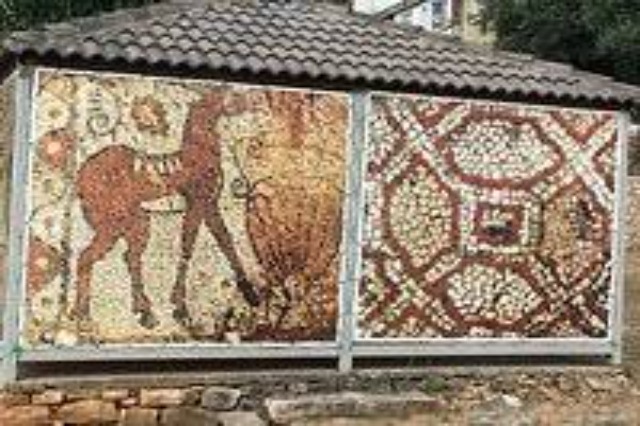
An archeological monument can be found right in the center of Saranda.The ruins are the remains of the center of what was once a wealthy Jewish community that lived in the area. You can see the archaeological excavations of a 5th century synagogue complex and basilica of ancient Onhezmus.
Archaeologists believe that construction of the Christian basilica first started in the 4th century BC and that it was later transformed into a synagogue at the end of the 5th, beginning of the 6th century AD. Besides religious activities the complex has also been used as a community center and had a school for bible studies. According to archaeologists, the synagogue has undergone various periods of use, and in its last stage it was even converted into a Christian church.
Particularly interesting to see is a mosaic floor depicting Jewish symbols such as a ram’s horn, a menorah (seven branched candelabrum) and an etrog (citrus). The initial excavations of the site started in 1984 under communist rule. In 2004 additional discoveries were made and further excavation occurred by a joint Albanian-Hebrew University delegation. The newly discovered ruins are an extension on the complex by rooms with more mosaic pavings. The decorations represent a fish, different animals, trees and symbols and a shrine.
The colorful decor inside is covered with sand, for protective effects from atmospheric agents. The richness of colors and drawings, with a series of floral and zoomorphic figures, impressed any viewer. Elegant drawing of ducks, kids, eating bush leaves, lamb, eating a flower pot; the bull in front of a menacing lion, the angels, around whose neck the red cord and the roe deer and the dolphin were distinguished, created the scene of the ucaristia, on either side of which are depicted two brown sorcerers with the neck upwards. In the center of the mosaic stands a candlestick with a cross, and the emblem with the motif of the sun, the cross and the persimmon leaves, as a symbol of the tree of life, in the Paleo-Christian tradition.
In the period of construction of this basilica, in the processes of urban development of Christian cities, two main trends were noticed: the restoration of the previous surroundings, preserving the construction lines, since the time of Diocletian (284-350), and the construction of a new system of fortifications and edifices in accordance with the new principles of Byzantine architecture. From the center, with urban, pagan structure, they turned into centers, with typical Byzantine Christian typography. The fact that Onhezm had three basilicas of this period, five mosaics and especially, the monument of the 40 saints, shows an economic and social development, for civic life, not only in the beginnings of Christianity, but also earlier. The central nave must have been arched and decorated with marble columns, the iconostasis made of white marble and fine crystals, the floors paved with mosaics, testify to artistic work.
Archaeologists have confirmed that this was eventually abandoned after a burn that engulfed the entire building. Coins found during excavations at the basilica, dating to 577, rule out the burning of the city by the Ostrogothic leader, Totila, whose fleet of 300 ships arrived in Epirus in 551 and makes the burning of the city by Slavic hordes credible in the time frame 586-587 who devastated among others also Northern Epirus.
In the northern part of the basilica, another mosaic is decorated, in the center of which is placed a candlestick with seven candles – seven wings – Menorah, the most significant element of the Jewish symbol of Christianity in the V-VI centuries, an etrog, or citrus, the driver, the ram’s horn, both known as important Jewish symbols, usually accompanying the Menorah and used during religious festivals. This synagogue complex performed the functions of a cult monument.
In the central panel are presented two sea lions in a heraldic position. The style coincides with that of the Roman type. The synagogue of Saranda is the most realized and the most maintained. In Lecce, Italy, a tombstone was found by a professor at Tel Aviv University, where the name of the son of the head of the Onhezm Jewish community was written.
The symbolism of the mosaic scenes speaks of a synagogue in an earlier period than the Christian building, the Jewish complex as the first phase must have had the room with menorah, continued in the second phase with the construction of the basilica and its conversion into a church , this must have worked for a period of 100 – 200 years.
The construction of the synagogue in Saranda must have been done by a group of emissaries of the spread of Christianity, its ideology and rites. For the time they have lived in Saranda, they needed a shrine, where they could perform their rites, but also a model for the spread of this ideology. The name of Saranda itself comes from the forty saints, whose monastery belongs to the IV century AD, which proves that Saranda had a civilization, which accepted this new ideology since conception, becoming the center of spread of Christianity.
Archeology is important not just to quench the curiosity of the antiquity of discovered objects, but to relive the lost eras.
/Klara Ruci/
Të ngjashme










Most read










 RTI