
 English
 Français
 Deutsch
 Italiano
 Turkish
 Greek
 Serbian
Church of Saint Nicholas in Shelcan, An Onufri Masterpiece That Defies the Centuries




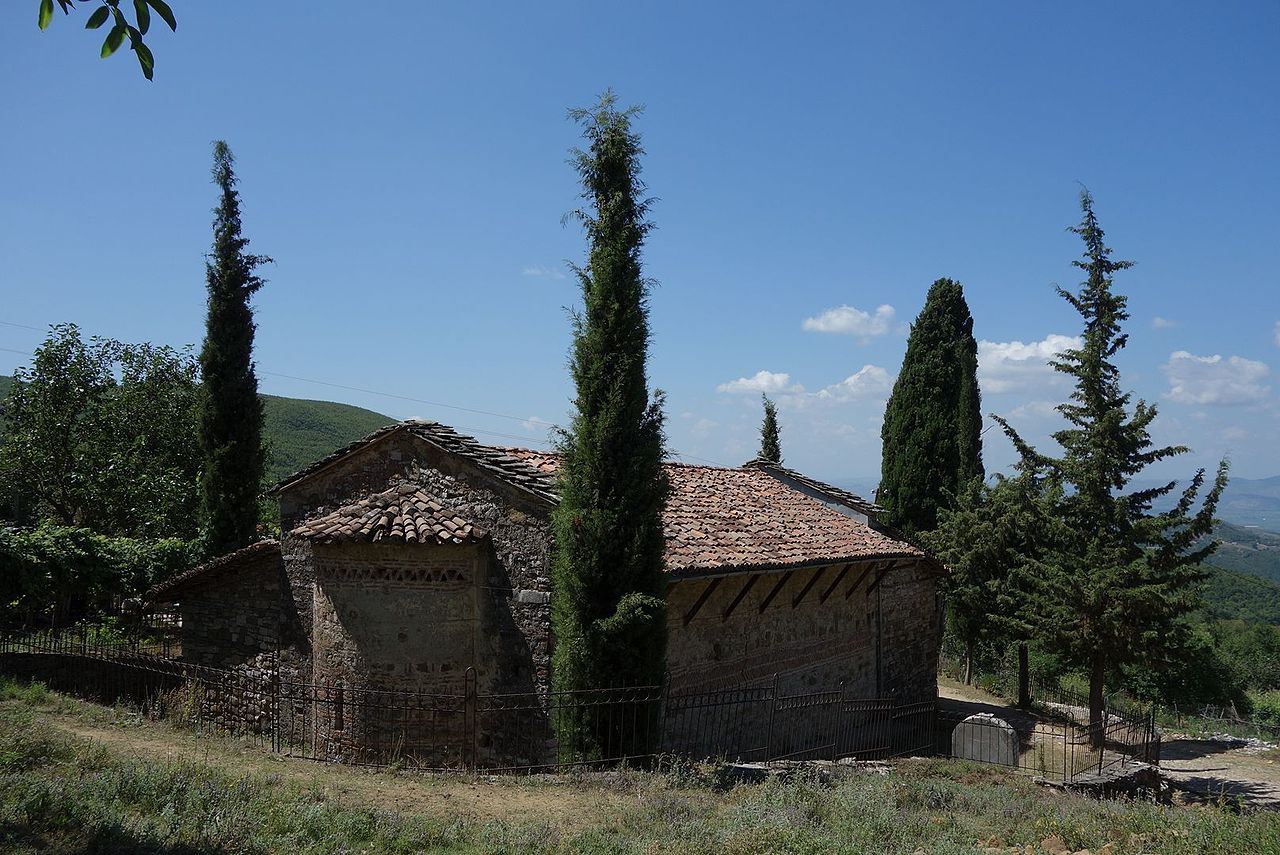
Only seven kilometers from Elbasan, the village of Shelcan rises on a hillside, scattered across several distant neighborhoods. At its peak stands the Church of Saint Nicholas, a rare treasure of medieval art.
Inside, the church reveals its greatest value: the frescoes of Onufri and Kostandin Shpataraku. These works give the small structure extraordinary cultural weight. The last major repair took place in 1988, when restorers rebuilt the dome and the narthex, although they left the bell tower unfinished. In the following years, new drainage lines and a full enclosure strengthened the building’s protection.
The floor consists of irregular stone slabs, while a wooden roof with visible trusses—restored in 1969—covers the nave. A painted masonry iconostasis separates the nave from the altar. It includes two doors, one in the center and one to the north. Although workers plastered most of the walls and hid the construction technique, the eastern wall still shows its original form.
That eastern wall confirms that the church predates the Ottoman conquest. It holds a circular apse with a narrow, high window framed by radial bricks. Meanwhile, zigzag brickwork decorates the upper part of the apse, likely added during a later period. Builders used the klausonazh, a Byzantine-era construction technique, arranging bricks in vertical or double horizontal rows. Because this masonry style belongs to the late 14th century, scholars date the church to that era.
Visitors immediately notice Onufri’s icons. Beneath the faces of the saints, he portrayed real inhabitants of the Shpati region. Their vivid expressions and Onufri’s signature red bring the scenes to life. The artist shows instinctive mastery; his perfect proportions, sculptural forms, and refined detail reflect the tradition of the Constantinople School, which continued to flourish in Albania long after the fall of the empire.
Several times a year—especially on Easter Eve—hundreds of believers gather here. They come not only from Shelcan but also from Trepshenisht, Kryezjarth, and even the deeper Shpati villages. Since the church’s small interior cannot hold them all, the celebration flows into the courtyard.
To protect the frescoes, the Institute for the Protection of Cultural Monuments now bans candle lighting both inside the church and under the portico.
For Shelcan’s residents, the Church of Saint Nicholas remains a sacred jewel. It has survived centuries of turmoil and kept the Orthodox faith alive through five hundred years of Ottoman rule.
Today, the village views it as a priceless heritage that deserves care, respect, and constant protection.
Të ngjashme




Latest News










Most read










 RTI