
 English
 Français
  Deutsch
 Italiano
 Turkish
 Greek
Greek Serbian
FAZ: Edi Rama, the Prime Minister Balancing Politics and Art




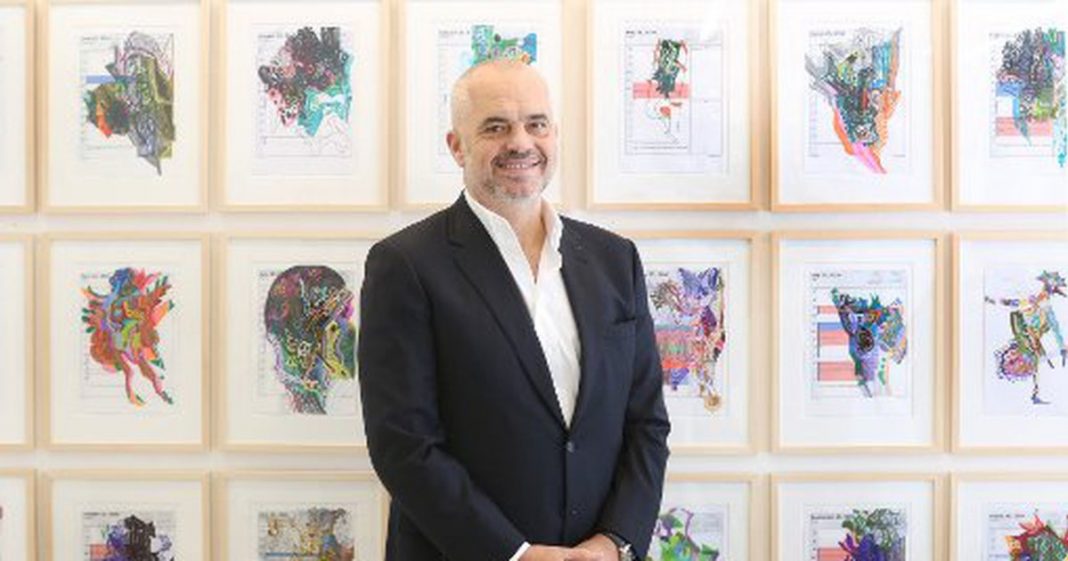
Edi Rama, Albania’s prime minister, is a controversial figure. As a visual artist, he balances government duties and growing artistic success, reports Faz.net.
Writer, athlete, actor in a comedy film, and painter, Rama is not always the typical politician. Examples exist in Czechoslovakia, Ukraine, and the United States.
A philosopher leading a government exists only in Plato’s “Republic.” Since 2013, Albania has been led by a visual artist, illustrator, and sculptor: Edi Rama.
Basketball Player, Politician, Artist
Born in 1964 in Tirana, Rama studied painting at the University of Arts. He later lectured as an independent professor before entering politics. He served as Minister of Culture, Mayor of Tirana, and finally prime minister.
As mayor, he transformed city facades with striking murals. He became prime minister and was re-elected last year for a fourth term, with his Socialist Party holding an absolute majority.
Critics accuse him of authoritarian tendencies. Supporters see him as an ambitious cosmopolitan aiming to bring Albania into the EU.
Rama’s drawings were never meant to be sold. At first, he hated long political meetings. “I could not stand them,” he said.
He felt “immersed in all meetings.” While others doodled during calls, Rama drew during conferences. Studies show this increases focus.
He calls it a kind of “automatic writing,” like the Surrealists. During our Zoom interview, he focused on drawing a bird with black lines on the table.
Even today, his office doubles as his studio. In the late 1990s, a cabinet colleague showed him his art collection. Rama was irritated.
His life resembled a film. The script, he admits, had no pre-written chapter on entering the art market.
When he developed his painting from sketches, former student and internationally acclaimed artist Anri Sala encouraged him to publish his works in books.
One book reached Berlin gallery owner Michael Schultz, opening doors to the art market.
A friend used one of his leaves to make a ceramic piece. Rama gave it to his mother. He enjoyed it so much that he spent weekends making sculptures in his friend’s studio, “drawing in 3D.”
His abstract, enamel works are fluid, wavy, and impastoed. They are colorful, lively, and expressive. Critic Martin Herbert says they lead the eye “through curves, cavities, and surfaces.”
In 2016, Rama emailed gallery specialist Marian Goodman to join their program. He thought it was a joke. Sala, already represented by the New York gallery, confirmed it was real.
Goodman’s interest was sincere. Rama doubted the offer was unrelated to his political career.
Combining politics and art is rare, Goodman said. Even George W. Bush paints. Now, Société Berlin also represents him.
Owner Daniel Wichelhaus values Rama’s natural drawing style and his colorful, picturesque themes. Drawings sell for around €3,800, sculptures €35,000, and installations up to €50,000.
Does art merge with politics in Rama’s mind? Often he asked, but the answer is no.
Politics is “battle, conflict, dealing with insensitive people, survival.” Art is “prayer, a chance to calm.”
Without politics, he says, he would not have drawn so much. He does not see himself as an isolated studio artist.
He last visited an art fair in 1994, in Paris. Since then, he has exhibited in Venice Biennale, New York’s New Museum, Paris’s Pompidou Center, Munich’s Haus der Kunst, and Kunsthalle Rostock. He is also represented by galleries in Naples, Porto, and formerly Berlin.
In May 2026, Société Berlin will host a solo exhibition of his sculptures. Rama promises to attend the opening.
/a.c/
Të ngjashme
Latest News
Most read



 RTI
RTI