
 English
 Français
 Deutsch
 Italiano
 Turkish
 Greek
 Serbian
Paris Peace Conference (1919) and Albania’s Effort to Secure National Sovereignty




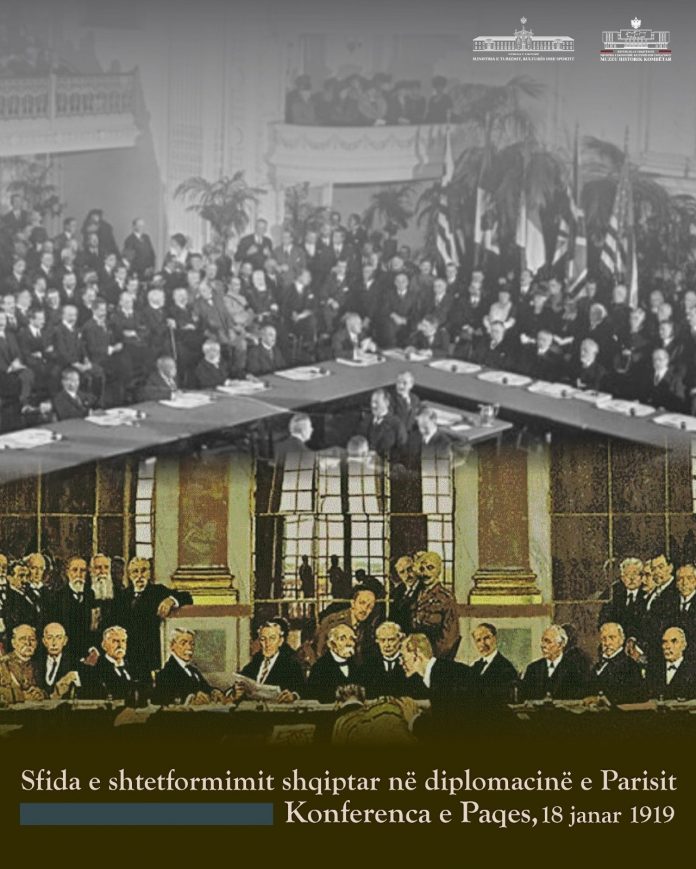
On January 18, 1919, following World War I, the victorious powers convened the Paris Peace Conference.
The main goal of the conference was to reorganize the geopolitical map after the war. Under the leadership of Britain, France, Italy, the U.S., and Japan, the forum also examined Albania’s status. At the time, Albania faced a delicate sovereignty situation and territorial claims from neighboring states.
The Albanian delegation was led by Turhan Pasha of the Durrës Government and included prominent figures such as Luigj Bumçi, Gjergj Fishta, Mit’hat Frashëri, Mustafa Kruja, Luigj Gurakuqi, and Lef Nosi.
Notably, the delegation included the only woman with full rights at the conference, Parashqevi Qiriazi, as well as representatives from Albanian communities abroad.
The delegation defended Albania’s independence within the 1913 borders. Through official memorandums, they argued that border decisions should follow the principle of self-determination promoted by U.S. President Woodrow Wilson, including Kosovo and Chameria within Albania. However, secret wartime agreements, such as the 1915 Treaty of London, and the interests of the Great Powers created serious obstacles for Albania’s demands.
This process led to the Congress of Lushnjë in January 1920, which marked Albania’s sovereign initiative to consolidate state institutions and legitimize national independence.
The Paris Peace Conference (Jan 18, 1919 – Jan 21, 1920) aimed to establish a new world order to prevent further conflict. President Wilson attended, visiting Europe for the first time, and presented his 14-point program emphasizing the principle of self-determination.
Albania left the conference without a final resolution on its status or borders. This outcome highlighted the need for further political reorganization, which was addressed at the 1921 Conference of Ambassadors, where Albania’s sovereignty within its 1913 borders was finally recognized.
/a.c/
Të ngjashme


Latest News




Albania and Azerbaijan Seek Stronger Tourism Ties and New Partnerships


Most read










 RTI