
 English
 Français
  Deutsch
 Italiano
 Turkish
 Greek
Greek Serbian
Kercisht i Sipërm: Byzantine Churches and Dramatic Mountain Views in Dibër




Albania’s northeastern border with North Macedonia runs along the mountain slopes of the Deshat massif, part of the Korab-Koritnik National Park. Below these slopes, Kercisht i Sipërm offers one of the most impressive viewpoints in the Maqellarë area.
Locals call the village the “Balcony of Maqellarë.” From here, visitors can see the entire valley, the Arber Road winding toward Peshkopi, surrounding villages, water basins, forests and the mountain peaks across the valley.
To reach Kercisht i Sipërm, travelers take the Maqellarë road from the Peshkopi roundabout. The journey takes a little over an hour from Tirana. The road is in good condition. Meanwhile, Maqellarë itself offers a glimpse of vibrant rural life, with local businesses, well-maintained multi-story homes, cultivated fields, apple and cherry orchards and centuries-old walnut trees.
Kercisht i Sipërm lies about 3.5 kilometers from the center of Maqellarë. The village became part of Albania’s national “100 Villages” program because of its history and cultural heritage.
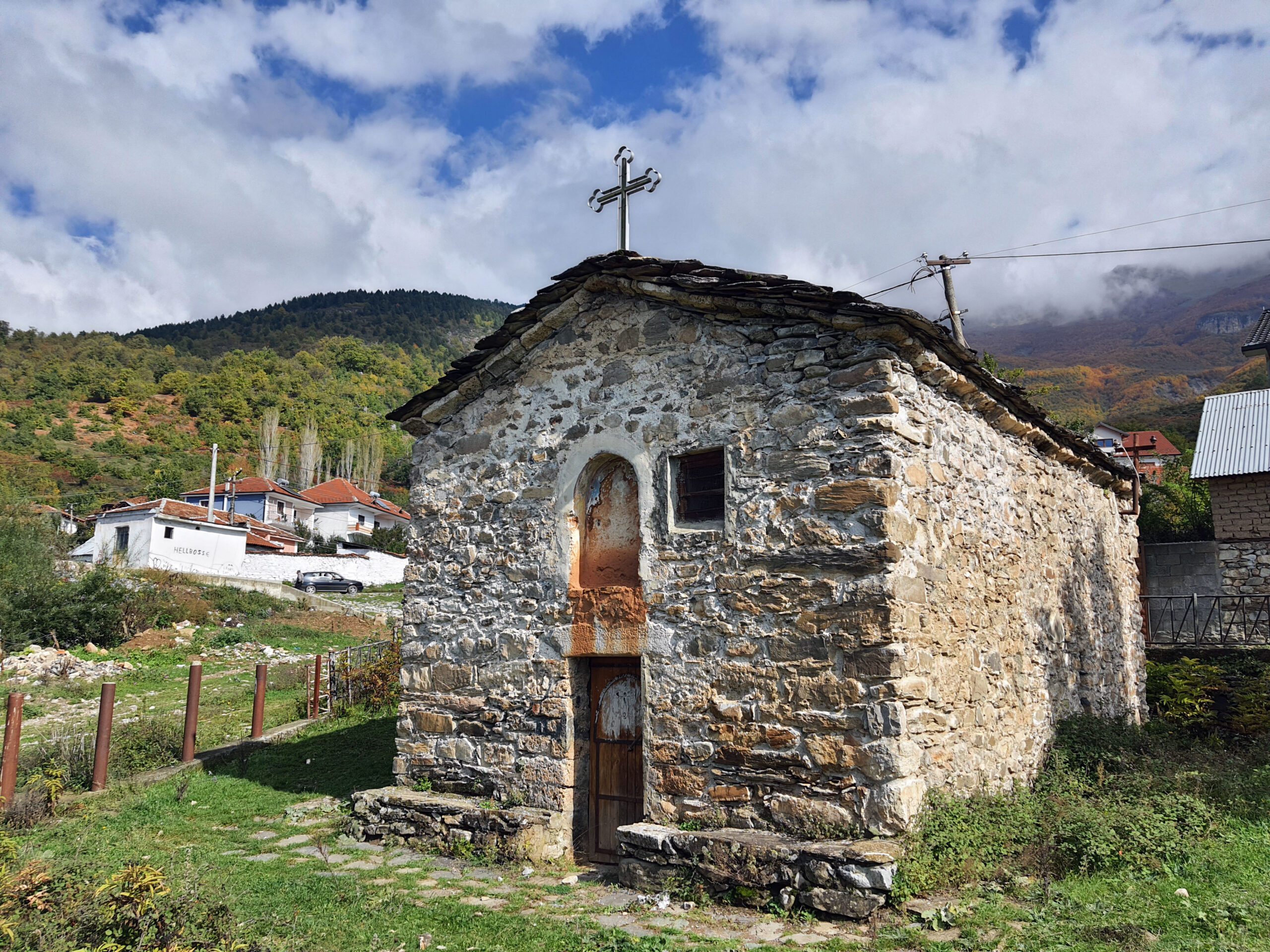
The road climbs toward the village and leads visitors to St. Demetrius Church. The building forms part of five medieval churches that local residents have preserved over the years.
Today, most of the village population follows Islam. Nevertheless, local Muslim residents continue to clean, protect and maintain the old churches. Their efforts offer another example of the area’s long tradition of religious coexistence.
Residents have restored two churches, St. Demetrius and St. Sotir. Visitors can enter the churches, particularly during community celebrations when residents who have moved to North Macedonia return to the village. However, damaged frescoes inside the churches still require further restoration.
The other three churches survive only as ruins. In some cases, only a few stones remain to mark their former locations.
Historical records indicate that local craftsmen built St. Demetrius Church in 1892 using stone and lime mortar. Authorities declared it a Cultural Monument in 2007. Stone slabs cover its roof, while damaged post-Byzantine frescoes decorate its ceiling. Every year, the community celebrates St. Demetrius Day on October 26.
St. Sotir Church also represents an important medieval place of worship. Local residents restored the church themselves. The building offers further evidence of the area’s early Orthodox history.
Old Orthodox cemeteries provide another link to that past. Visitors encounter them soon after leaving the village and heading toward the mountain.
According to local residents, the Byzantine churches stand in a formation resembling a cross. Two of the churches sit on the mountain slopes.
The village also preserves a complex linguistic and demographic history. During the 19th century and the early 20th century, under Ottoman rule, Kercisht i Sipërm had a predominantly Orthodox Christian population. While many surrounding villages later became predominantly Muslim, Kercisht i Sipërm and neighboring Herbel retained their Christian communities for a longer period.
Until recent decades, the village also maintained a mixed population that included a Slavic-speaking community alongside its Albanian residents. Macedonian remained in use in the village until the late 1990s and continues to be spoken today, although most families who used the language have since moved to North Macedonia.
Today, the village comes alive during the autumn days. Children play in the streets and knock walnuts from the centuries-old trees scattered around the settlement.
The village also preserves two contrasting architectural landscapes. Abandoned or nearly abandoned old houses feature roughly carved stone walls, lime mortar and dark stone-slab roofs. Newer homes, meanwhile, feature red-tiled roofs, carefully maintained courtyards, grapevines, fruit trees and flowers.
The narrow streets still preserve traditional stone paving. However, some sections need better maintenance. The surrounding greenery and abundant trees soften the overall appearance.
Kercisht i Sipërm lies within the protected area of Korab-Koritnik Nature Park. Improved road access has strengthened the village’s potential for ecotourism.
Several mountain trails start from the village and lead toward Mount Kercin, which rises to 2,341 meters, and Mount Rudina, at 2,238 meters. Foreign tourists also frequently use these trails.
Local residents have grown accustomed to welcoming mountain enthusiasts. They explain the routes and send visitors on their way with a smile.
The village has abundant water resources. Along the route toward the higher elevations, visitors can also see two water-storage facilities and an irrigation channel serving the surrounding agricultural land.
The higher visitors climb, the wider the panorama becomes. Strong mountain winds push the clouds across the sky. Gradually, alpine meadows appear. As the peaks draw closer, the landscape opens toward Lake Great Dibra, dense forests along the border between the two countries and picturesque mountain villages.
Like many mountain villages in Dibër, Kercisht i Sipërm faces population ageing and significant migration. Many residents have moved to Tirana or abroad.
Only a small number of people now live in the village throughout the year. However, the population grows during the summer months when emigrants return and tourists arrive.
The village’s inclusion in the “100 Villages” program has also raised its profile. Official travel guides now feature Kercisht i Sipërm, while national and international agencies increasingly bring visitors to explore its Byzantine churches, dramatic mountain views, clean air and rich history.
Kercisht i Sipërm stands today as a meeting point between nature and heritage. Its churches preserve centuries of history, while its mountain trails offer new opportunities for tourism. At the same time, its surviving traditions tell the story of a community that has endured beside Albania’s border for generations.
/a.c/










 RTI
RTI