
 English
 Français
 Deutsch
 Italiano
 Turkish
 Greek
 Serbian
Above Tepelena: From Luzat’s Open-Air Art to the Breathtaking Views of Mount Buzë Bredhi




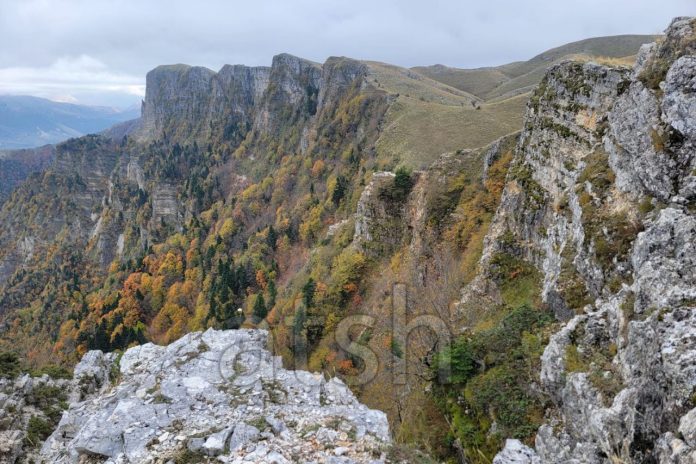
Just four kilometres outside Tepelena, along the national road to Gjirokastra, a turn-off leads to Luzat village. It opens the way to one of Albania’s most beautiful yet unexplored natural areas.
The historic part of the village features picturesque old houses at the foot of mountains rising more than 1,500 metres. Forests and streams surround the settlement. Today, however, only five houses remain permanently inhabited, mostly by elderly residents. Many other families have moved abroad or relocated to nearby towns and Tirana.
The houses feature spacious courtyards, grapevines and fruit trees. Chickens and other domestic animals roam freely through the village streets.
Despite its small population, Luzat welcomes visitors with remarkable hospitality. One local woman opens her door when visitors ask to refill their water bottles before hiking towards Mount Buzë Bredhi. She lives there with her husband, while their children work abroad.
“We have worked our entire lives to build this house,” she says, responding to a compliment about her home.
A village where art meets tradition
Although modest in appearance, Luzat offers several attractions. Its location near the national road also makes it a starting point for outdoor activities and cultural visits.
One of its main attractions is the Kalo Family Museum House. The family rebuilt the historic property to preserve and display the area’s history, culture and patriotic heritage. Inside, visitors can explore traditional Labëria household objects, historical documents and accounts of the village’s contribution to major national events.
Meanwhile, the village’s former school now houses the LuzatArt regional centre. Every year, usually in mid-August, the village welcomes artists from Albania, the Western Balkans and other countries. They stay for several days and transform the village into an open-air art space.
The artists create installations, mosaics, stone and wood sculptures, as well as murals on village walls. One of the best-known works is “The Moon”, a mural by Italian artist Giorgio Rizzo.
These works remain permanently in the village. Together, they create an open-air contemporary art museum, with sculptures and installations scattered among hills, trees and stone walls.
Meanwhile, the remaining residents keep local traditions alive. They also welcome families who return from abroad to visit relatives and maintain their homes, land and livestock.
Three waterfalls hidden in the forest
In November, Luzat offers a particularly peaceful atmosphere. The trail towards Mount Buzë Bredhi, also known locally as Mount Buzë Derrit, begins near an abandoned quarry. Its excavations, pits and tunnels create an unusual landscape.
For visitors seeking a shorter hike, the Luzat Waterfall offers another option. Locals also call it the Lyer Waterfall or the Three Waterfalls. Dense vegetation hides the site from view.
Three waterfalls follow one another, just metres apart. Their icy water flows from the slopes of Mount Buzë Derrit. Unlike some other waterfalls in southern Albania, which dry up completely in summer, Luzat benefits from numerous springs. As a result, its waters continue to flow throughout most of the year.
Higher up, the landscape becomes even more impressive. A mountain trail winds through dense woodland, where autumn colours dominate the slopes. Yellow and deep red foliage creates a striking contrast.
The forests above Luzat feature rich vegetation. The silver fir stands out as the mountain’s defining tree. Indeed, one of the area’s best-known natural landmarks takes its name from it: Buza e Bredhit, which also enjoys Natural Monument status.
Red hornbeam trees add intense shades of red and orange to the rocky landscape of Tepelena. Their rounded leaves contrast beautifully with the evergreen fir trees.
Wild maples also grow across the forest. Their star-shaped leaves turn bright yellow, orange and red in autumn.
Inside and around the village, centuries-old trees also catch the eye. Some still stand proudly with branches reaching towards the sky, while others bear the marks of lightning strikes and time.
A challenging climb with spectacular views
As the trail climbs higher, the sounds of the forest mix with barking dogs from nearby shepherd settlements. Metal-roofed buildings and water reservoirs used by livestock reveal the importance of animal husbandry to local livelihoods.
Goat herds are the most common sight along the route. The area’s dairy products are also well known and highly sought after across Albania.
The trail crosses several mountain ridges before reaching the alpine pastures above the forest. Once hikers reach Buza e Bredhit, the landscape changes dramatically.
Local legends offer an unusual explanation for the name Mount Buzë Derrit. According to one story, a giant wild boar fled hunters, exhausted and furious, before crashing into the mountain and turning into stone.
The surrounding landscape seems to bring the legend to life. Deep cracks, sharply cut rocks and uneven grassy depressions create the impression of a powerful impact. In reality, however, geological formations over time shaped these dramatic features.
Another possible explanation links the name to the wild boars that inhabit the surrounding forests. Their tracks are visible along the trail, where they dig into the soil in search of edible roots.
The mountain’s summit may also resemble the snout of a wild boar, rising above the deep valley below.
At the top, cold winds and light rain offer little time to rest. Still, the views make the climb worthwhile. The entire Vjosa Valley unfolds below, stretching from the Mezhgoran Gorge through Tepelena before disappearing westward into the distance.
On the southern side, the summit ends in a dramatic 700-metre vertical rock face overlooking the Luzat Valley. On the opposite side, vast karst depressions shape the terrain.
Beyond the Vjosa Valley, the mountain ranges of Shëndëlli, Lunxhëri and Bureto rise in parallel ridges, with their peaks following one another across the horizon.
To the north, Mount Këndërvica dominates the skyline at 2,121 metres. It is the highest peak in the Kurvelesh Highlands. Further away, the view extends towards the Çika mountain ridge.
Meanwhile, the southern horizon reveals the valley leading towards Gjirokastra, surrounded by hills and small, isolated villages.
The climb to Mount Buzë Bredhi is undoubtedly challenging. However, those who make the effort are rewarded with one of the wildest and most spectacular views in Labëria.
Të ngjashme
Latest News

Kolkondas: Where History, Art and Faith Come Together
The UK iPaper highlights Tirana’s growing cocktail scene
Cosmopolitan UK features Albania in five-day summer trip for women


Most read










 RTI