
 English
 Français
 Deutsch
 Italiano
 Turkish
 Greek
 Serbian
Albanian folk dances promoted as a tool for improving public health




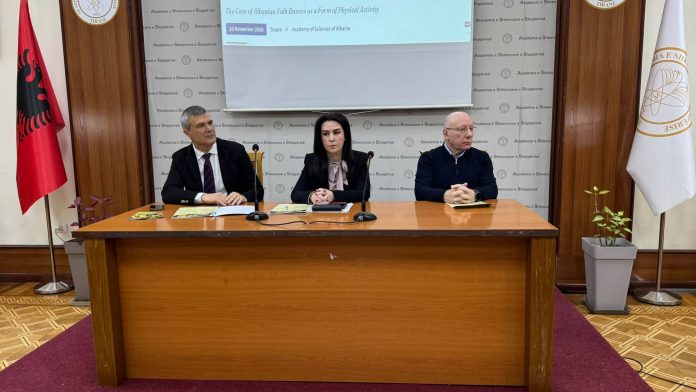
Albanian folk dances could play an important role in promoting physical activity, preventing chronic diseases and improving public health. They also offer a natural way to combine cultural heritage with physical and mental well-being.
The Academy of Sciences of Albania explored this approach at an international scientific conference titled “Health Promotion and National Traditions: The Case of Albanian Folk Dances as a Form of Physical Activity.” The Academy organised the event in cooperation with the Institute of Public Health and the World Health Organization (WHO), with support from the “Public Health Resonance” project.
Academician Genc Sulçebe, head of the Academy’s Permanent Medical Commission, highlighted the role of physical activity in disease prevention. He noted that modern lifestyles, prolonged computer use and frequent reliance on cars have significantly reduced daily movement. Therefore, he described folk dancing as a promising way to encourage physical activity and improve public health.
Deputy Minister of Health and Social Welfare Eugena Tomini stressed that Albanian folk dances serve a dual purpose: they preserve cultural heritage while encouraging physical activity, social interaction and collective well-being. She also raised concerns about physical inactivity among children and young people, largely driven by excessive screen time and technology use. Consequently, she called for schools and communities to incorporate cultural traditions into practical public health programmes.
Meanwhile, Ardita Baraku, director of Kosovo’s National Institute of Public Health, described traditional dances as an accessible, low-cost way to prevent chronic diseases, improve mental health and strengthen social ties.
WHO Representative in Albania Fabio Scano emphasised that people are more likely to maintain physical activity when they enjoy it and feel internally motivated. Such activities, he said, can become lasting lifestyle habits.
The conference featured two scientific sessions covering the health benefits of physical activity, its social and cultural dimensions, the monitoring of children’s health behaviours and policies to promote active lifestyles in Albania, Kosovo and beyond.
Participants also examined Albanian folk dances, Hawaii’s traditional Hula dance, ethnographic dance classifications, folk games and children’s physical performance. They gave particular attention to “K’cimi i Tropojës”, one of Albania’s distinctive cultural heritage elements. International contributions from the United States, Kosovo and Brazil also presented different models for promoting physical activity, particularly in schools.
At the conclusion, participants called for concrete measures to put these ideas into practice. They proposed including folk dances in school physical education curricula, organising community activities for all age groups and conducting scientific research to measure the energy expenditure (MET) associated with different regional dances.
Through these initiatives, Albania’s rich folk dance heritage could serve not only as a tradition to preserve and pass down through generations, but also as a valuable tool for building a healthier and more active society.
Të ngjashme


Latest News
Most read










 RTI