
 English
 Français
 Deutsch
 Italiano
 Turkish
 Greek
 Serbian
December 8, National Youth Day in Albania




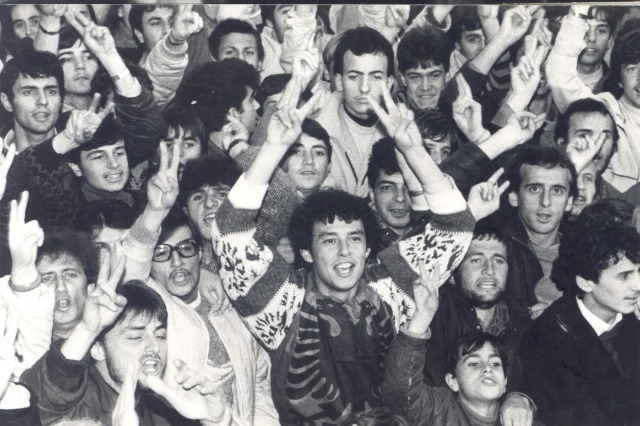
December the 8th is celebrated as Youth Day in Albania. It is a day remembering the students of Tirana State University demonstrations, breaking in the streets of Tirana, precisely on December the 8th 1990, asking for freedom and a democratic European society in Albania.
Democratic changes throughout the Eastern Europe had a considerable impact on Albanian society, under communist rule of the hard Stalinist line, since the end of WWII. The hardest communist anti-social rule of all eastern Europe countries started also in the Albania since 1945, a semifeudal, still having very much observable prints of the backward regime of the centuries old Ottoman Conquest.
News that all other former communist country under Soviet rule were changing into democracies, and crises of the embassies in Tirana of July 1990. Democratic flame was growing little by little throughout over 1990 all over the country, in Tirana, especially. In October, famous author, Ismail Kadare, seen by the youth as the Pole Star, defected the communists and went in France, being it the only way left to help his countrymen.
Even though it was never a part of the Soviet Union, its government followed Marxist Communist hard line with a high degree of state control and administration. As a result, Albania became an isolated country and one of the most difficult to visit in the world. It was arguably one of the most successful communist regimes, in terms of economic success, albeit one that was built on heavy lending from other socialist states. However, the state also silenced many freedoms, including the right to hold political opinions and religious beliefs. In 1967, it declared itself the world’s first atheist country, outlawing Faith Worship.
Leaders in Albania were alarmed by the fall of the Berlin Wall and by the protest movement in Romania that led to Nicolae Ceauşescu’s execution as its leader. The Helsinki Agreement, which improved human rights, replaced the Warsaw Pact. Numerous demonstrations had occurred in various eastern Europe countries during 1989-90. Finally in Albania too on the evening of December 8, 1990, students in Tirana, the country’s capital, gathered in a political demonstration, never happened before in Albania.
Initially, after the first protest in the city, the protests were confined to the Tirana University Campus square, now-called Democracy Square. They tried to enter the streets of Tirana but were stopped by the police. They erected a stage in the square and played music, gave speeches, and spoke freely for the first time in public. The Communists allowed this and did not once try to enter Tirana University Campus.
During those 3-4 days the students had formed a commission and drafted a Petition with some 10 demands, signed by thousands of them, where the main demand, that of political pluralism stood out.
Most of capital citizens joined and prominent intellectuals. Communist party solved the situation by accepting the political pluri-party system, as the first step to democracy, thus giving in to the popular pressure and stepped down
During those days of protests, police did not use violence against students with the exception of light rubber battens when students tried to leave Tirana University Campus. A few arrests were made but they were soon released and returned to the dormitories.
Ramiz Alia announced decision for multi-party pluralism. Following Albania’s liberation from communism, many of the students emigrated out of the country.
While the student protests of 1990 were not the end of the communist regime, they were one of the final pushes towards its downfall. The regime was already economically and politically bankrupt and could not be sustained for much longer. December was about aspiration- the aspiration for freedom and wellbeing which was summed up in several now-famous slogans; “Freedom and democracy” and “We want Albania like all of Europe”.
The students marched to seek political change in the country, but as is so often, their focus soon switched to other, more pressing causes after they started to protest the loss of energy.
Because of the other changes occurring in Eastern Europe and the Soviet Union at the time, Albanian rule was ruined, but it was only a question of time first before the country experienced regime change. The student protests lit a fire that was already smoldering. The protests became known as the December Movement, and they compelled the Central Committee of the Communist Party to support political pluralism on December 11, 1990, with the biggest opposition party, the Democratic Party, established the next day.
34 years after, Albania is still a democracy in the building, an EU candidate and a NATO member country. Through the vicissitudes of establishment the rule of law, Albania is still struggling on her resolute path to join her natural home, Europe, as Tirana State University called for during those fiery days of December 1990.
/a.p./
Të ngjashme

Latest News

Korça attracts autumn tourists as New Year bookings begin

Most read










 RTI