
 English
 Français
 Deutsch
 Italiano
 Turkish
 Greek
 Serbian
Radio Tirana International celebrates the 85th anniversary of its foundation




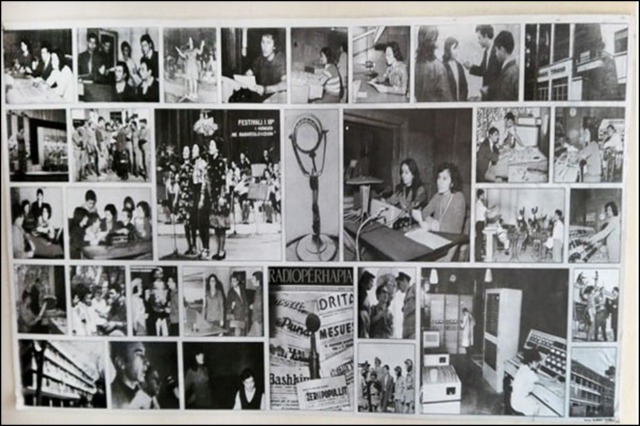
Radio Tirana International has built its own history, along a difficult but successful journey, always in development, as a very important part of the big umbrella of Radio Tirana.
Unique in style, presentation and perspective, the section that crossed the barriers of official borders with international waves, is today a reflection of the memory of an institution that is approaching a century of life. As in all international public broadcasters, the mission of Radio Tirana International was clear from the beginning, projecting the positive image of the country, an unchanged objective in more than 8 decades of history. With this unwritten slogan, this history started since the first half of the 20th century.
In 1938, the people who so dedicatedly and passionately took the first step, knew very well that the national culture and information would be completely truncated, if the airwaves did not carry messages in foreign languages even thousands of kilometers away, in every corner of the planet, where Albanians and people who admired Albania lived.
In this way, in addition to the informative character, Radio Tirana made a combination of Albanian art and culture with international ones. In the first steps, Revista Radio Tirana presented its program schedule in English and Italian, while later broadcasts also started in Bulgarian, Romanian, Turkish, Serbo-Croatian and Greek. A few months after the first broadcast, on the eve of the fascist occupation, in Black April of 1939, Gjergj Bubani, the director at that time, called in several foreign languages ”Save Albania because it is being invaded by fascist Italy”. This message was the strongest signal in the history of the foreign language broadcasting sector, at that tragic moment the country was going through.
During the Nazi-fascist occupation, Radio Tirana began broadcasting news and programs in foreign languages, reflecting the political and social situation of the time.
After the liberation of the country, Radio Tirana followed the official policy of the new state. Until 1950, there were broadcasted 7 and a half hours of Albanian programs and 4 hours in foreign languages. In 1952, the medium and short wave radio station was built, reaching all continents.
Gjergj Bubani, the polyglot man, educated in the West, has the great merit of laying the foundations of Radio Tirana service in foreign languages. Tough game for the people of that time. No one could cross the ideological barriers, ironic for a radio that had long since broken the earthly boundaries.
A large number of translators worked at the Foreign Service of Radio Tirana. One of the first translators was Mother Teresa’s older sister, Age Bojaxhi. She was a very good connoisseur of several foreign languages. She worked as a translator and announcer in the Serbo-Croatian section from 1940 until 1957, when she was fired.
In the first two decades after liberation, Radio Tirana broadcast only one program a day in English, French, Russian, Italian, Serbo-Croation and Greek. Later, over the years, broadcasts in other languages were added. Its broadcasts would reach 24 foreign languages, in more than 80 hours of programs a day.
The number of translators also increased continuously. It is worth noting that foreign women married in Albania, who came from different countries, mainly from the former socialist camp, such as Tamara Gaci, Inga Tarasova, Janka Selimi, etc. The wave of political suspicions by the regime towards this contingent led to the departure of some of them from the Radio institution, which challenged in some way translation quality in these languages.
Each program had two to three translators, who were usually involved in translating articles and political comments written by Foreign Service radio editors. Many of them were also announcers or anchors of the materials they translated. The materials were first recorded on magnetic tapes and then broadcast from studios guarded by police officers. Access to these studios was strictly controlled.
After the breakdown of relations with the Soviet Union (19610, THE Radio Tirana Foreign Service would start broadcasts in Czech, Hungarian, to continue in other languages, such as Polish, Portuguese and Spanish. By 1969, there were 52 transmitters, eight of them shortwave, and Radio Tirana broadcasted in 17 languages.
The Radio Tirana Foreign Service was one of the largest broadcasters in Europe, operating on 1395 kHz and broadcasting in 20 foreign languages, in addition to Albanian, aimed at Albanians abroad. These broadcasts were in the following languages: Chinese, Arabic, Turkish, Serbo-Croatian, Polish, Czech, Hungarian, Romanian, Italian, Portuguese, Indonesian, English, French, German, Swedish, Spanish, Persian, Russian, Greek and Bulgarian.
During the 45 years of the communist regime, foreign individuals were also active as translators and announcers in the Foreign Radio. Their activity and commitment lasted for a certain period of time (generally 2 to 4 years), then they returned to their place and were replaced by other couples. They were part of the communist regime’s propaganda machinery to broadcast the voice and successes of socialist Albania to the world.
In 1987, 66 hours of programs in 20 foreign languages were broadcasted every day. Political propaganda prevailed and included: “Presenting Albania”, “Listeners’ Letters”, “Culture and Art in Socialist Albania” and “The Song of Our Life”. Radio Tirana also broadcast programs of revolutionary music from around the world, while the program “What we saw in socialist Albania” offered interviews with foreign visitors to Albania.
The broadcasts passed through several filters. Materials were checked by dedicated editors and then translated. The translation was checked by foreign colleagues and then recording started in the studio with 2 observers for each language, who listened to the broadcasts, made observations and proofread them before they were broadcast.
Evidence of the global reach of Radio Tirana are the manuscripts and letters that arrived at the radio’s address. It was a large sea of letters which were of course first checked and then delivered to the offices of Radio Tirana Internacional.
Most of the letters that came to Radio Tirana from abroad were not only from admiring listeners of the time, but also from radio amateurs, from listening clubs with almost 40 members, shortwave radio enthusiasts, etc. This helped in contacting people on all continents, a good way to explore the fascinating world of radio communications. And Radio Tirana International achieved this mission in the best way.
This modest radio service carried its signal to Singapore, Sri Lanka, Thailand, Japan, China, South Korea, Taiwan, Bolivia, Brazil, and India, where no ray of Albanian light could penetrate otherwise. This fact makes Radio Tirana one of the most special institutions in the history of world radio.
During 1979, 8348 letters had arrived from 99 countries of the world. Most from Europe (5974), especially from West Germany (2092), Italy (872), England (573), Spain (300), Finland (374), France (374), Sweden (311), East Germany (252) and Switzerland (152). Hundreds more came from Asia, 262 letters from Japan, Africa, Oceania, and 66 from North and South America.
In their letters listeners sent QSLs, listening reports (a typical postcard) and sent via post. Each QSL contained a signal report, details about the station, the listening, the time and date it occurred (usually specified in UTC), the radio frequency or band used, etc.
At the end of their letters was the column “Comments”. Listeners made evaluations on the content of the radio show, often evaluations of the work of the foreign service staff and of course questions about this small country, where little or nothing was talked about in their media. So the letters were a world of their own. Strange stories of listeners, not only about their country, but also personal stories.
Thousands and thousands of letters. This archive is the most accurate evidence of the fact that Radio Tirana International was the only torch that shed some light on the fact that somewhere in a forgotten corner of the Balkans, a completely isolated people continued their normal life.
Other times, golden of course for the nostalgic, a parallel universe that can only be understood by those who lived it.
During the last months of the socialist era, political programming was drastically reduced, and the long-established practice of placing “The International” at the end of each broadcast was discontinued.
After the fall of the regime, the foreign radio service was reduced to seven languages and only three hours a day, in Turkish, Serbian, Greek, German, Italian, French and English.
Today Radio Tirana is an organized complex that broadcasts online programs.
Radio Tirana International (RTI) has gone through many challenges during its journey. One of these challenges has been the transition from shortwave to online broadcasting.
Radio Tirana Internacional had traditionally operated with shortwave until 2017 as a main way of distributing its signals, but now many technologies are included.
There is certainly no doubt that radio has come a long way over the years. It has seen and gone through many challenges and still managed to come out on top, proudly remaining a heard medium even today.
In the digital age, one of the important challenges facing RTI as well as other public radio stations around the world is audience fragmentation. With the proliferation of digital platforms and the rise of on-demand content, listeners have a variety of options to choose from, eroding the once-dominant reach of radio, resulting in a decline in traditional mass audiences and a challenge for RTI to capture and maintain listenership.
Radio Tirana Internacional is a radio with consolidated national features. The mission of Radio Tirana Internacional is to promote Albania, its prospects.
RTI journalists produce a daily product for the listener such as: Daily news; historical calendar; Albanian folklore; Albanian figures who have contributed in various fields; tourist guide, where we provide information to foreign listeners about the main tourist destinations in Albania, as an excellent basis for exploring the country; light and popular music, of course accompanied by abundant information. So it is a promotion of historical, archaeological, cultural values, natural beauty, touristic values, economic development, drastic and dynamic changes that Albania has undergone over the years.
It is a Radio that reflects the position of the Albanian government and state on national, regional and international issues, so it is valued as a tool for mirroring the national image of Albania.
RTI’s objective today is to be a valued, vital and vibrant service and to seize new opportunities to serve the audience. Audience the first is the principle of RTI.
This is RTI, small but valued with its voice in the big media market!
/Radio Tirana International Editorial Office/
Të ngjashme
Latest News
Most read










 RTI