
 English
 Français
 Deutsch
 Italiano
 Turkish
 Greek
 Serbian
Albania: Surprising country that’s ‘real’ Europe, without the prices




On the short flight across the Adriatic to Albania, something special happens. The very moment we make landfall, a rainbow forms.
Actually, it’s more like a shimmering circle that spotlights the mountains and valleys beneath me in a spectrum of colors. It’s mesmerizing and stays with us all the way inland to the capital, Tirana, only vanishing as we come into land.
It’s quite the welcome. An omen, as it turns out, of the bright and wonderful adventures Albania has in store for me.
Tucked into the Adriatic coast between Croatia and Greece, Albania has always been overshadowed by its more glamorous neighbors.
The former Communist stronghold – in its day (1941-1985, under dictator Enver Hoxha) even poorer and more paranoid than North Korea is today – still labours under delusions about its safety and reputation.
When a colleague heard I was heading here she said, “I imagine it’s full of gangsters driving aged Mercedes on potholed roads.” (In fact, the Mercs are often late models, and many main roads are brand new.) Our own government’s Smartraveller website advises a “high degree of caution” and warns of landmines and road deaths.
“I have noticed that my country has a problem with its image,” says Elton Çaushi, the founder of local tour agency Albanian Trip. “That it’s either not known at all, or else it’s badly known and badly interpreted.”
Çaushi planned my weeklong itinerary which was, like that remarkable rainbow, a brilliant, unexpected and extended surprise.
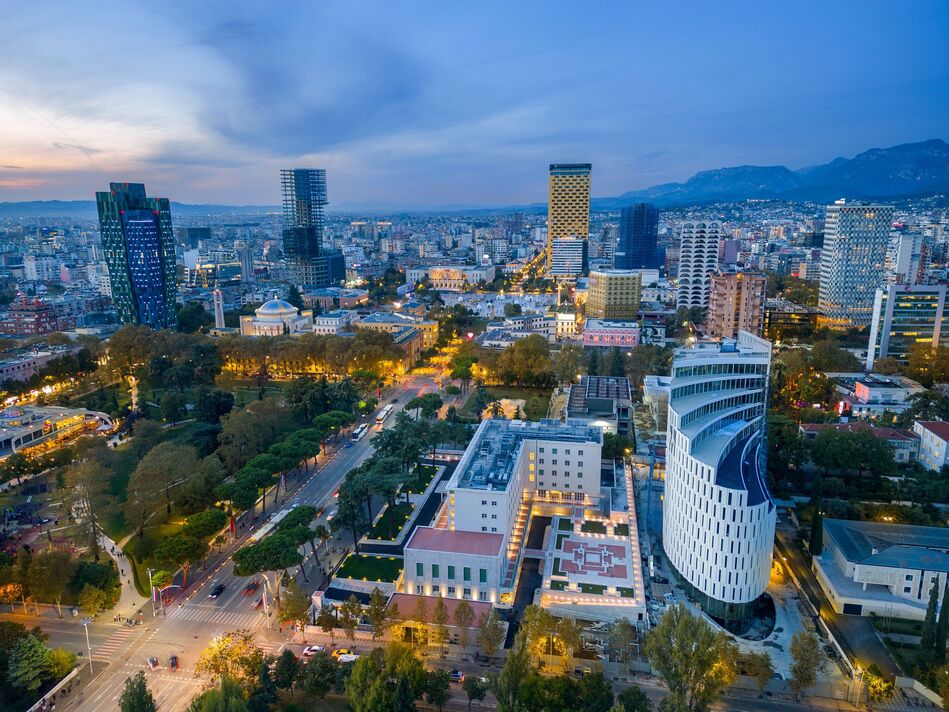
In Tirana I stayed at the smart Lot Boutique Hotel and spent a pleasant Sunday evening in chic Ish-Blloku, until quite recently the Kalashnikov-guarded haunt of Politburo chiefs and off-limits to ordinary Albanians. Today it’s a fashionable quarter of packed restaurants, bars, French pâtisseries and designer sunglasses. Video billboards advertise a summer music festival.
The passeggiata – called gjiro here – is in full swing, with stylish types strolling the monumental main square, through Blloku to the Grand Park and the pretty artificial lake. The café and bar terraces are full, the mood lively and laughing.
Beyond the capital, Albania’s landscapes are raw and beautiful. Grapevines and olives everywhere. Cornfields, haystacks, sunflowers. Horse-drawn carts. Roadside stalls selling fruits, vegetables, mountain herbs and honey. Tortoises, considered good luck, pop up all the time.
Villages of whitewash and pale terracotta cling to mountains above the blue Adriatic. Ruined hilltop castles recall Albania’s strategic importance from Julius Caesar to the Ottomans, whose expansionist dreams were thwarted in these mountains in the 15th century.
In the country’s northern Alps I stay beside the Montenegrin border in an agritourism cradled by muscular limestone peaks clad in oak and pine and known, unfortunately, as the Accursed Mountains.
Bujtina Lepushe Agroturizem is popular with hikers and bikers, who tuck into hearty meals of delicious, hot bean-soup starters and warming digestive shots of plum raki. All ingredients come from the small village of Lëpushë, population about 30.
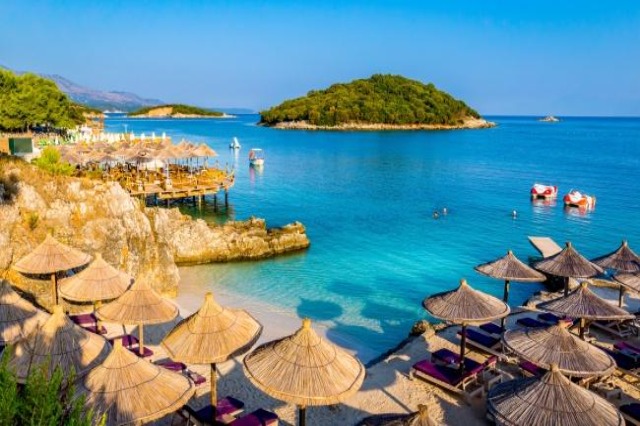
In the far south at Ksamil, by the Greek border, I swim in see-through waters among a clutch of small islands, Corfu looming large on the horizon. I hear about a local man here, Gjonny (Johnny) who fled to Corfu on a Lilo after Hoxha died in the mid-’80s.
Many Albanians emigrated in the early ’90s when Communism collapsed, or in the late ’90s when the country’s economy dissolved and a sort of civil war ensued.
Seemingly everyone has a survival story. I meet a chef who arrived in London on the underside of a truck and worked his way up to the kitchens of the famed Le Gavroche. A tattoo artist who honed his skills in a US prison – “things happened and I got locked up,” he explains – and now plies his trade from a nuclear fallout shelter, one of more than 170,000 bunkers peppered across this corner of the Balkan Peninsula.
My new friend Mona Stefa, also a journalist, and her architect husband, Piro, went to Greece in the early ’90s, then Canada in the late ’90s, before coming home in the early 2000s to build and open their seaside Hotel Picasso in Radhime.
“Our story is the story of Albania,” she smiles, before pausing to tell yet another passing guest that I am from Australia. “I’m so happy!” she cries.
If I had to sum up Albania in a word it would be “authentic”. It feels real in a way that much of Europe no longer does.
“I believe it’s still very genuine,” Çaushi agrees. “There’s still plenty of heart here in Albania.”
Despite the scary headlines, it’s a very friendly, easy country to explore – and it’s substantially cheaper than travelling in, say, Italy or Greece. The Albanians I met are simply good people who’ve had bad things happen to them. Somehow they’ve weathered their many misfortunes with warmth and humanity intact.
TAILORED TOURS
Elton Çaushi started Albanian Trip in 2007 with two friends – one of them now his wife, Wilma – to “try to do a development project for my country. To make it more known, to give it the place it has and that it deserves in the history of the Mediterranean and the European nations.” The company tailors itineraries to individual tastes – like the food and wine odyssey they put together for me – and offers tours focused on bird-watching, “beaches and bunkers”… even a Jewish history tour./Kendall Hill/
Të ngjashme







Most read










 RTI