
 English
 Français
 Deutsch
 Italiano
 Turkish
 Greek
 Serbian
Bloomberg: Now With Colorful Blocks, Tirana’s Pyramid Represents a Changing Albania




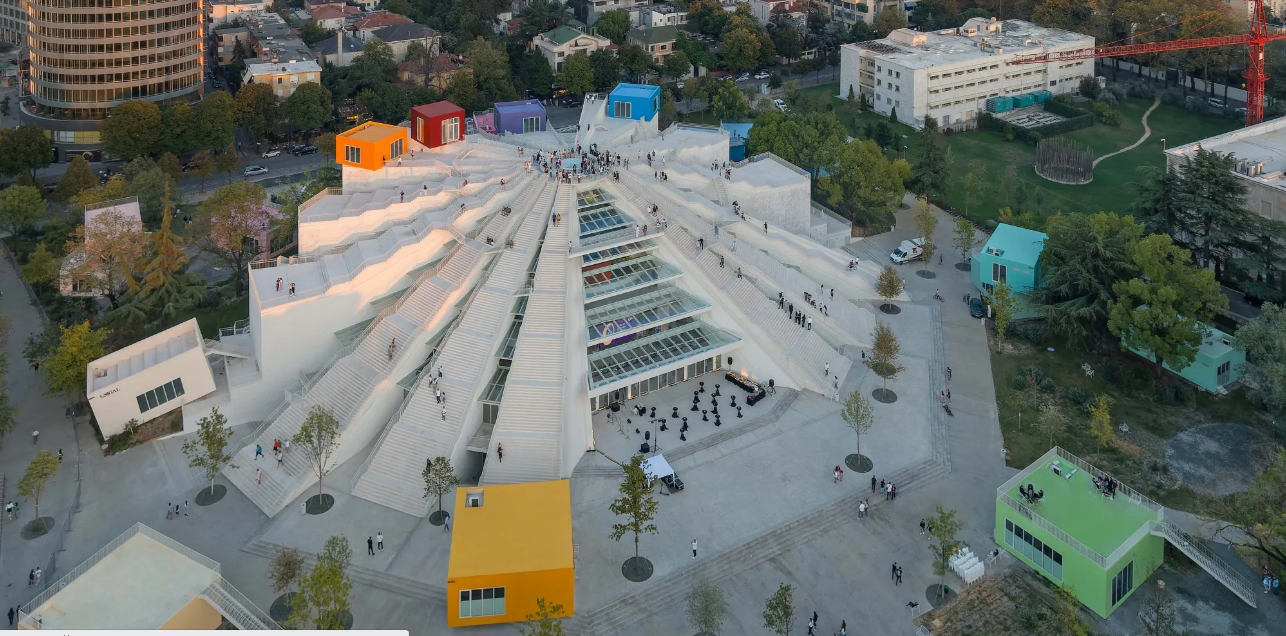
A monument to Albania’s former dictator, remade as a tourist-friendly community center, points to the western design influences reshaping the capital city.
The top of the Piramida, as residents of Tirana call it, is a great place to see the skyline of Albania’s capital. The soaring, communist-era ode to longtime dictator Enver Hoxha, who ruled the country for more than 40 years after World War II, offers clear views across downtown. From there, you can see the boxy silhouettes of the modernist apartment blocks built under his rule.
Today those apartment buildings are overshadowed by stylized high-rises — and the monument itself has a new sheen, too.
The pyramid of Tirana is now the centerpiece of a booming capital. After a high-profile makeover by the Netherlands-based MVRDV, the former monument now serves as a kind of hybrid cultural center and education nexus — a place for looking forward, not backward.
The refined new look is something of a microcosm for development in Albania’s capital, where western practices seem to dominate. While a building boom has brought jobs and ushered in revamps of streets, squares and suburbs, it has also raised concerns that the city is being defined from the outside.
Standing about 65 feet (roughly 20 meters) tall at its highest point and once covered in marble, the pyramid contained a towering statue of the dictator when it was dedicated in 1988. The building looks like it could stand in for George Orwell’s Ministry of Truth: an “enormous pyramidal structure of glittering white concrete.” And it served the same function, as a last gasp of authoritarianism for the violent and isolationist communist government, which had cut ties with Moscow, Belgrade and Beijing and clung to power even after Hoxha’s death, until 1992.
In the following years, the Piramida housed a radio station, a nightclub known as the Mummy and a NATO base during the war in neighboring Kosovo. It eventually fell into disrepair but remained part of city life. Tirana youths often climbed its sides and slid back down, a sort of informal reclamation that endeared the structure to locals. It stayed that way for nearly two decades.
Jump forward to 2000, when Edi Rama — an artist, was elected mayor of Tirana, and gained fame for his initiative to repaint the capital’s drab communist-era housing. He later kickstarted an urban master plan, which eventually became the Tirana 2030 project, led by Italian architect Stefano Boeri. The plan proposed a radical transformation of the city, which was already changing rapidly as private owners took over and began to remodel formerly state-owned buildings. Boeri’s approach mainly involved building up and greening but often with a preference for eye-catching designs. The moves positioned Rama as part of an energetic new guard — he famously ousted Socialist Party stalwart and leader Fatos Nano to become its head — but opposition politicians accused him of corruption and of turning his position into a personal platform. After serving as mayor for more than a decade, Rama was elected as Albania’s prime minister in 2013.
In 2018, with the support of the Albanian-American Development Foundation, the city of Tirana enlisted MVRDV, led by founding partner and principal architect Winy Maas, to redesign the pyramid. It was seen as so consequential, Prime Minister Rama opened the completed project.
“What can you do with this building?” says Maas, speaking about the options his practice faced when approaching the design. “Erase it. That is one thing. And certain people wanted that. The other option is repair it completely. Restore it back. And the third was basically to deal, and maybe celebrate, the overcoming, or the taking over by the population,” he adds. “Public accessibility was the key.”
Going with option three, MVRDV maintained the basics of the original form, but replaced the long-dilapidated façade with concrete and added 16 staircases with railings along the building’s sides. Maas and team didn’t revamp the entire structure. One section has been left as a sloping surface where visitors can slide back down, in a nod to its earlier popular use. The rear was once fully clad with marble slabs and as the monument fell into disrepair, many of these fell out; the practice decided not to plug several of the holes. The architects also left cracks that appeared on the pyramid and opted to paint over them rather than fill them in.
Most notably, Maas and team added 32 large, colorful, box-like structures. These new spaces originally housed studios and classrooms, but they’re increasingly used for cafes. They look like they’ve been placed randomly both inside and outside the building — a stylistic nod to the squatters that lived in the pyramid’s grounds during its tumbledown years. The studios that remain are expensive to rent, with price tags reaching several thousand euros.
All over town, the stripped classicism and bombastic monumentalism that defined Hoxha’s urban legacy is getting a new shine. Not far from the pyramid, a dome-topped former regime bunker that once included a bedroom for the communist party’s powerful interior minister has been transformed into a museum space, with recreations of offices used by the Sigurimi, the regime’s secret police. Off Mother Teresa Square, a glossy, nearly 330-foot-tall Marriott hotel, designed by Italy-based firm Archea Associati, towers over the stark archaeological museum — part of the practice’s complete redesign of the historic Qemal Stafa Stadium soccer grounds, now known as the Air Albania Stadium. A new College of Europe campus, designed by US based Oppenheim Architecture, is also in the cards.
Westerners are at the forefront of Tirana’s design boom, along with significant developments led by real estate investors from the United Arab Emirates, Qatar and Kuwait. The nuclear-bunker-turned-museum was the brainchild of Italian journalist Carlo Bollino, for example. MVRDV, too, is leading other projects throughout the city, including the Skanderbeg Building and Downtown One, the latest additions to Tirana’s skyline. At times, critics of the process allege, these new monuments have been created at the expense of the old. There were public protests, for example, when Albania’s existing National Theatre was demolished in 2020 to make space for a new theater designed by Danish practice BIG. Built in an Italian rationalist style in 1939 and considered one of Albania’s most important monuments from the interwar period, the theater’s demolition took place in the early morning, only after police cleared the building forcibly of artists, activists and protestors.
Among the new buildings, some concepts can feel zoomed out, even a little cartoonish: MVRDV’s Skanderbeg Building is supposed to look like the head of Gjergj Kastrioti, known as Skanderbeg, the 15th-century Albanian national hero who fought the Ottomans. Downtown One is adorned with a deconstructed geometric map of the country. MVRDV is famed for playful, often purposefully absurd designs characterized by bold gestures and theatrical flourishes. Its horseshoe-shaped Markthal in Rotterdam contains a Sistine Chapel–like mural with giant fruit, for example, while 16 foot expressions such as “AAHHH” and “OH” adorn the Pop Art–inspired WERK12 in Munich. The firm’s reputation for dropping whimsical projects everywhere it practices has not helped to deflect criticism that Tirana is being reshaped by designers with few ties to the country.
“The case of the pyramid, I think, says a lot about the lack of engagement of the public,” says Dorina Pllumbi, an architect and architectural critic from Albania who lives in Delft, the Netherlands. “And the lack of engagement of having a discussion, a proper discussion that would do justice to the history of the place and to the way it has been used by the locals.”
Indeed, the city of Tirana awarded MVRDV the pyramid project without an open competition. Pllumbi tells Bloomberg CityLab that she believes development projects in the capital are “packaging history” through buildings that are mainly for an “outside gaze.” In a 2021 article for The Architectural Review, Pllumbi wrote that the western-led redesigns are triggering gentrification in a society that “has not settled accounts with its past.” For his part, Maas responded to Pllumbi’s piece in a letter to the The Architectural Review, writing that as an architect from another country, he recognized his responsibility to be a listener “while celebrating the future.”
Certainly, Albania’s problems have changed dramatically over the last three decades: Communist party control was once so absolute citizens didn’t know the Berlin Wall had fallen. After the brutal one-party state ended, the country experienced the whiplash transition from a centralized, agrarian economy to a market-based one. The economy collapsed in 1997 when widespread losses in high-risk pyramid schemes devastated citizens’ savings. The slump brought the country to the brink of civil war with weapons depots looted and citizens taking up arms, prompting intervention by UN peacekeepers.
But as of 2022, the picture in Albania had changed. Foreign direct investment topped $1.44 billion, with capital flowing into real estate, energy, and infrastructure. Tourism, too, is on the up. Though the country is experiencing high emigration and a declining birth rate as its population ages, Tirana, with a metro population of more than 500,000, has doubled in size since the transition from communism. This year, Jared Kushner secured approval to develop a $1.4 billion luxury resort on the island of Sazan, about 65 miles from the capital. The project involves turning a former military base into a hotel with ferry access planned from the mainland. The green light came from a development committee chaired by Prime Minister Rama.
Some critics fear that Tirana’s rapid transformation masks deeper problems for Albanians.
“The architectural styles are window dressing,” says Dorina Pojani, an Albania-born associate professor of urban planning at the University of Queensland, who has written and researched extensively on the urban history of the city. “This hiring of fancy architects is also a way to displace the discussion from the real political and economic issues to design issues,” she says. “The real issue is about money. Who finances these megaprojects?”
Research by the Global Initiative Against Transnational Organized Crime says money laundering is an issue for the construction industry in Albania, Kosovo and North Macedonia. It found that approximately €1.6 billion had flowed through Albania’s property market from 2017–2020 as “dirty money,” with nearly 60% of project investments traced back to illicit origins. Ahead of parliamentary elections in May, Elion Veliaj, the current mayor of Tirana, was arrested on the back of allegations he funneled money to associates and spent hundreds of thousands of euros on luxury goods.
MVRDV told Bloomberg CityLab that the firm knows about crime concerns in Albania’s construction industry. “We also note the country’s ambition to join the EU in the near future,” the firm said in an emailed statement, “a process that requires the development of robust policy and enforcement measures on corruption, transparency, planning, and public procurement.” A representative added, “In the meantime, we continue to carry out background checks on new clients and partners, as required by Dutch law.”
As Albania readies for potential EU membership, the pyramid is surely among the most civically driven of the shiny projects reshaping its capital. It may even make a case for a new urban architecture that is neither overly nostalgic nor detached from the past in a country traditionally at the margins of Europe.
Modern Tirana is being likened to a Rotterdam of the Balkans, where striking designs from international architects weave into the urban landscape, and these rapid changes underscore a tug of war between local identity and outside influence. The revamped pyramid is emblematic of this tension: It is a Western-led project anchored to a public accessibility theme but symbolically tied to a regime that was explicitly oppressive. For critics like Pllumbi, bridging that gap is questionable without input from the public.
“It’s beyond the building. It’s beyond the design,” Pllumbi says, “It’s about how we are seen and how we are treated.”
-https://www.bloomberg.com/news/features/2025-05-29/tirana-pyramid-redesign-shows-western-influence-in-albania-architecture-
Të ngjashme




Latest News










Most read










 RTI