
 English
 Français
 Deutsch
 Italiano
 Turkish
 Greek
 Serbian
Bridges built by Ali Pasha Tepelena




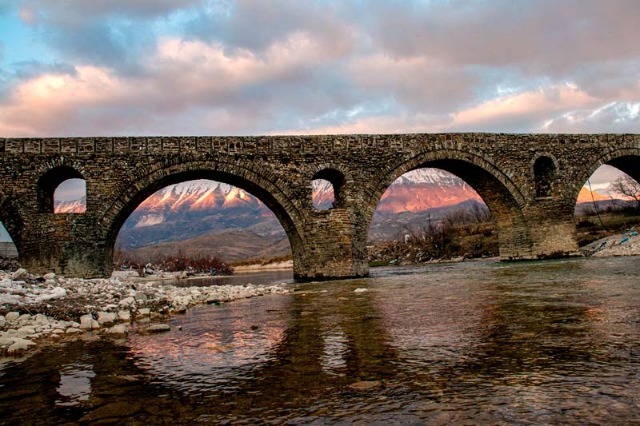
Vokopola Bridge is an Ottoman cultural heritage monument in Vokopolë, Berat County. It is located on the stream of Çorrogjaf, near the source of “Black Water”. It is thought to have been built during the time of Ali Pasha Tepelena and served as an important point in the connection of the Osum valley with the Vjosa valley. The branch which connected Berat with Tepelena and then Joanina passed through these villages: Vokopolë-Çorgjaf-Qafa e Gllavë-Luftinjë-Memaliaj. The Vokopolë bridge is a stone bridge with a large vault, with a circular segment and two discharge windows. The bridge is 43 m wide, has three arches and two niches. The cobblestone of the Vokopola bridge is made of black stone slabs, placed in a row, while the vault is built with two rows of stones. The Vokopola bridge is one of the largest, most monumental and best-preserved bridges of this region.
There is another 19th century bridge, built by Ali Pasha Tepelena. It has become one of the most visited bridges in the country in recent times. This is because next to this beautiful historical bridge are the healing Baths of Bênja, one of the most popular destinations. You can find the bridge and the baths 8 km from Përmet. Although not as long as a bridge, its great arch spans the river beautifully. The entire surrounding area is known for prehistoric finds from the Neolithic (7000-3000 BC) and Eneolithic (3000-2000 BC) periods.
The so-called Ali Pasha Bridge, or Dunavat Bridge, was part of a larger aqueduct complex commissioned in the beginning of the 19th century by Ali Pasha of Tepelenë. The aqueducts fed the castle’s cisterns with water from the Mount Sopot, 10 km away. Gjirokastra didn’t have water service at the time, and Ali Pasha quickly discerned the need for this structure. The bridge is an easy 30min hike from Gjirokastra and makes for a nice off-the-beaten-path destination. The aqueduct was mostly demolished in 1932, but this section in the Dunavat Quarter still remains. An early depiction of this famous “bridge” is found in the painting of Edward Lear, the British poet and painter, who traveled to Albania in the mid-19th century.
Another bridge of Ali Pasha that is worth mentioning is that of Beçishti, located below the Tepelena Castle on the Vjosa River. With fragments from the Roman period, the Middle Ages and the 17th century, the 260-meter-long bridge is truly fascinating. It connects Tepelena with seven villages, one of which is Beçishti, the birthplace of Ali Pasha Tepelena.
Bridges of Zagoria – Gift of Ali Pasha Tepelena
In exchange for his shelter and protection from the Turkish soldiers, Ali Pasha Tepelena, according to popular legend, donated the famous bridges of Nivan and Hoshteva to Zagoria. The structures that, beyond mouth-watering, carry all the architectural graces of the period are centuries-old witnesses of the journeys of merchant caravans. They gave birth at the beginning of the century XIX communication not only commercial but also spiritual between Gjirokastra and Përmeti. The caravans coming from Gjirokastra passed over the Hoshteva Bridge, in Hoshteve, in Gjurmeshke, in Buhaj, in Lipe and ended in Përmet, while the second most important route that passed over the Nivan Bridge then stopped at the Nivan Monastery, built in 1777. It continued to Nivan, Sheper to Qafa e Dëmbeli and then to Përmet. Built with a double stone vault about 1.1 m wide and a light space of about 15 m, Hoshteva Bridge offers one of the most amazing landscapes over the river Zagoria. The Nivan bridge represents a more complex structure with 2 stone arches and a span of about 20 m. Both bridges are covered with cobblestones, respectively 28m and 40m long.
Kordhoca Bridge, “Cultural Monument of Category I”, is an important junction of the old road that connected the two sides of the Drino valley. Built about 200 years ago by Ali Pasha Tepelena, in 1820, this bridge was part of the road that connected the main cities of the vilayet of Ioannina at that time; Janina, Libohova, Gjirokastra and further, Tepelena.
The bridge is built over the Drino river, about 4 km south-east of the city of Gjirokastra, at the end of the village of Lazarat. It is built with black stones from the area, while its filling is made with limestone. The construction of this work has interwoven the style of local architecture with the Ottoman oriental style.
Kordhoca Bridge is 20 meters long and 7 meters high at its peak. There are five arches, beautifully decorated with black stonework, which together with the full cobblestone paving along the entire length, give it great historical and architectural value.
The last restoration in 2018 revealed some of the secrets of its construction techniques.
During the process of strengthening one of the legs of the bridge, it was discovered that under it there were a considerable number of wooden beams, deeply embedded in the river bed, on which the leg of the bridge itself was placed and stood. The wooden beams, although over 200 years old, were in very good condition, undamaged by moisture throughout the years and centuries.
/k.s/
Të ngjashme



Latest News









Most read










 RTI