
 English
 Français
 Deutsch
 Italiano
 Turkish
 Greek
 Serbian
British ‘The Times’: The last undiscovered corner of the Med — for less




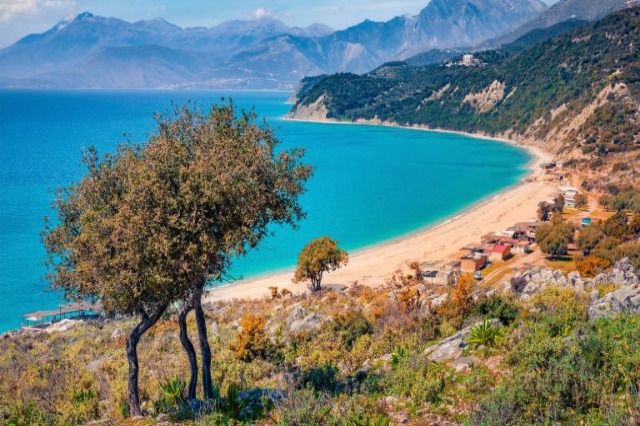
Don’t call Albania the ‘new Greece’ or the ‘cheap Maldives’. Its coastline is full of surprises — and shepherds’ trails with fabulous vistas are right at heart of it.
We waded through the same thick pine and fir forests as Julius Caesar did in 48BC, half-nervous, half-excited at the thought of bumping into the European wildcats, wolves and wild boar that live among the trees of Albania’s Llogara National Park. Suddenly we — my partner, and I — emerged at a viewpoint and admired the surrounding mountains, creased by pine-clad valleys, and the turquoise waters of the Ionian Sea stretching towards the heel of Italy. We were midway through one of our hikes, organised by the tour operator Walks Worldwide, and this view justified all our reasons for booking.
Albania’s Ionian coast has burst into view for international travellers in recent years thanks to picture-perfect villages such as Ksamil that have pristine white beaches so Instagrammable they go by the moniker “the Maldives of Europe”. However, I knew there was much more to Albania’s coast than just sun and sand, including unspoilt nature and fascinating historical legacies of 50 years behind the iron curtain. As my partner and I can get a little itchy sitting on a beach all day, the idea of a sunny destination that had something deeper to explore really appealed.
The final selling point was price. According to Walks Worldwide, overall costs for a holiday in Albania are about two thirds the price of something comparable in Greece. In restaurants, you can pay about half what you would in Corfu — which is just 30 minutes by ferry from Albania. Instead, we flew to Tirana, Albania’s capital, and enjoyed the three or so hours’ drive down to the coast, the scenery flitting curiously between grey Soviet-esque towns and sprawling sea views.
We were on a self-guided walking tour that focused on the country’s so-called Riviera. Given that Albania is still a bit of an unknown and it was hard to find information about hiking routes online, we’d chosen this package because it offered the best mix between getting stuck into nature (with walks every day ranging from three to seven miles) and a bit of comfort and hand-holding.
You’re given a GPS device pre-loaded with the trails, so it’s extremely difficult to get lost. This was a relief as, although the routes had red-and-white markings, there were often none at the moments you needed them most. Plus there’s no roughing it or lugging your stuff around. The seven-night route hops between hotels, with a taxi driver arriving each morning to pick you up and drop you off at the start of that day’s walk, then returning to collect you at the end, transporting your luggage to the next hotel if necessary.
The route was also a nice combination of trekking in ancient pine forests and walks along the beaches around Himare, a popular seaside town. Our accommodation in Himare, the Guest House Solive, was hidden up a dirt track. It was simple but clean with a charming little garden where the owner, Tony, grows fat, juicy lemons and cherubic peaches and cooks delicious omelettes for breakfast.
For our first walk we went to the cobblestone village of Kudhes to follow the old shepherds’ trails. These led us through olive groves and sage meadows where the scent of camomile and herbs made is feel as though we were inhaling infusions of herbal tea. The only living creatures that crossed our path were bleating nanny goats and their kids.
Eventually the route descended into Qeparo, another crumbling village with a handful of ivory-stone farmhouses and one or two sleepy tavernas. We sat under the shade of an oak at one of them, Te Rrapi ne Qeparo, admiring the view down over the Ionian Sea as we tucked into byrek (a traditional filo pastry) bursting with wild herbs.
By following the goatherds’ trails (and the goats) we escaped the built-up areas. The walk from the village of Lukove to Borsh was one of my favourites, taking in waterfalls and dilapidated churches and plonking us unexpectedly in gorgeous stretches such as Bunec, where, in low season, the only other signs of human life were the tents of some wild campers.
We also headed into Llogara National Park, a series of mountains and alpine meadows overlooking the Riviera. These dense woodlands once provided shelter for Julius Caesar and his army as he fought his great rival Pompey. Such a rugged landscape so close to the beaches felt very different from what I’d experienced in other parts of the Mediterranean. It’s a landscape that also captivated romantics such as Lord Byron, who raved about Albania in his epic poem Childe Harold’s Pilgrimage.
This felt like the wild side of Albania, supporting my initial inkling that the country was much more than the cheap beach break that Instagram posts suggest. Even so, I felt the country had more to give. Not least in terms of its history — one of the most chequered and topsy-turvy in Europe. We met up with Elton Caushi of Albanian Trip, who was one of the first to promote travel to the country when it was released from the iron grip of the communist dictator Enver Hoxha and his successor in the early 1990s (day tours from £125pp, including lunch and driver; albaniantrip.com).
“Under Hoxha, Albania was one of the most isolated countries in the world. We were even cut off from the Soviet Union,” Caushi told us. Hoxha’s suspicion of the outside world is the reason that, today, Albania’s landscape is littered with concrete military bunkers (there are estimated to be more than 700,000 — about one for every four Albanians).
We stopped at a couple, ducking inside to imagine children as young as 12 being trained to man them in case of invading forces. “There’s a real risk people will come to the beaches and leave without knowing anything about our history,” Caushi said.
Apart from its exploding tourism industry, Albania’s food scene is going from strength to strength, with a budding farm-to-table movement. We drove inland for about three hours to visit Pupa, a family-run winery where they grow indigenous Albanian grapes such as puls (found only in this region) and dozens of different vegetables for their restaurant. The crisp white and zingy rosé paired perfectly with vegetable-based dishes that burst with flavour, such as sweet peppers stuffed with creamy cheese. The winery also has elegant bedrooms (dishes from £2.50; B&B doubles from £63; pupawinery.com). On the coast, the food was of a similarly high quality, though slightly more expensive. For under £15 each we tucked into platters of meaty grilled octopus and plump, shell-on prawns at Taverna Velco in Himare (velco-bb.al).
We were looking to get even further from the beaten track, and Caushi took us on a jolting detour up what could barely be described as a road to the village of Tragjas, where we visited the home of Sofo Daupaj, a goatherd, and his wife, Dhurata.
There was once a sizeable community up in these remote hills, but as a stronghold for resistance forces fighting the Nazis during the Second World War, it was bombed and abandoned. The survivors and their descendants now live in concrete homes at the foot of the mountain — except for Daupaj. He and his wife remain with their herd of about 400 goats, 40 cows and nine dogs.
They built a barn, from which Dhurata now serves delicious homemade lunches and dinners for those who call in advance — “We’re not a restaurant. There is no menu,” she said. Last year they added three stane (stone shepherd’s huts), with straw roofs and enough space for a double bed. While there’s no wi-fi, the huts have plugs to charge a phone and there are hot showers in the toilet block (available via tours with Albanian Trip).
In the evening, as the reddening sun set endless meadows of sage bushes and their yellow flowers aflame, we followed Daupaj to his goat herd. He commanded them with a strange barking language (“It’s not even really Albanian,” said Caushi) as he milked the plumper nannies. Fireflies began to flicker and we heard a faint and reassuringly distant yowl of jackals. I considered trying to take a photo but dropped the idea. The sounds, the smells, the taste of warm goat’s milk … this was a side of Albania no Instagram post could capture.
https://www.thetimes.com/travel/destinations/europe-travel/albania/the-last-undiscovered-corner-of-the-med-for-less-3dxnddjs2
Të ngjashme
Latest News










Most read










 RTI