
 English
 Français
 Deutsch
 Italiano
 Turkish
 Greek
 Serbian
Business Traveler: Adventures in Albania




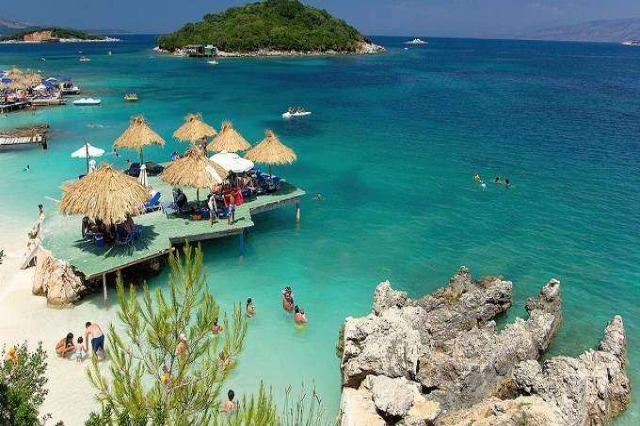
You might have noticed headlines cropping up over the past 12 months, hailing “the Maldives of Europe”. Or, if you’re on social media, influencers going crazy for a scenic stretch of beach in a tiny seaside town called Ksamil. This coveted new hotspot can be found in the somewhat unlikely destination of… Albania.
Unlikely, because up until 1990, this staggeringly beautiful Balkan country, bordered by Montenegro, Kosovo, Macedonia and Greece was, to all intents and purposes, closed off to the rest of the world. Ruled for 40 years by dictator Enver Hoxha, it laboured under a Stalinist regime which foisted extreme poverty on its people; by the time of his death in 1985, the country was the poorest in Europe, and the third poorest globally, with a GDP per capita of US$640 and an average monthly income of around 5,000 lek (£41).
What a difference a few decades makes. Since emerging from the heavy mantle of communism, Albania has started to flourish under its new, free-market economy, and the leisure and business sectors are sitting up and taking notice.
Reasons to visit are manifold: firstly, the sparkling Adriatic and Ionian coastline, known as the Albanian Riviera, which stretches down from the bustling city of Vlorë, through smaller, prettier towns such as Dhërmi (popular with dance music fans thanks to annual beachside festivals such as Kala and Ion), Himarë, Sarandë and, of course, Ksamil. It also offers mountainous landscapes, a plethora of hiking trails, fascinating UNESCO heritage sites, a delicious culinary scene and – currently, as it’s still waiting to have its request to join the European Union fully approved – fantastic value for money. A pint of beer or glass of wine will set you back around £2, a cocktail around £6, with a restaurant meal nearing £12. What’s not to love?
Rich offerings
Over the past few years, tourism has shot up stratospherically; recent figures from the European Travel Commission show it’s grown 86 per cent since 2019. Its GDP per capita has also been increasing, and last year stood at US$8,800, while the average monthly salary is now around 84,000 lek (£704). Foreign direct investment is also on the rise, with countries including Switzerland, Italy, and the Netherlands targeting sectors such as energy, mining, information and real estate to a value of around US$1.5 billion in 2022, according to UNCTAD’s World Investment Report. Not bad for a country which used to depend on foreign food aid.
Today, Albania’s main economic hub – and its most industrialised and fastest growing area – is its handsome, cosmopolitan capital, Tirana. As a result, it has plenty of hotels, conference and event spaces that service the MICE industry – from the Tirana International Hotel & Conference Centre on central Skanderbeg Square, to the Palace of Congresses, a 60s-era, Soviet Modernist-style building a short drive away. The full gamut of international hotel brands can also be found here, including Radisson, Hilton, Marriott, Meliá and the recently opened Mercure, with more in the works.
Due to open in 2025 is a brand new InterContinental, currently being constructed on one corner of Skanderbeg Square. It will house around 300 rooms and suites, a luxury spa, casino, several dining outlets including a rooftop restaurant and bar, and a large conference centre with capacity for up to 1,000 people.
Expo Albania, a convention centre with hotel rooms and a wine museum, has also been newly commissioned this year. Designed by US firm Stephen Holl Architects, in conjunction with Polish artist Agnieszka Kurant, renderings show striking wavy architecture, with plans for high ecological standards ranging from recycled rainwater pools to solar shingles (photovoltaic roof tiles).
A third international airport is also underway at Vlorë, on the southwest coast, joining the main hub in Tirana and Kukës International Airport in the north. The new airport is scheduled for completion in 2025, and is projected to cost around US$116 million. Vlorës seafront is also being transformed with the Vlorë Marina, a mixed-use development project that will include a new five-star hotel and stylish, sea-view apartments, with moorings for over 400 yachts and super-yachts.

Immerse in culture
All this being said, Albania is still some way off from being a high-end, luxury destination; its lack of high-quality infrastructure positions it roughly where the likes of Croatia and Montenegro were 15 to 20 years ago. But that’s also part of its undeniable, unhurried charm. Even the most discerning traveller will find much to get excited about, especially in Tirana, which, with a population of around 528,000, is walkable and relatively easy to navigate.
Skanderbeg Square is a great starting point, lined with imposing buildings boasting magnificent historic architecture, from the strikingly brutalist Opera and Ballet Theatre (also known as the Palace of Culture) to the National History Museum, whose facade is emblazoned with an intricate, Socialist Realism-style mosaic depicting important milestones in the country’s history. Nearby is the 18th century Et’hem Bey mosque – approximately 59 per cent of Albania’s population is Muslim – with an elegant, hand-painted interior.
For a taste of Hoxha’s brutal and terrifying regime, visit Bunk’Art 1 and 2. The museums/art galleries are recreations of the estimated 750,000 underground bunkers Hoxha had built throughout the country between 1960-1980, paranoid about nuclear attacks. From the domed entrance, descend several sets of steps into its gloomy concrete depths to learn more about life under communist rule, from the secret police force to how the regime finally ended.
A short stroll down the elegant main thoroughfare, Bulevardi Dëshmorët e Kombit, reveals more modern structures. One is The Cloud, an art installation by Japanese artist Sou Fujimoto, which relocated from London’s Hyde Park in 2016. The second is the Pyramid of Tirana, an extraordinary, spaceship-like construction, formerly a museum dedicated to Hoxha’s legacy, and now the TUMO Center for Creative Technologies, aimed at helping young people get skills in industries such as gaming, programming, 3D modelling, robotics and more. You can even climb its exterior, which offers views onto leafy Rinia Park.

Buzz and beaches
Just ten minutes’ walk away is one of the city’s most exciting neighbourhoods, Blloku. This was where Hoxha, and senior members of his regime, had their homes, and it used to be bleak, grey and uninspiring. Today it’s a hip and lively set of streets reminiscent of London’s Soho or New York’s East Village, crammed with boutiques, cool bars and a mix of restaurants ranging from straight-down-the-line to the more sophisticated.
Start your evening with a £7 Negroni at the Colonial Cocktail Academy, then chow down on tasty local dishes at Piceri Era such as petulla te fshira, a stack of layered thin pancakes cooked with garlic, feta and butter, patëllxhan i mbushur, aubergines stuffed with tomato and peppers, or ragu me jufka, beef stew with noodles. Albanian cuisine, a blend of Turkish, Italian and Greek, tends towards the hearty side. For a lighter alternative, head to Salt, a stylish Asian-inspired enclave with everything from ceviche to sushi.
Green space in abundance can be found at Tirana’s Grand Park, which boasts over 289 hectares of land, a sizeable artificial lake, a zoo and a botanical garden. Another great way to get away from the urban landscape is to take the cable car up to the top of nearby Mount Dajti, which offers spectacular views over forests and lakes from around 1,110 metres above sea level. Alternatively, you can head beyond the city limits to experience the country’s many beauty spots.

Berat
This UNESCO-listed heritage town is located 90 minutes’ drive south of Tirana. Its main draw is the rows and rows of wide, flat-roofed, multi-windowed Ottoman-era houses, layered along the hills through which the Osumi river flows. Take a free walking tour with knowledgeable guide Bruno (@freetourberat), which encompasses the 13th century castle, frescoed Byzantine churches and the elegant Gorica Bridge.
Vlorë
A big, bustling seaside town, Vlorë’s winding seafront is lined with lively bars and restaurants. It’s also home to a serene old town, where cobbled streets house colourful buildings, and you’ll find quiet squares with cafes.
Gjirokastër
To the south of the country, Gjirokastër is located in a valley between the Gjerë mountains and the Drino river, at 300 metres above sea level. It’s also a UNESCO heritage site, thanks to its imposing castle, which looms above the old town at 336 metres. Built in the 12th century, and expanded under Ottoman rule in the 1800s, explore its five towers, prison, clock tower and cistern.
Sarandë
A short drive from Sarandë, another popular seaside town, is a remarkable natural pool. In the centre, a dark, underwater cave resembles a pupil, surrounded by crystal clear aquamarine water – hence its name, Syri I Kalter, ‘the blue eye’.
Ksamil
So what’s all the TikTok fuss about? There are dozens of beaches around this little seaside town, with some gaining comparisons to the Maldives. These include Ksamil Beach, Bora Bora Beach, Ksamil Beach 7 and Mirror Beach, thanks to their golden sands and turquoise water. Plan your visit out of season; September is still warm and sunny.
Të ngjashme



Latest News










Most read










 RTI