
 English
 Français
 Deutsch
 Italiano
 Turkish
 Greek
 Serbian
Çela: Cybercrimes Demand Efficient Responses. Dumani: More Coordination Needed Among Law Enforcement Agencies




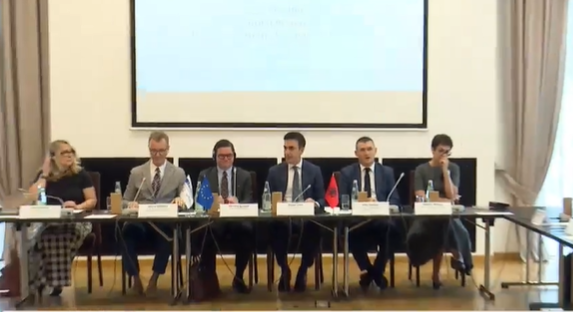
On Tuesday, June 17, the Western Balkans Consultative Forum brought together justice officials from the region and international partners. They discussed ways to strengthen cooperation against organized crime and tackle new security challenges.
General Prosecutor Olsian Çela stressed the vital role of regional cooperation in fighting cross-border crime.
He said, “We must set realistic goals and make serious commitments to continue this work. Thanks to this project, we have seen clear improvements in regional collaboration”.
Çela highlighted key steps taken against organized crime.
For instance, he noted, “The creation of contact points for the Western Balkans and continued support from EUROJUST liaison prosecutors have built reliable channels for sharing information”.
However, he also warned about new challenges posed by advancing technology. He pointed out that institutions often struggle to keep pace.
“Cybercrime, the use of technology, and crypto-currencies in illegal activities require fast and effective responses. Our systems still adapt slowly due to high costs and the need for specialized training,” Çela explained.
He concluded by emphasizing the need to build stronger national capacities and increase flexibility in regional cooperation.
He added, “We must keep strengthening institutional abilities and improve coordination among law enforcement agencies at the national level”.
Meanwhile, Altin Dumani, head of SPAK, stressed that success in fighting organized crime depends on close regional cooperation.
“To break down criminal networks, we need to act decisively and together as a region. This means more joint investigations, faster information sharing, and greater trust among prosecutors,” Dumani said.
He also praised EUROJUST for breaking down barriers to international cooperation and highlighted the concrete results for SPAK.
Dumani stated, “Eurojust acts as a strategic hub, helping us overcome key obstacles in international cooperation. This partnership has delivered real results for SPAK and allowed us to manage complex cases”.
According to EUROJUST’s 2024 report, SPAK leads among non-EU countries in opening new cases. Currently, SPAK runs 23 joint investigation teams working not only with EU nations but also with countries from the region and Latin America.
/a.p./
Të ngjashme
Latest News


Most read










 RTI