
 English
 Français
 Deutsch
 Italiano
 Turkish
 Greek
 Serbian
Christian symbolism in the basilica of the ancient city of Antigonea




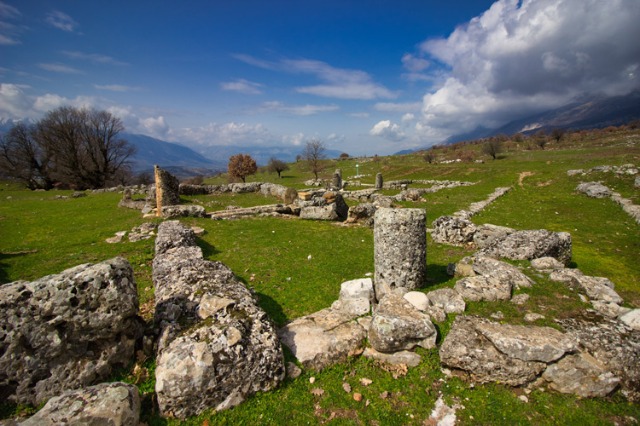
The Archaeological Park of Antigonea, covering around 92 hectares, along with the parks of Shkodra Castle, Lezha, Apollonia, Byllis, Amantia, Orikum, Finiq, and Butrint, forms the Albanian system of archaeological parks.
Antigonea was founded by Pyrrhus, the king of the Molossians, in 295 BC according to his wife’s name. Antigonea, the second city of the Epirote province of Kaonia, after Finiq, both in size and importance, controlled the famous Via Egnatia connecting Dyrrachium (Durres) with Apollonia and Orikum with the mountains of Janina and southern Epirus.
The city was surrounded by solid walls about 4,000 meters long, protecting it from all sides, especially in the southern and western parts where the risk was greater due to the terrain.
According to a post by Regional Directory of Cultural heritage of Gjirokastër on social media, on the southern edge of the ancient city of Antigonea, the ruins of a Basilica-type cult object dating back to the 5th-6th century are found.
The motif applied in the central part of the mosaic, forming an anthropomorphic figure, has the shape of a woman and according to researchers’ interpretation, favors “Saint Christopher” the Christ-bearer.
Beside it, there is a figure of a snake symbolizing paganism in conflict with Christianity. The mosaic is adorned with several inscriptions, thought to be the names of the individuals who realized and paid for it.
In Antigonea, all historical periods of humanity can be found, from prehistoric times to modern times. While the caves of Spilea and Ladovishta indicate that the area has been inhabited since ancient times, the grandeur of antiquity is represented by Antigonea itself, late antiquity and the Byzantine period are represented by three paleo-Christian basilicas within the ancient city and some churches in neighboring villages. The hermit monastery of Spilea, the Church of St. Koll in Saraqinishta, the Paleochristian Mosaic in Antigonea, are clear evidence of the embrace and spread of Christianity in this area and throughout the Drino Valley. Meanwhile, the Ottoman period has left its traces in the houses with architecture from the 17th and 18th centuries.
/k.s/
Të ngjashme




Latest News










Most read










 RTI