
 English
 Français
 Deutsch
 Italiano
 Turkish
 Greek
 Serbian
Cifteli, Albanian traditional musical instrument




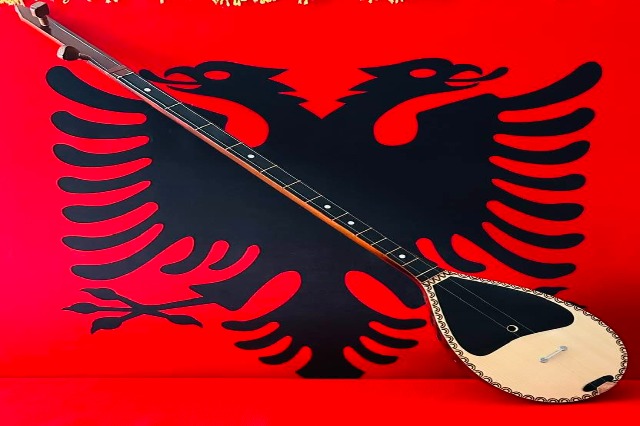
The çifteli is an Albanian traditional musical instrument with two strings, often used in Albanian folk music. It consists of three parts: the bowl, the neck, and the head, with sizes and shapes varying by region. The main type of çifteli has two strings.
Making a handcrafted çifteli, requires first selecting suitable wood, typically walnut wood or mulberry wood; yet, other types of wood can also be used. The tree should be cut in winter when the leaves have fallen and should be over 40 years old.
The cutting process should be done when the old moon occurs, while the wood is grown in sunny areas. After splitting and cutting the wood, the process continues with its shaping by scraping it out to form the cup-shaped part or head. During this phase, the wood should still have some moisture content. Initially, the scraping out and carving of wood is not applied in full. It must be seasoned for 3 to 4 months before the scraping out and carving process is complete. The next phase is the drying up process which lasts for about 8 months.

The instrument varies in length from 60 cm (from the horse to the last fret) to 63 and 66 cm, as preferred by the instrumentalist.
The neck of the çifteli is made of seasoned white beech wood. It features a triangular shape with curved edges. The part where it joins the head is wider than at the end where the string pegs are fixed. The frets which are 13 in total, are also installed on the neck/stringboard and are usually made of bronze material. The frets are not equally spaced, but they are installed according to a master pattern, depending on the length of the instrument.
Pegs or keys: produced of palm wood, are wide-headed and conical-shaped. The hole in the neck section where the peg will be fixed is also made in a conical shape.
Two string holders are also produced, one at the lower end of the instrument head (tailpiece) and the other behind the last fret (nut), made of bronze or stainless steel.
The embellishment is performed by painting and pyrography. The substance used for dyeing and painting is called gomallak, which dissolves in alcohol at 960 C. Next, a preferred color is added to this liquid substance and the desired figure is drawn.
The play focuses on the first string, while the second string is used as a rhythmic and harmonic support in the form of drones. There are also cases where the second string of the çifteli is used for difficult melodic transitions, mainly by virtuoso instrumentalists.
In the çifteli repertoire, lyrical songs are included, accompanied by dances.The cifteli repertoire includes lyrical songs, accompanied by dances. The çifteli is frequently used by Albanians in weddings and at concerts.
The çifteli combines beautifully with other popular instruments of different genres such as the lute, bagpipe, clarinet, flute, etc., being part of instrumental formations together with them. The çifteli has traditionally been used mainly in Kosovo, the northern regions, Northeast, but extends to the regions of Central Albania and partly to some regions of Southeast Albania.

/k.s/
Të ngjashme




Latest News










Most read










 RTI