
 English
 Français
 Deutsch
 Italiano
 Turkish
 Greek
 Serbian
CNN:This country’s Cold War paranoia left it riddled with bunkers. Now they’re coming back to life




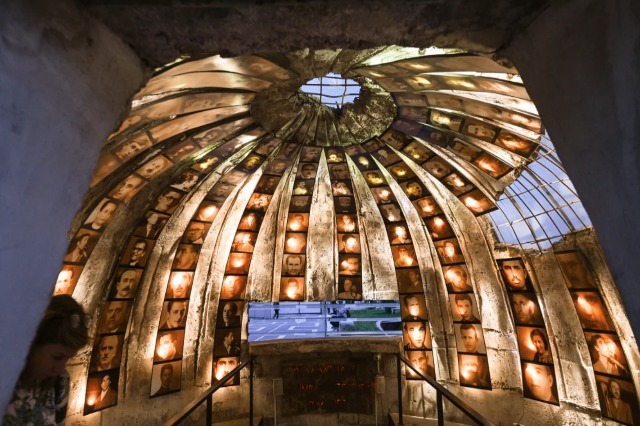
The current state of Hoxha’s residence sums up how many Albanians feel about the communist years. Having suffered a collective trauma of cruelty, many would rather forget he ever existed.
During the height of communist rule, the infamously paranoid and isolationist Hoxha closed off Albania’s borders, shot those who tried to leave, and built enough bunkers to house every family in the country. His regime’s mistrust of communist allies, use of state surveillance, and Stalinist-style brutality earned Albania the unflattering (but not inaccurate) nickname, the “North Korea of Europe.”
After Hoxha’s 44-year reign of terror ended in 1985 – and communist rule ended in the 1990s — Albania inherited as many as 221,143 bunkers and military objects, which for decades have served as solemn reminders of darker days — until recently.
Today, Albania is experiencing a tourism renaissance, supported by entrepreneurs and returning émigrés who are giving a second life to communist military structures once used to house weapons of war.
To reclaim their history and take back traditions once stolen from them, Albanians are now reusing bunkers and former military barracks as restaurants serving traditional food and wine, curiously unique settings for guesthouses, art and history museums, and even tattoo studios.
Drive 16 minutes up the mountainous hillsides outside of Tirana, past patchy farmland with grazing sheep, down a few zigzagging narrow streets, and you’ll be greeted by a mannequin dressed in military fatigues and a gas mask. Welcome to Kazerma e Cerenit, a former military barracks and compound turned into one of the city’s newest restaurants and agrotourism destinations.
This is the brainchild of Ismet Shehu, a UK-trained Albanian chef who once served lunch to the late Queen Elizabeth II, now returned home to build a growing empire of restaurants, his latest project being Kazerma (meaning “military barracks” in Albanian), which opened just a year and half ago.
He shows the way through the dining hall’s imposing doorway, the preserved main entrance to the original barracks, and proclaims, “Old is gold,” while making a sweeping gesture of his surroundings — the ivory-washed brick walls, original concrete columns with the dates ‘82 and ‘76 etched into them, and green grenade crates that now hold wine glasses.
What is currently a two-floor dining hall was once a spartan, cavernous garage for military trucks. It’s almost unrecognizable from its former incarnation, apart from the original iron rails supporting the wooden roof and punched-out holes in the brickwork that have been left untouched.
“Kazerma is about farm to table,” Shehu explains. “It’s about helping Albanians and our neighbors. When people come here, they say, ‘Wow!’, this place used to be for soldiers, it used to be for tanks, TNT and grenades. Now it’s a place of peace, people serving with a smile; you have good food and very nice desserts. And that’s a big change, right?”
Shehu walks on into a hallway where he has framed photographs of what the abandoned compound looked like before he was able to acquire the 100-year lease from the government to reform it.
One of the framed mementos is an old list of soldier’s rations on a piece of paper, browned and wrinkled by age, which reads: “120 grams meat, 200 grams bread, 100 grams pasta…”
In the spirit of the soldiers once stationed here, Shehu has maintained a military mess hall decorum, serving guests traditional Albanian dhallë (buttermilk) in aluminum canteen cups, and using trays and pans from military field kits to serve dishes of duck, pasta and flija, a traditional Albanian dish consisting of countless layers of crepes, typically made slowly over a wooden fire.
Waiters dress in military clothing, sometimes with a red communist party neckerchief.
“My staff is dressed as soldiers,” says Shehu, “And they do the service with a smile — and sometimes fake guns.” To end the meal, guests are presented with their check in a fake grenade pouch.
https://edition.cnn.com/travel/albania-communism-bunkers-cold-war/index.html
Të ngjashme




Latest News










Most read










 RTI