
 English
 Français
 Deutsch
 Italiano
 Turkish
 Greek
 Serbian
Constitutional Court Annual Report: Zaçaj Highlights 408 Decisions on 2024




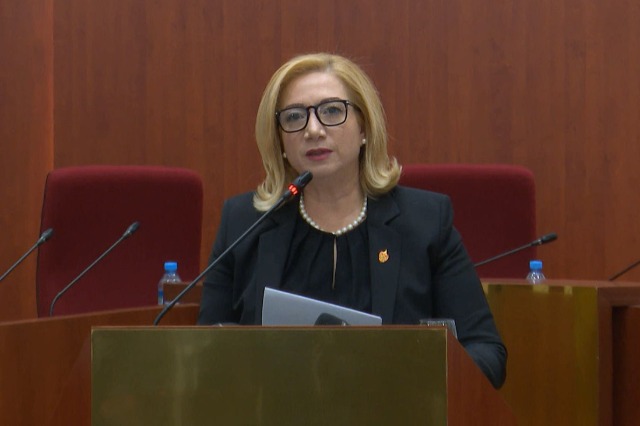
Holta Zaçaj, President of the Constitutional Court, presented the institution’s annual report for 2024 today, noting a substantial increase in both the number of requests and decisions over the past two years.
In a press conference, Zaçaj announced that the Court issued 408 decisions in 2024, a sharp rise from 201 in 2021.
She explained that the Constitutional Court has “shifted its approach in several areas, aiming not only to ensure citizens’ access through individual constitutional complaints, which rose by 16% compared to last year, but also to expand the scope of constitutional protection”.
Despite a heavy caseload, Zaçaj emphasized the Court’s commitment to adhering to procedural deadlines while maintaining decision quality.
A total of 520 requests were considered in 2024 (427 new requests and 93 carried over from 2023). Of these, 408 were examined and supported by reasoned decisions. The current number of pending requests within procedural deadlines stands at 104, with 28 in plenary sessions and 77 in the preliminary review stage.
Zaçaj revealed that the Court accepted or partially accepted 55 requests and rejected 31. Of the decisions made, 42 were unanimous, 42 were by majority vote, and only two decisions were rejected due to a lack of majority or insufficient votes.
The President also confirmed that there are no outstanding cases beyond procedural deadlines.
Zaçaj highlighted positive feedback from the European Commission’s “Rule of Law 2024” report, which praised the Constitutional Court as effective in maintaining control and balance among state powers.
The report also referenced several key decisions made in 2024, including those concerning property rights and the tax rate for self-employed individuals providing professional services, which the Court deemed “disproportionate”. Other significant rulings included the unconstitutionality of certain provisions regarding medical students’ rights to education and employment.
“For the first time, the Court examined the right to environmental information under Article 56 of the Constitution and the Aarhus Convention, particularly in relation to the Skavica Hydroelectric Plant project, highlighting the importance of community input during public consultations,” Zaçaj noted.
On the issue of fundamental rights, Zaçaj emphasized the Court’s review of voting rights under the Electoral Code, focusing on pre-election voting. The Court concluded that the inclusion of party-nominated candidates with fixed rankings or those subject to pre-election voting did not infringe on voting rights or the electoral parties’ right to be elected and participate in the political will formation process.
Another notable decision involved the preliminary review of the Migration Protocol with Italy. The Court examined the constitutional concept of territoriality in both physical and jurisdictional terms before allowing the ratification of the Protocol by Assembly, concluding it did not alter Albania’s territorial borders or introduce new constitutional rights or restrictions.
Zaçaj also discussed the Court’s ruling on the Administration of the Butrint Park, affirming that indirect management does not undermine the state’s primary role in protecting and conserving cultural and natural heritage.
The Court also reviewed the legality of the Parliament’s Rules of Procedure, balancing parliamentary autonomy with representative democracy. It addressed disciplinary measures that could impact the exercise of a representative mandate and found several violations.
Additionally, the Court examined the constitutionality of laws concerning the creation and operation of parliamentary investigative committees, assessing the constitutional rights of the parliamentary minority in establishing and exercising its role in investigations.
Throughout 2024, the Court reaffirmed the constitutional obligation for all state bodies to implement its decisions.
“On this constitutional principle, the Court resolved a jurisdictional dispute between the parliamentary minority and Parliament, which arose from Parliament’s failure to implement the Court’s decision regarding the declaration of a deputy’s mandate incompatibility,” Zaçaj concluded.
/a.p./
Të ngjashme


Latest News






Most read










 RTI