
 English
 Français
 Deutsch
 Italiano
 Turkish
 Greek
 Serbian
Cultural tourism of Berat, Gjirokastra, Kruja and Korca




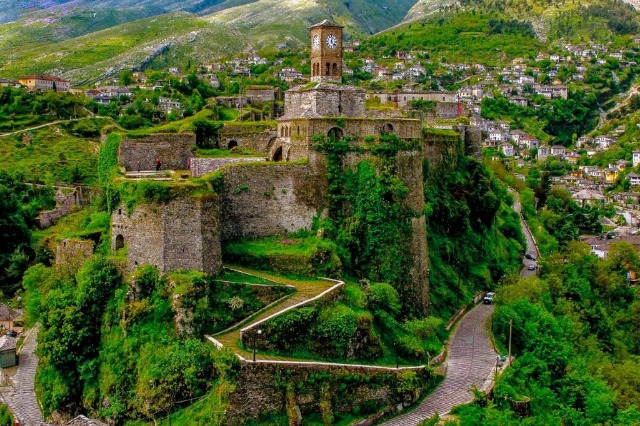
Cultural tourism is among the most popular for tourists in Albania. Berati, Gjirokastra, Kruja and Korca stand out for a developed cultural tourism.
Berati has a rich cultural heritage. Parts of this heritage are cultural monuments that include religious buildings, folk dwellings and fortifications. The old historical part consists of three neighborhoods separated by the Osum River, which make up the Historical Center and they are: Kalaja, Gorrica and Mangalem. The city also has the Medieval Center which consists of old religious monuments of the Bektashi sect.
The city has an ancient and continuous history. There are 107 monuments of the first category and 383 of the second category. Berat Castle is one of the largest inhabited castles, which offer a variety of styles and contributions from different eras such as: Roman, Byzantine, Albanian and Ottoman.
The Christian and Muslim cult objects are the best preserved and belong to different historical periods. Once there were 42 churches in the castle, while today only 8 are preserved. The earliest ones mainly belong to the 13th and 14th centuries. While the apartments in general belong to the 18th and 19th centuries. They are still habitable today.
Berat became part of the list of UNESCO world heritage sites on July 8, 2008. This city bears the testimony of the coexistence of different religions and numerous cultural communities throughout the centuries.
Gjirokastra continues to remain an important destination for local and foreign tourists, while in recent years the number of those visiting the museum city has increased. Gjirokastra Castle offers visitors a combination of eras, histories and events. The peak of its history, this castle had during the PASHALIK of Ioannina when Ali Pasha Tepelena made a series of constructions and interventions, which gave the Gjirokastra Castle the architectural and construction physiognomy it has today. The clock tower, the cult objects, the princess towers, the prison of 7 windows or the National Weapons Museum are some of the objects that can be visited in the fortress of Argjiro.
The characteristic houses gave Gjirokastra the status of “museum city”. Characteristic apartments turned into guesthouses increasingly attract the attention of visitors who spend more than a day in the stone city. Their visitors are numerous due to the fact that among these houses there is also the birthplace of the dictator Enver Hoxha and the writer Ismail Kadare. Visiting Gjirokastra should not be limited to what the city has to offer, as the Gjirokastra area is rich in numerous historical monuments and archaeological sites. The ancient city of Antigone, which for years holds the status of the National Archaeological Park, is located 16 km from the city of Gjirokastra and continues to remain one of the most popular and favorite resources in the south of the country.
The city of Kruja also has a developed cultural tourism. Kruja is a medieval city. It is mentioned for the first time as an Episcopal center in 879. Kruja Castle was built during the 5th and 6th centuries. The surrounding walls are reinforced by 9 towers which served for observation and signaling during periods of war.
Within the walls of the castle there are still some inhabited houses. In the castle, there is the ethnographic museum Gjergj Kastrioti, which is dedicated to his 25-year wars, with the aim of protecting Albania from the Ottoman occupation. There are many documents and architectural elements that give the museum a special atmosphere.
On the way to the castle is the old medieval bazaar of Kruja. Its main feature is the cobblestone street and the wooden shops. Here tourists can find a lot of objects and souvenirs such as handicrafts of filigree, alabaster, silver, copper, woodwork, wool carpets, antiques, etc.
Korça of traditions and history has long been turned into a tourist destination not only for mountain tourism but also as a cradle of culture. In this city there are also five unique museums that should not be missed. The five unique museums are an added value in the streams tourism, which attract the interest of visitors at any time of the year.
Museum of Photography “Gjon Mili”
In the Gjon Mili Museum, 240 photographs of the world master of photography of Albanian origin, are exhibited, his sayings or those of other people, who have expressed themselves about him, exhibits with elements from his life or the time he lived.
National Museum of Medieval Art
The National Museum of Medieval Art was built on April 24, 1980 and is located in two characteristic Korça dwellings declared cultural monuments. As the name implies, this museum preserves the most valuable heritage created by Albanian painters for five centuries. There are about 1,200 objects, most of them from the Bronze Age and the Iron Age, and about 6,000 are icons.
The National Education Museum in Korça is located in the building of the first Albanian school, opened on March 7, 1887 by the patriotic teacher Pandeli Sotiri. This building, which was originally the private home of the Korça patriot Diamant Terpo, has enjoyed the status of National Museum of Education since 1967, while since 1973 it has been declared a Cultural Monument.
“Bratko” Oriental Museum – “Bratko” Oriental Museum is an art museum. It contains a collection of mainly Asian art. In this museum, 432 objects are exhibited such as: piano, Chinese altar, Japanese women’s clothing, Chinese skirts and belts, Indonesian sword, European medals, Japanese paintings, various photographs.
Archaeological Museum – The Archaeological Museum of Korça was created in 1985 and took on a wider and more complete form after the organization of 1990. This museum is located in two characteristic Korça houses of the early XIX (19th) century, which for their architectural values have been declared cultural monuments. Several important prehistoric settlements are represented in this museum.
The Archaeological Museum of Korça has about 1200 exhibited objects, most belonging to the Neo-Eneolithic, Bronze and Iron Age.
/k.s/
Të ngjashme




Latest News










Most read










 RTI