
 English
 Français
 Deutsch
 Italiano
 Turkish
 Greek
 Serbian
Czech Scientists Discover the Largest Subterranean Thermal Lake Ever Found in the World, Located in Albania




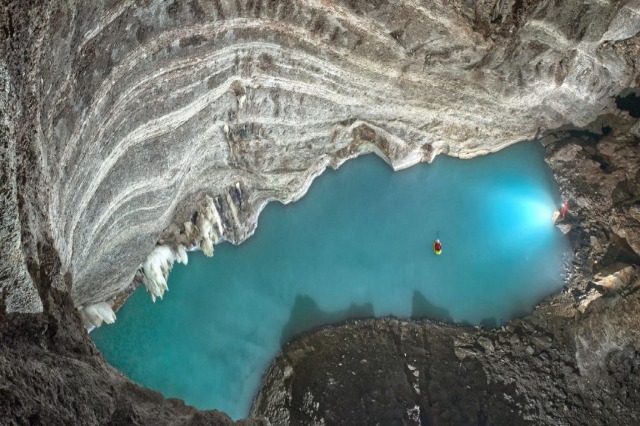
A team of Czech scientists has discovered the world’s largest subterranean thermal lake in southern Albania, naming it Neuron Lake. The discovery was reported by Danny Bate in an article for Czech Radio, with funding provided by the foundation backing the expedition.
The team has been exploring the complex underground conditions of the mountain valleys along the border between Greece and Albania for several years.
In the Vromoneri region, on the Albanian side, the scientists found a vast cave system in 2021, which they have since thoroughly mapped. This system contains multiple hot springs that emit columns of steam. Tracking the steam led them to a deep cavern over 100 meters in depth, which they named Atmos.
At the bottom of this cavern, the team confirmed the existence of the largest subterranean thermal lake ever discovered.
Measuring 138 meters in length, 42 meters in width, and with a perimeter of 345 meters, the lake can hold 8,335 cubic meters of hot water. The chamber’s size is three times that of the main hall of the National Theatre in Prague.
Mapping the cave system and discovering the lake required advanced technical equipment, which was provided by the “Neuron Foundation.” The Czech foundation contributed nearly 1 million Czech korunas to the expedition, funded by private donors. In honor of the foundation’s support, the lake was named Neuron.
Richard Bouda, a photographer and spelunkist, shared details of the discovery: “During our initial exploration, we created a base map with the equipment we had. Even then, we knew we had found something truly extraordinary.”
“Thanks to the Neuron Foundation, we were able to purchase a mobile LIDAR scanner, which allowed us to measure the entire cave and lake area. We will also work with hydrologists to measure the underwater portion of the lake using sonar, a system for detecting underwater objects,” Bouda explained.
The team also utilized the latest “GeoSlam” technology, a 3D scanning tool, to create accurate models of the cave.
The formation process of the cave containing the lake is unique. The lake’s mineral water is saturated with hydrogen sulfide, which, upon contact with air, oxidizes to produce sulfuric acid. This process repeatedly turns the limestone into soft gypsum.
Bouda concluded, “The work of our team in Albania will help deepen understanding of this rare type of cave formation, and there is still much to be done. With the help of our collaborators, we know that the surrounding springs are fed by water from the lake”.
“We believe this discovery could contribute to the protection of the entire area and enhance our understanding of its hydrology. To this day, no one knows exactly how the underground waters are connected to the surface,” he added.
Të ngjashme




Latest News










Most read










 RTI