
 English
 Français
 Deutsch
 Italiano
 Turkish
 Greek
 Serbian
Economic Investment Plan: EU Support for Albania




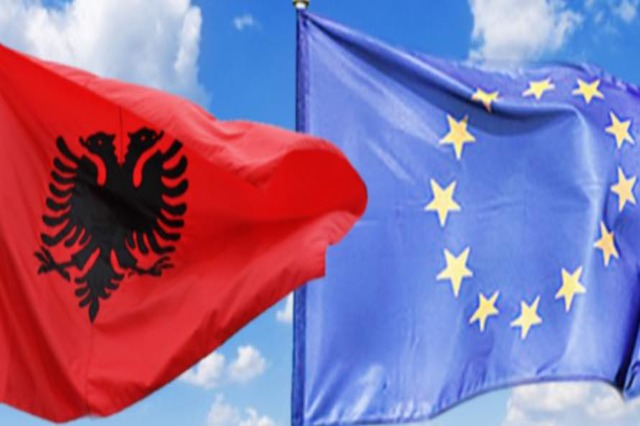
Albania has been a candidate country for the European Union since 2014, but its journey towards EU membership began in April 2009 when it applied for membership and the Stabilization and Association Agreement came into force.
In June 2014, the European Council granted Albania candidate status. In April 2018, the European Commission recommended the opening of membership negotiations. In March 2020, the European Council decided to open the membership negotiations. In July 2022, the Intergovernmental Conference was held to initiate the negotiation process. In October 2024, the Intergovernmental Conference took place to open negotiations for Chapter One – Fundamentals.
Growth Plan for the Western Balkans
In 2023, the EU announced a historic Growth Plan aimed at accelerating the socio-economic development of Western Balkan partners and their integration into the EU.
The plan aims to promote socio-economic convergence through enhanced economic integration with the EU’s single market and regional integration within the Regional Common Market, while expediting essential reforms.
As part of this Growth Plan, Albania was invited to prepare a Reform Agenda focused on unlocking the national and regional growth potential and aligning with the foundations of the enlargement process, including the rule of law, democracy, respect for human rights, and fundamental freedoms.
The Reform and Growth Mechanism, worth €6 billion for the Western Balkans, will provide key support for implementing the Growth Plan.
In October 2024, the Commission approved Albania’s Reform Agenda.
Albania will have access to €922.1 million in non-repayable grants and favorable loans once it fulfills the commitments made in its Reform Agenda.
Ongoing EU Support for Albania
The EU is Albania’s largest trading partner, biggest investor, and primary provider of financial assistance.
The EU is the largest donor to Albania, offering a variety of programs and instruments to support the country’s development and its EU accession process.
Pre-Accession Instrument (IPA)
From 2021 to 2024, the EU has provided over €500 million in financial and technical assistance to Albania under IPA III. This support is provided in the form of non-repayable grants.
This includes:
– €80 million for the Energy Support Package, which assisted needy families and SMEs in Albania with energy prices.
– Over €30 million to improve environmental protection and develop an inclusive circular and green economy.
– €115 million for the rehabilitation and reconstruction of schools and cultural sites after the devastating earthquake in 2019.
Economic and Investment Plan (PEI)
The EU’s PEI for the Western Balkans identifies ten key investments in sustainable transport, clean energy, environment and climate, digital future, human capital, and the private sector to support a green and digital transition and bring the region closer to the EU’s single market.
For projects in Albania, the EU has mobilized €1.4 billion in investments since 2020, including €600 million in EU grants. Funds are gathered through instruments like the Western Balkans Investment Framework (WBIF). This includes:
– Rehabilitation of the 120 km Vorë-Hani i Hotit railway section, including renovation of 12 train stations and modernization and electrification of the railway tracks.
– A floating solar photovoltaic plant on Lake Vau i Dejës that generates 18 GWh of electricity and displaces 8,700 tons of CO2 annually.
– 654 computer labs in 615 primary and secondary schools to enhance the programming skills of young students.
What is Being Achieved Together between Albania and the EU?
– 713 MW of installed renewable energy generation capacity.
– 185 km of rehabilitated railway lines.
– Improved water and sewage services for over 975,000 residents.
– 627 schools equipped with smart labs for 198,000 students annually.
Close Trade and Investment Links
The EU is Albania’s main trading partner.
In 2023, the EU accounted for 57.7% of Albania’s total merchandise trade (72.1% of total exports and 50.6% of total imports).
Total EU foreign direct investments reached €736.3 million in 2022.
Progressive trade liberalization and reciprocal tariff-free access for most goods has been in effect since 2006 and is currently based on the EU-Albania Stabilization and Association Agreement (SAA).
Cooperation in Foreign Policy and Security
Albania has continued to align fully with the positions and statements of the EU’s Common Security and Defence Policy.
Furthermore, Albania has actively participated in EU crisis management missions and operations under the Common Security and Defence Policy, particularly EUFOR Althea in Bosnia and Herzegovina.
As part of the European Peace Mechanism, in 2024, the EU approved a €13 million measure to enhance the operational effectiveness, mobility, and protection of the Albanian Armed Forces.
The EU provides support for addressing hybrid threats, including manipulation and interference in cyber and foreign information.
People-to-People Contacts
Since 2010, Albanians have benefited from visa-free travel to the EU.
Since 2021, the EU has funded over 7,700 exchanges between the EU and Albanian citizens in education, training, youth, and sports through ERASMUS+.
In April 2024, the EU supported the establishment of a new campus of the College of Europe in Tirana.
Të ngjashme

Latest News









Most read










 RTI