
 English
 Français
  Deutsch
 Italiano
 Turkish
 Greek
Greek Serbian
EESC, the first institution of the European Union to accept candidate countries as its members




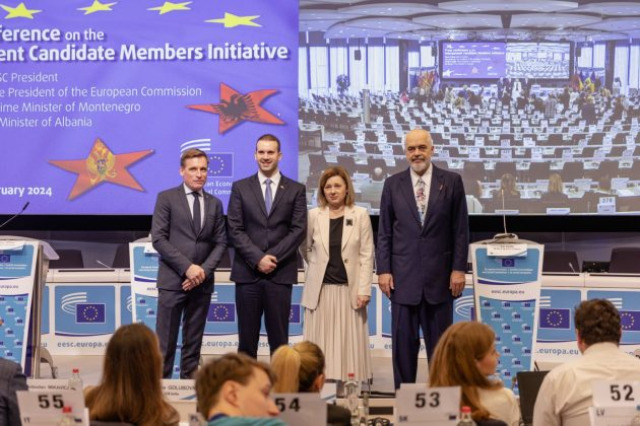
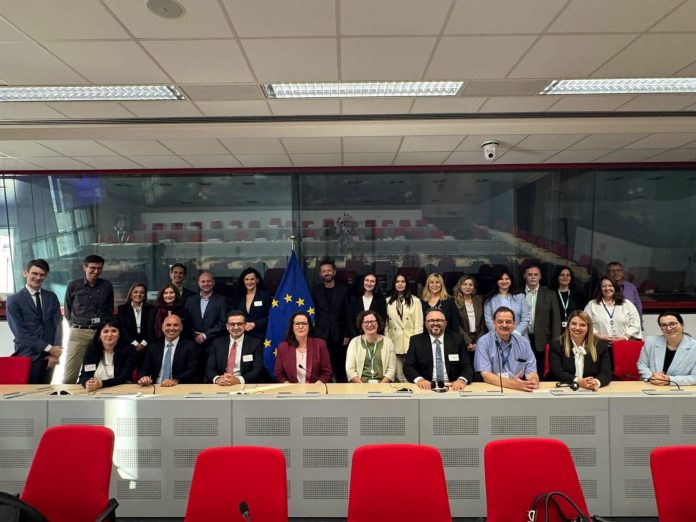
The European Economic and Social Committee (EESC) has become the first institution of the European Union to accept members from candidate countries. The new members were appointed and on February 15, they participated for the first time in a plenary session of this committee.
Present at the ceremony of this initiative in Brussels, in addition to the chairman of the EESC, Oliver Röpke, was also the vice-president of the European Commission, Věra Jourová, the prime minister of Albania, Edi Rama, and the prime minister of Montenegro, Milojko Spajić, who come from the two candidate states for EU membership.
The EESC deals with social and economic issues, and representatives of civil society, trade unions, employers, and various industry sectors participate in this committee. In the EU, this institution has an advisory role.
The members of this committee coming from the candidate countries will take an active part in the work of the EESC and will be equal to their colleagues from the EU countries. However, they will not have the right to vote.
Members from nine candidate states have been admitted to this committee, and Kosovo has been left out. Kosovo is a state involved in the enlargement process but is the only one in the Western Balkans that does not formally have the status of a candidate state for EU membership.
According to the president of the EESC, Oliver Röpke, a formal condition to be included in this committee is to have the status of a candidate country, which Kosovo does not have.
This committee has accepted Albania, Bosnia and Herzegovina, Georgia, Montenegro, North Macedonia, Moldova, Serbia, Turkey, and Ukraine as members. All these states are formally candidate countries for membership in the European bloc.
Röpke said that this initiative marks an important step towards the gradual integration of the candidate states before they formally join the EU. He expects colleagues from these countries to bring useful experience to the work of the institution he leads.
The European Commissioner, Věra Jourová, said that the enlargement of the EU is a common interest, a two-way road that benefits both the candidate countries and the EU. She called for the candidate countries to focus on the values of democracy and move towards the EU, respecting common values, especially the rule of law and media freedom.
There were more than 600 candidates from candidate countries to be appointed to this committee.
The Prime Minister of Albania, Edi Rama, and that of Montenegro, Milojko Spajić, expressed their willingness for their countries to work towards gradual integration into the EU, not as a substitute for full membership, but only as a path to formal membership.
Rama called for the example of the EESC to be followed by other EU institutions, namely the European Parliament, the Commission, and the Council. According to the Albanian Prime Minister, this would make people in the Western Balkans see that EU integration is real and would avoid entering into cycles of good intentions that do not produce concrete results.
Rama, citing the impact that Russia’s aggression against Ukraine has had on increasing support for the enlargement process, said that one should not wait for another aggression to move forward in this process.
/m.ll/
Të ngjashme

Latest News



Most read






 RTI
RTI