
 English
 Français
 Deutsch
 Italiano
 Turkish
 Greek
 Serbian
Environmental organizations demand the protection of the Vjosa River on the Greek side as well




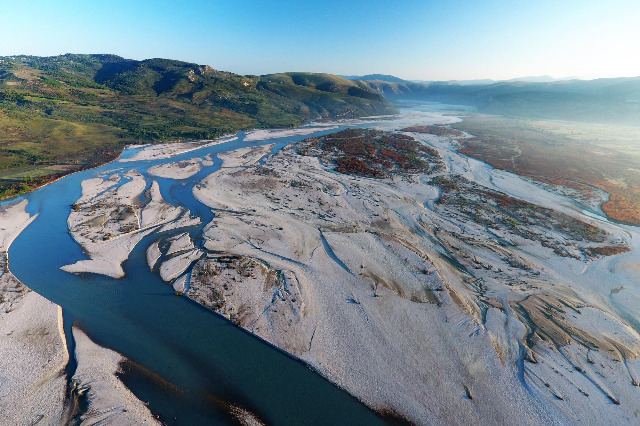
Several Greek environmental organizations at the national and local level are supporting a campaign to extend the boundaries of the Northern Pindos National Park towards the border with Albania to ensure cross-border protection for the Vjosa River.
Vjosa originates from the Pindos mountain range in Greece and after traveling 70 km on the Greek side it enters Albania and after 192 km flows into the Adriatic Sea. With the exception of an upstream dam at the river’s headwaters, called ‘Piges’, the Vjosa River flows freely for over 270 kilometres, undulating through stunning canyons on both sides of the border and meandering its way to the sea in the Albanian territory .
The Mediterranean Institute for Nature and Man in Greece, the organization “Pindos Environment” and other local Greek organizations have focused on the cross-border area Grammoz – Konica – Pogon, with the ultimate goal of joining the national area of Northern Pindos with the newly announced Vjosa National Park from the Albanian government.
According to the organizations, even on the Greek side, the Vjosa River, in its 70 kilometers, is threatened by the imminent construction of dozens of small hydropower plants, which, if implemented, would undermine the efforts of more than a decade to create the first Transboundary National Park of the wild river in Europe.
Greek environmental organizations emphasize the fact that the new Greek National Energy and Climate Plan signed in 2019 foresees a 15% increase in the installed capacity of hydropower plants by 2030 and one of the areas where great interest has been expressed in the installation of hydropower plants is the Vjosa river basin. This basin consists of a complex of rivers, tributaries and streams that remain almost intact to this day.
The organizations have submitted proposals to the public consultation expected to be concluded at the end of April demanding the ban on all hydropower works in the entire Vjosa river basin (including the main rivers and streams).
The biggest intervention in the sources of Vjosa on the Greek side was made in the late 80s with a large hydroelectric dam where water from the artificial lake is diverted to the Arachthos catchment, with impacts on the flow, hydromorphology and ecosystems of Vjosa.
In 1989 Plans to “exploit” the water potential of the area included the construction of a dam and a water reservoir in the heart of the North Pindos National Park. The Association for the Protection of Continental Nature appealed to the Council of Europe and in 1990 to the European Court of Justice, and after strong reactions from environmental organizations and the European Environment Commission, which referred Greece to the European Court of Justice, the project was dropped.
However, the issue of dams on the Vjosa River on the Greek side returns to the foreground from 2000 onwards.
In 2009, a plan was submitted to the Ministry of Environment, Energy and Climate Change and Public Works to divert additional amounts of water from the river to neighboring watersheds, and in particular the lake, in the city of Ioannina. The plan also provided for the construction of hydroelectric stations along the diversion channel.
The announcement of the plan caused a backlash from local communities and environmental organizations and in 2010 the then environment minister rejected the plan. The initiators of the project were withdrawn, taking into account the decision of the European Court of Justice on a similar issue.
However, the fight of Greek environmental organizations did not stop from the moment that the project to divert a quantity of Vjosa waters to Lake Ioannina was included in the first River Basin Management Plan of the Epirus water department, in 2013.
Even the Plan of the Greek Energy Regulatory Entity includes three large hydroelectric projects with the creation of reservoirs in the Vjosa watershed, as well as 293 small hydroelectric projects.
/k.s/
Të ngjashme



Latest News


Most read










 RTI