
 English
 Français
 Deutsch
 Italiano
 Turkish
 Greek
 Serbian
Ethnographic Museum of Gjirokastra




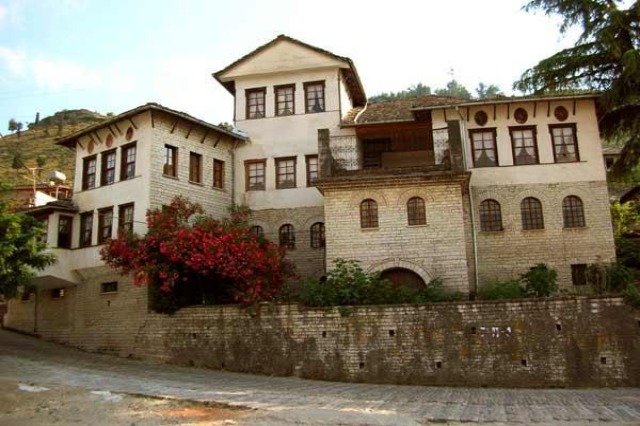
The Ethnographic Museum of Gjirokastra is located on the site of former house of communist dictator Enver Hoxha. The fire destroyed the original house where Enver Hoxha was born (in 1908). Reconstructed during 1964-1966, not as a replica of Hoxha’s house, but as a model of the traditional houses of Gjirokastra. The house has many classic cultural elements copied from other beautiful houses of city.
Even though it is identified as the house of the dictator, inside there is nothing related to Enver Hoxha, nor his belongings, objects or furniture from his real house, and nothing about his history. The interiors replicate those of the finest Gjirokastra houses of the 19th century. The rooms are arranged as they would actually have been used. Decorations are with cultural artifacts, household items, folk costumes, clothing and kitchenware etc.The neighborhood of the castle called “Palorto”, holds some of the most famous houses of the country: those of the most famous Albanian writer Ismail Kadare, the Çabej, Babaramo or Fico families. All of these represent buildings of rare architectural value!
The rooms look as if they are still in use, with artistic objects that testify to a culture that comes from wealthy families of the 19th century. The ground floor, where stone dominates, was used for winter gardens. The first floor, low, with small windows, is a tradition for all houses, while the guest room is located on the second floor, higher and with woodwork. The third floor holds a single and the most beautiful room, which is called the chamber: a high ceiling room, where women used to stay to get the best views of the city. It seems that the house offers not only the idea of the dictator’s childhood but the whole history of Gjirokastra, a city which, in many ways, influenced the history of an entire people.
/Klara Ruci/
Të ngjashme








Most read










 RTI