
 English
 Français
 Deutsch
 Italiano
 Turkish
 Greek
 Serbian
EU Invests in Innovative Solutions for Glass Packaging Waste in Albania




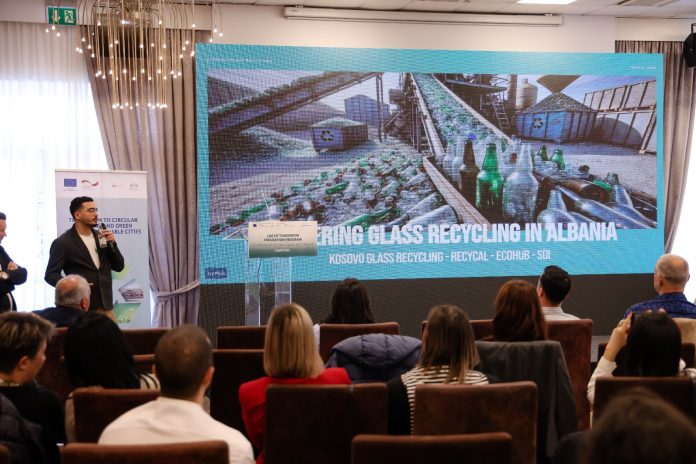
Four innovative solutions aimed at addressing the challenge of glass packaging waste in Albania will receive financial backing through the “Lab of Tomorrow 23” program, supported by the European Union and Germany.
After four months of incubation, in which businesses were provided with legal and technical expertise, four projects were presented with the goal of creating a robust infrastructure to reduce glass packaging waste, which amounts to an estimated 40,000 tons annually in the country.
With a €200,000 investment, the Lab of Tomorrow program is supporting the pilot phase of these innovative solutions for glass waste management in Albania.
The four selected ideas focus on: developing a reverse collection, cleaning, and reuse system for glass bottles used in local microbreweries and wineries; recycling glass to create new products such as terrazzo tiles and glass filter media for artificial water environments; establishing a circular system in Gjirokastër for the reverse collection, cleaning, and reuse of glass bottles involving local actors; and transforming glass waste into artistic and functional products through upcycling.
Dr. Iven Schad, Head of Development Cooperation at the German Embassy in Tirana, praised the initiative, emphasizing the crucial role of the private sector in the circular economy as a driving force for innovation and sustainable development. He also underscored the importance of ideas that engage both businesses and consumers, fostering awareness about the reuse of packaging materials.
Edvin Pacara, Program Manager for Environment and Climate Change at the EU Delegation in Albania, highlighted the potential of these projects to create new jobs in the green economy, contributing to the country’s sustainable economic growth.
The Lab of Tomorrow program, now in its 23rd edition, is being held for the first time in Albania, bringing together 23 businesses, experts, and organizations. It is supported by the EU Circular Economy and Livable Cities project, co-financed by the European Union (EU) and the German Federal Ministry for Economic Cooperation and Development (BMZ), and implemented by GIZ Albania in cooperation with the Ministry of Tourism and Environment (MoTE).
The four selected business teams will have six months to test and implement their solutions in the market.
This initiative offers businesses in the HORECA sector, such as wineries, breweries, and agrotourism, the opportunity to play an active role in advancing sustainable solutions for managing glass packaging waste.
The EU Circular Economy and Livable Cities project aims to accelerate Albania’s transition to a circular economy, empower municipalities to build livable cities, and create new job opportunities in the green sector.
Të ngjashme

Latest News

Most read










 RTI