
 English
 Français
 Deutsch
 Italiano
 Turkish
 Greek
 Serbian
“Expansión”: Albania among the 24 best destinations of 2023




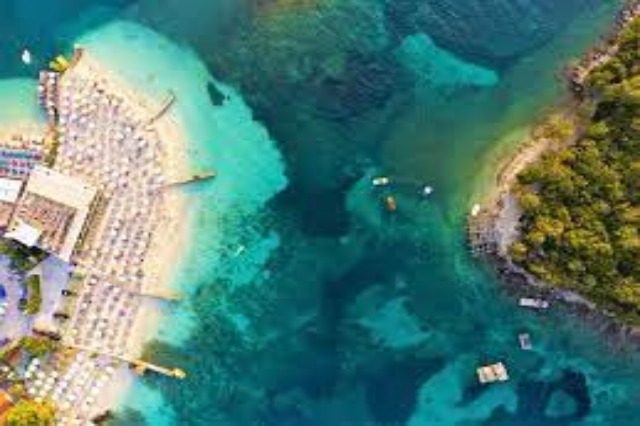
For centuries, different cultures from East and West have been intertwined in the Balkan country. Albania is a tourist power under development. Direct flights have been operating for several months from Madrid and Barcelona airports to this small Eastern European country. Nestled between the Balkan mountain ranges and the Dinaric Alps and washed by the Adriatic and Ionian seas, Albania’s natural wealth has become a coveted desire for many civilizations from the East and West. Albania is a surprising country full of contrasts that has amazed the most curious travelers.
With an extension of 28,750 square kilometers, the Republic of Albania is bordered to the north by Serbia and Montenegro, to the east by North Macedonia and to the south by Greece, writes the Spanish business newspaper “Expansión” in an article.
The country has more than 3 million inhabitants, a large part of whom live in the coastal cities of Durrës, Vlora and in Shkodra, near the lake of the same name, as well as in its capital, Tirana. The other two-thirds of the population reside in its vast rural environment.
The history of Albania
The Romans baptized Albania for the whiteness of its snowy peaks. Previously, the Greeks had established several important polis (city-states in ancient Greece) on their coasts. With the division of the Empire in the year 395, Albania remained on the side of Byzantium and under the influence of the Christian religion and the Greek language until the Middle Ages. With the Turkish invasion, the country became part of the Ottoman Empire between the 15th and 20th centuries.
After a brief period of independence, Albania was not spared by the effects of World War II and the Cold War that followed. In 1939 it was invaded by Mussolini’s Italian troops, later becoming a Nazi protectorate. In 1944, the head of the Albanian Labor Party, Enver Hoxha, took control of the Albanian state to establish a socialist regime that would last until the collapse of the Warsaw Pact bloc in 1991. Today, Albanians call their country Albania, the eagle, as the emblem of its flag, a double-headed eagle constantly looking from East and West.
Tirana, the Mediterranean capital
If there is something that connects Spain with Albania, it is the waters of the Mediterranean, “Mare Nostrum”. It would be precisely that or its close relationship with neighboring Italy that makes its capital, Tirana, a multicultural city, open to the world and far from the geopolitical conflicts in the Balkans of other times. With 600,000 inhabitants, Ismail Qemali street is the epicenter of Tirana’s social life, a place to stay up late, and where you can try raki, a traditional home-made drink or a beer named after the city.
Tirana is the heir to the country’s rich and troubled past, a history that Albanians have managed to turn into an attractive resource. For example, today you can enjoy the local gastronomy in one of the many restaurants of Bllok, the former neighborhood of the communist elite, the entrance of which was closed to ordinary citizens. Bunker’Art stands out among the artistic attractions, an old bunker transformed into a museum of historical memory. All this surrounded by Orthodox churches, Ottoman mosques and large French-style residential boulevards.
The beaches of the Albanian Riviera
The southern coast of Albania is known as the “European Caribbean” and with good reason. From Vlora to Butrint National Park, there are more than 100 kilometers full of pebble beaches and turquoise water. A haven for locals and foreigners alike, it’s worth the drive along the winding SH-8.
In the Albanian Riviera, urban destinations reserved for families such as Saranda or Himara coexist with the offer for the younger and more lively public of the large resorts in Jala or Ksamil. You can also find beaches with almost virgin nature such as those of Borshi or Gjipe and impressive architectural monuments, such as Ali Pasha’s castle in Porto Palermo.
Ksamil
This city on the edge of the Greek border is the perfect place to start your journey along the Albanian Riviera. A true paradise, where beaches with turquoise waters and white sand, one of the few in the country, still resist the tourist overcrowding.
Butrint National Park
On the southern coast of Albania, on the border with Ksamil, lies Butrint National Park, an enclave headed by the ancient city of the same name, where human presence has been documented since the Bronze Age. The remains of the Greek theater of Butrint are part of this archaeological complex.
A place steeped in history
The ancient site of Butrint was declared a UNESCO National Heritage Site in 1992. Dating back 3,000 years and spread over 200 hectares, the city has been coveted by various civilizations, including the Greeks, Romans, Byzantines, Venetians and Ottomans.
Saranda
Saranda is the natural port of entry to the Albanian Riviera and one of the most urbanized areas with intense commercial activity. A place between rugged mountains and small harbors that will remind you of conventional Mediterranean destinations.
Bunec beach
As we leave Saranda, we begin to find quieter, almost virgin beaches, ideal for those travelers who prefer solitude, such as Bunec.
Borshi beach
Borshi is a spectacular and extraordinary beach 7 kilometers long. The greenery of the coast contrasts with the turquoise of the bay, where neither hammocks nor umbrellas will hinder you.
Qeparo beach
Further north is the beautiful village of Qeparo, a quiet place where your only worry will be avoiding the pebbles before diving into the water.
Porto Palermo Beach
The bay of Porto Palermo offers a series of small and quiet coves that you can discover on a pleasure boat. The landscape is interrupted only by a few concrete bunkers on the seashore that former leader Enver Hoxha built during communism.
Ali Pasha’s Castle
Connected to the coast of Porto Palermo through an isthmus stands Ali Pasha’s Castle, a castle named after a nineteenth-century Ottoman governor with great influence in the area. It can be visited during the day, so you can see the incomparable views of the bay.
Llamani beach
Between the two hills is the beach of Llamani, a very popular place with local tourists where there are several resorts, bars and restaurants with very good prices. There is free parking!
Himara beach
Himara is another place of the Albanian Riviera, which stands out for three consecutive sandy beaches that open into a spectacular bay with crystal clear waters. A place of contrast between urban family tourism and authentic Albanian villages that you will find just a few kilometers inland.
Livadhi beach
Livadhi Beach is a haven of nature between Himara and Jala, which in turn has all the necessary services for tourists such as beach bars, terraces and restaurants. A sandy area from where you can see Himara Castle and the impressive mountains that surround it.
Jala beach
In the area of Jala there are several pebble beaches, some reserved for family tourism, and others colonized by locals, ideal for travelers who prefer holidays.
Gjipe beach
Hidden under the canyon of Gjipe, the homonymous beach becomes a precious reward after overcoming its difficult access. It is a place frequented by young people, bordered by large rocks, which has a camping area and several restaurants.
Dhërmi beach
Dhërmi Beach, the last frontier of the Albanian Riviera, stands out for its pebbly sand, its offer of water sports and the high flow of local tourism.
Gjirokastra: UNESCO World Heritage Site
In the interior of the country and near the border with Greece is the ancient city of Gjirokastra, an inevitable stop if you are going to travel to Albania. Founded in the 1st century AD, it preserves many traces of the Byzantine Empire, such as the fortress of Gjirokastra, translated as silver castle, on which an important commercial center was established.
The musealization of some civil and religious buildings from the Ottoman period, as well as the houses of the writer Ismail Kadare or the politician Enver Hoxha, have helped Gjirokastra to be recognized as a World Heritage Site by UNESCO since 2005.
Berat, a mystical place
At the other end of the country, in the north, is the city of a thousand windows, Berati. It’s an enclave that straddles both sides of the Osum River, although its appearance might vaguely remind you of Italy’s Amalfi Coast. The city retains its medieval layout and is home to the Onufri National Iconographic Museum, with an interesting collection of religious symbols that managed to survive the cultural revolution of 1967.
Its historic center, which unites the Muslim quarter of Mangalem, the Orthodox quarter of Gorica and Kula, around the castle, enabled its acceptance as a world heritage site by UNESCO in 2008.
/k.s/
Të ngjashme



Latest News










Most read










 RTI