
 English
 Français
 Deutsch
 Italiano
 Turkish
 Greek
 Serbian
Experience the Majesty of Dajti Mountain: Your Guide to Albania’s Stunning National Park




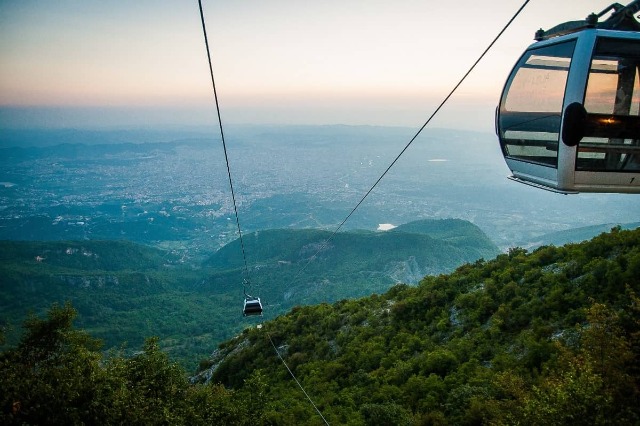
Dajti Mountain National Park is a protected area established in 1966, situated in the heart of Albania. Covering an area of 293.84 km² (approximately 114 square miles) since 2006, the park is located about 40 km (approximately 24.85 miles) east of the Adriatic Sea and approximately 26 km (approximately 16.16 miles) from Tirana, the nation’s capital. The management of the park is a collaborative effort between the Albanian Agency of Protected Areas and the Tirana Municipality Parks and Recreation Agency.
Geographical Context The park shares borders with the Shtamë Pass Natural Park to the northwest, the Kraste-Verjon Protected Landscape to the west, and the Mali me Gropa-Bizë-Martanesh Protected Landscape to the east. Its rugged and fragmented topography fosters diverse ecosystems and rich biodiversity.
Conservation Status Dajti Mountain National Park has been classified as Category II by the International Union for Conservation of Nature and recognized as an internationally Important Plant Area by Plantlife.
Visiting Dajti Mountain National Park The optimal time for visiting the park spans from April to November, when the weather conditions are generally favorable for exploration. The hottest months are July and August, while January marks the coldest period. Rainfall is most common during January, February, March, October, November, and December; therefore, mid-year is ideal for visitors seeking pleasant temperatures and minimal rainfall.
Ecosystem and Biodiversity Dajti is known for its diverse ecosystem, characterized by a warm climate conducive to plant growth, making it one of Albania’s most treasured parks. The park showcases a unique variety of flora distributed across three altitudinal levels.
In the Mediterranean scrubland zones, perennial shrubs thrive, while gorse soil supports other perennial plants such as heather.
The dominant forest areas are home to oaks and beeches, with distinct oak varieties flourishing in the environment.
Beech terraces feature forests predominantly composed of beech trees.
The Dajti forest is considered largely untouched by human interference, enhancing its scientific and ecological significance. The plant diversity within the park aids in preserving ancient habitats and serves as a food source for local fauna.
Wildlife The park’s ecosystem hosts an intricate web of life, where plants, trees, and animals interact. The decomposition of organic materials by bacteria and fungi, alongside the activity of various animals, sustains this complex cycle. Fallen trees provide essential habitats for birds, insects, and other wildlife.
In lower altitudes, vegetation consists mainly of shrubs, heathers, myrtles, and wild strawberries. Between 600 and 1,000 meters, oak forests dominate the landscape, accompanied by beech and maple trees. Above 1,000 meters, conifer species can be observed, while rocky peaks display sparse vegetation due to harsh environmental conditions. This rich biodiversity renders Dajti a captivating destination for nature enthusiasts.
The varied geology and topography of Dajti Mountain have fostered a rich habitat for fauna. The park is home to eight species of mammals and 11 species of birds, highlighting its ecological significance. Notable mammals include bears, wolves, rabbits, hedgehogs, otters, various bat species, and squirrels, alongside wild boars, Eurasian wolves, red foxes, European hares, and European wildcats. Birdwatchers can spot eagles, woodpeckers, and mountain partridges, along with seven species of reptiles and four species of amphibians.
Accessibility and Visitor Information
By Bus: From Skanderbeg Square, you can take a bus to Linzë, which serves as the starting point for the Dajti Ekspres cable car. The return bus departs from the opposite side of the road.
On Foot: For those seeking an active option, walking from the center of Tirana takes approximately one hour.
By Taxi: Taxis are available from the city center, with costs ranging from 700 to 1,000 lek (approximately €5.50 to €8). It is advisable to negotiate the fare before boarding.
Entrance Fee: A round-trip ticket for the cable car costs 800 lek (approximately €6.50), with reduced rate options available.
Practical Advice: Visitors are encouraged to carry sufficient cash for the day, as ATMs at the cable car station may be unreliable.
Dajti Mountain National Park stands as a testament to Albania’s natural beauty and ecological richness, making it a must-visit destination for both locals and tourists alike.
/a.c/
Të ngjashme




Latest News










Most read










 RTI