
 English
 Français
  Deutsch
 Italiano
 Turkish
 Greek
Greek Serbian
Father Gjergj Fishta: The Genius of Pen and Defender of Albania on the International Stage




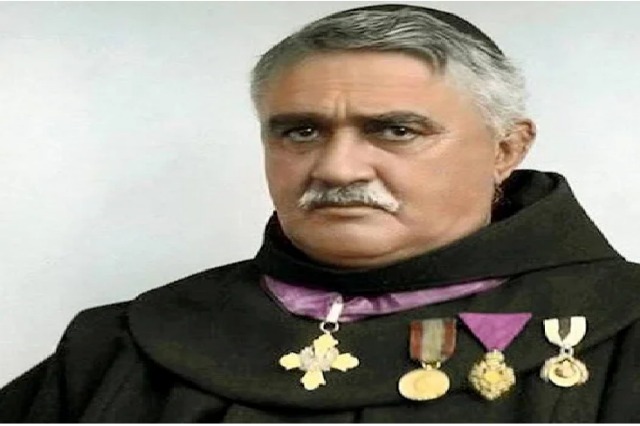
Father Gjergj Fishta, poet, writer, translator, and publicist, is considered one of the direct and authentic successors of the Albanian National Renaissance. He expressed patriotic and democratic ideals in the context of the 20th century, evident in his literary works, which follow the Renaissance’s literary techniques, notably romanticism, realism, and classicism.
Fishta, renowned for his monumental work ‘Lahuta e Malcisë’ (The Highlands’ Lute), passed away on December 30, 1940. Just before his death, Fishta left a message for the Franciscan youth of Albania, declaring, “I die content, having worked for faith, for the homeland, and for our province,” as noted by Fr. Agustin Gemelli.
Born on October 23, 1871, in Fishta, Zadrima, Father Gjergj Fishta showed his intellectual potential early. After being noticed by a local priest, he was sent to study in the Franciscan seminaries, later pursuing philosophical and theological studies in Bosnia. His early poetic exercises were published in 1899 under the pseudonym of the people.
Fishta’s literary work spans 40 years, using 24 pseudonyms. He was the first Albanian writer nominated for a Nobel Prize. His contributions to Albanian literature are vast, from poetry, epics, and translations to his involvement in the Albanian National Movement. ‘Lahuta e Malcisë’ (The Highlands’ Lute), his magnum opus, took him 40 years to complete, establishing him as the ‘Homer of Albania’.
Fishta’s activism extended beyond literature; he was a key figure in the national and political spheres. He actively participated in the Albanian independence movement, the Albanian Assembly, and the creation of a unified literary language. Fishta also advocated for Albania’s cultural integration in Europe, contributing to the Albanian Diaspora through his writings and political engagements.
In His later years included continuous creation and publication, with a focus on preserving Albanian culture and identity. Despite facing political persecution, his legacy remained solidified in the national consciousness after the 1990s.
Fishta’s contributions to Albanian literature, culture, and politics remain crucial in the shaping of Albania’s identity in the modern world.
/a.p./
Të ngjashme

Most read







 RTI
RTI