
 English
 Français
 Deutsch
 Italiano
 Turkish
 Greek
 Serbian
French Magazine “EnVols”: Gjirokastra, a Must-Visit Historic City




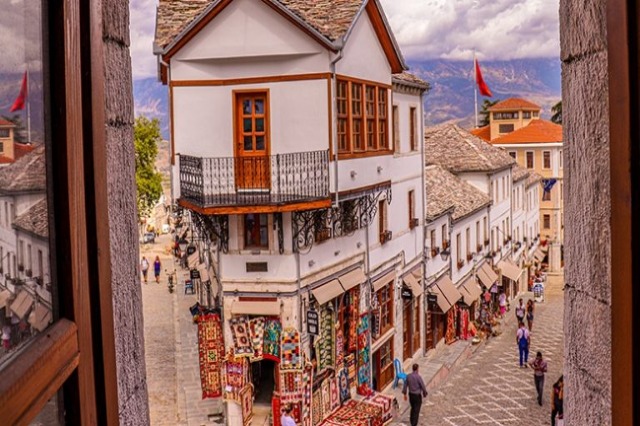
From the outside, you will only see its grey stone walls dominated by its imposing castle. However, just pass through its doors to discover what lies within the ancient castle of Gjirokastra.
Its colorful neighborhoods and white-filled streets will take you back centuries into the past.
The Historic Center: A Bicentennial Heritage
Renovated by the Ottoman Empire in the early 19th century, Gjirokastra is a traditional town. With its folkloric atmosphere, you will be immediately captivated by its former charm. A setting preserved by its residents for nearly 200 years.
Listed as a UNESCO World Heritage Site in 2005, the village’s architecture displays the elegance of ancient Turkish residences. You will be able to visit buildings supported by towers, connected with finely decorated arches, and often opening towards the sky.
Finally, enjoy the immense castle from the town, one of the oldest and largest castles in the Balkans that you must not miss.
From the highest point in Gjirokastra, you will discover a magnificent panorama of the valley.
A Deep Cultural Dive
Gjirokastra allows you to discover Albania’s traditions and customs, initially by walking through its streets, but also by attending folkloric events that highlight the country’s culture.
In 2023, within the grand castle, the eleventh edition of the National Folklore Festival of Gjirokastra was held, an event open to all and honoring typical dances and songs.
Local gastronomy is also at the forefront.
In every village restaurant, you can enjoy various traditional dishes. Meat, fish, or vegetables… There is something for everyone.
Five Unforgettable Places in the Medieval Village of Gjirokastra
The Castle of Gjirokastra
The second largest castle in the Balkan region, the Castle of Gjirokastra dominates the vast valley at its feet. Built in the 12th century and later renovated during the Ottoman occupation, the castle housed numerous garrisons during various European conflicts.
Today, you can see its gigantic military exhibition tracing the evolution of weapons from prehistory to World War II. It features an authentic US Air Force plane, the centerpiece of the museum, captured by the Soviets during the Cold War. Enough to impress history enthusiasts.
The Old Bazaar
A true staple in the old textile industry in Europe, Gjirokastra is a haven for Albanian artisans. In this bazaar, at the heart of the city, more than thirty traders offer you fabrics, traditional clothing, and various carpets, all handmade.
As you will see, everything is organized to faithfully reproduce the energy of old open-air markets, and all creations use methods passed down through generations.
The Skenduli House
Built three centuries ago, this tower-type residence, representing a typical model of life in a patriarchal urban family of the time, currently plays the role of an Ethnographic Museum in the city. One of the best representations of 19th-century Ottoman architecture and a former ethnographic museum during the communist regime, the Skenduli House now tells you the numerous stories of the village.
Once inside, there is no conventional exhibition, but a place of exchange with the oldest families of Gjirokastra, turned into guides.
In a calm and warm atmosphere, residents offer you immersive stories about the city’s design and traditions, accompanied by numerous period objects and old photographs. Finally, for the more adventurous, you can enjoy a small glass of raki – in moderation – a popular Albanian brandy.
The Cold War Museum
Nestled in the heart of the city, this museum consists of a gigantic network of tunnels and bunkers built in the aftermath of the Great War and later renovated during the Cold War.
Classrooms, living quarters, and even production areas… You progress through this museum as if within a real underground city, a city beneath a city. In the long galleries, in the soft light of gas lamps, you will hear many stories about the former Soviet soldiers who maintained the site. You will feel as if directly transported back 80 years.
The Blue Eye of Albania
Less than an hour from Gjirokastra, nestled in the heights and surrounded by greenery, the Blue Eye is a natural freshwater spring. Known for its soothing environment, it is above all the purity of the water, as evidenced by its crystal-clear color, that has forged its reputation.
A majestic panorama for artists and photographers, and a place of myths and legends for the more curious – its name, Blue Eye, comes from a dragon that is said to have birthed the spring. Even though swimming is prohibited, you can sit by the water and enjoy the almost supernatural atmosphere that emanates from this peaceful spot in the middle of the forest.
Të ngjashme
Latest News










Most read










 RTI