
 English
 Français
 Deutsch
 Italiano
 Turkish
 Greek
 Serbian
From Migration Agreement to Global Geopolitics: Rama’s Insights in Italian Media




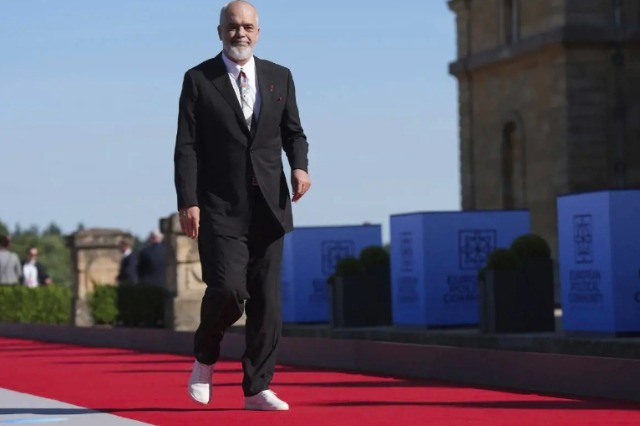
Albanian Prime Minister Edi Rama recently shared his insights on critical issues affecting Italy, Europe, and the wider world. In his remarks, he underscored his government’s position on current migration operations, diplomatic relations, and broader European challenges. The conversation reflects Rama’s pragmatic yet progressive views on governance, European unity, and the geopolitical pressures facing the continent.
Rama clarified that Albania holds no direct responsibility in executing Italy’s migration agreement with his country. Albania’s commitment centers on providing territory for Italian jurisdiction at designated centers within Albania. He acknowledged delays in the arrival of the Italian vessel meant to transport migrants, but refrained from speculating on internal Italian matters, expressing respect for Italy’s sovereignty.
When asked about his views on the Italian judiciary, Rama deferred, saying it wasn’t his place to comment on the work of another country’s legal institutions. However, he praised Italian Prime Minister Giorgia Meloni’s efforts in tackling illegal migration and highlighted the partial success of her policies.
While advocating for a collective European solution, Rama argued that a sustainable approach requires more than curbing illegal migration. He underscored the importance of fighting human trafficking networks while also establishing legal migration channels to meet Europe’s economic needs. For Rama, only a dual approach can address both security concerns and the region’s workforce demands.
Rama voiced concerns about the EU’s future, calling it “the most beautiful political project in human history,” but one that remains unfinished and increasingly vulnerable. He stated that short-term tactics and daily media dynamics have eroded long-term planning, leaving Europe in need of visionary leadership. He suggested that recent global challenges—such as the war in Ukraine—have demonstrated Europe’s strategic limitations.
Expressing concern about Ukraine, Rama warned of the conflict worsening before conditions improve. Additionally, he stressed the importance of a two-state solution in the Middle East, underlining Albania’s support for peace efforts and its long-standing stance against extremist groups.
Turning to economic issues, Rama acknowledged signs of slowing growth across Europe, with particular challenges in Germany. He speculated that while artificial intelligence (AI) may offer potential for future productivity, it also raises new questions about energy consumption and sustainability that Europe must address.
Reflecting on his admiration for Italy, he expressed confidence that Italy’s cultural resilience would see it through current difficulties, despite historical internal divisions. On the question of Europe’s competitive future, he criticized what he sees as excessive bureaucratic regulations that hinder business and innovation, creating an environment increasingly difficult for entrepreneurial ventures.
Rama questioned the idea of a traditional European military and instead proposed an “army for education, culture, and innovation.” Emphasizing that military power alone cannot secure Europe’s future, he advocated for investment in strategic areas like education and cultural development, seeing these as the most effective ways to empower future generations and enhance Europe’s influence on the global stage.
Të ngjashme
Latest News










Most read










 RTI